#e4mXplains: Apple Pay won’t beat UPI in India. It may not need to
Starting with a fraction of a fraction of UPI’s acceptance footprint, Apple Pay may not win India on transaction volume but own a smaller, higher-value payment relationship
 by
by
Published: Oct 6, 2026 9:10 AM | 7 min read
 Follow Us

- Apple Pay is set to launch in India in late 2026, allowing users to make contactless payments using Axis Bank-issued Visa and Mastercard credit cards on Apple devices, amidst an already saturated digital payment landscape dominated by UPI.
- The service targets a niche audience of affluent Apple device users, as it requires compatible hardware and banking partnerships, with initial access limited to Axis Bank, while larger issuers like HDFC Bank and SBI Card are not yet included.
- Experts suggest that Apple Pay may not aim to compete directly with UPI in transaction volume but instead focus on enhancing the payment experience for higher-spending users within the Apple ecosystem.
- The success of Apple Pay in India will depend on its ability to attract more banking partners and its effectiveness in providing a premium payment experience, as it may remain a complementary service rather than a widespread alternative to UPI.
A new digital payment option launching in India in late 2026 has to answer one awkward question before anything else: what problem is it solving?
UPI is already everywhere. QR codes sit beside cash boxes in supermarkets, restaurants, taxis and neighbourhood kirana stores. Paying usually costs little more than pointing a phone at a square of black-and-white pixels and entering a PIN.
Into this rather thoroughly solved problem comes Apple Pay.
Read earlier report on Apple Pay’s India launch
Apple launched the service in India on September 30, as of now allowing users to add only Axis Bank-issued Visa and Mastercard credit cards to their iPhone, iPad and Apple Watch. It can be used for contactless payments at physical stores, as well as within apps and on the web.
Which raises the obvious question. Why?
The answer may be that Apple Pay does not actually need to beat UPI.
Read more: Apple’s real marketing advantage
A very small starting line
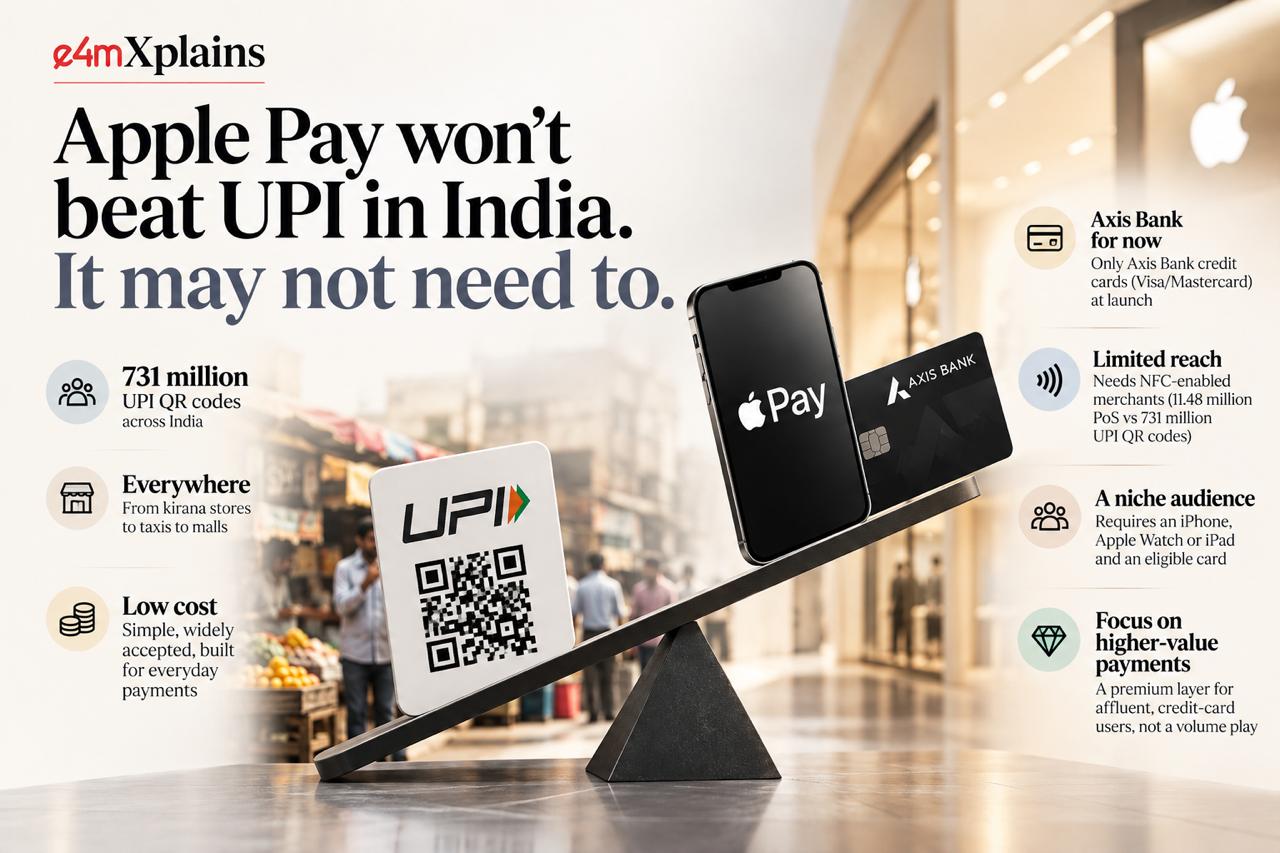
At launch, Apple Pay's addressable Indian audience is a niche inside a niche.
A customer needs an Apple device, an eligible Axis Bank credit card on Visa or Mastercard, and, for a physical transaction, a merchant capable of accepting NFC payments.
Could advertising data become a security risk? Read more here
Axis Bank accounted for around 16.29 million of India's 124.05 million outstanding credit cards as of August 2026, according to RBI data cited by Kunal Sharma, Managing Partner, TARAksh Lawyers and Consultants. Larger issuers including HDFC Bank, SBI Card and ICICI Bank are not yet part of the service.
The acceptance gap is even more stark.
Worldline data cited by Sharma puts the number of physical PoS terminals in India at around 11.48 million at the end of 2025, compared with 731.38 million UPI QR codes, or roughly 64 QR codes for every card terminal. NFC acceptance is consequently concentrated far more heavily in organised retail and larger merchants than in the small-ticket commerce where UPI has become ubiquitous.
Why India is a stress test for agentic commerce? Read here
On those numbers, Apple Pay taking on UPI for sheer transaction volume would appear ambitious. But volume may be the wrong metric.
Digital marketing heavyweight Nikhil Kumar argues that India is probably among the hardest markets for any new payments platform to win on transaction count precisely because UPI is so deeply embedded.
“Apple Pay therefore has a different opportunity: not replacing UPI, but adding a premium payment layer around the Apple ecosystem and its higher-spending credit-card user,” he says.
UPI won India by becoming the default way to move money. Apple Pay could succeed on different terms if it becomes one of the easiest ways for a relatively affluent subset of Indians to use credit.
From more payments to more valuable payments
Apple has spent years building precisely this sort of ecosystem logic around its hardware. The company followed its September device launch, which brought the iPhone 18 Pro, Apple Watch Series 12 and other products to stores, with Apple Pay less than two weeks later.
That matters in a market where Apple devices remain expensive relative to mass-market smartphones and financing has increasingly become part of the purchase journey.
As e4m noted around Apple's September launch, EMIs accounted for 57.5% of smartphone purchases through mainline channels in Tier-II markets in Q2 2026, according to Counterpoint Research, while financing was expected to support 42% of smartphone sales nationally this year. Apple had the longest average financing tenure among smartphone brands at 17.2 months.
Credit, in other words, is already closely intertwined with how a significant portion of Apple's Indian customer base enters the ecosystem. Apple Pay potentially extends that relationship beyond the device purchase.
Kumar points particularly to wearables. Paying through an Apple Watch can make the transaction itself almost disappear into the act of shopping. “For banks, that could make Apple Pay more than a payment channel; it could become a credit-card acquisition and usage lever, particularly among affluent customers,” he says.
For an issuer, Apple Pay compatibility could therefore become another benefit attached to a premium card. The customer does not necessarily make more payments because Apple Pay exists. They may simply use that particular card more often.
Except tap-to-pay isn't new
There is, however, a substantial hole in this argument. Apple did not invent tapping a phone against a payment terminal.
Prabhvir Sahmey, CEO and founder of Stratpulse Labs, is consequently less convinced that merchants will see a dramatic difference.
“Most people use tap and pay either by credit card or from their phone,” he notes, pointing out that premium Android phones offered this functionality long before Apple Pay's Indian arrival. “So this coming to Apple is only extending Tap & Pay to the Apple ecosystem.”
From the merchant's perspective, he adds, “not much matters”.
That may be broadly true from a consumer-interface standpoint, although the economics are beginning to shift at the margins. From October 15, qualifying UPI person-to-merchant transactions above Rs 2,000 will attract a 0.4% MDR, capped at Rs 300, although small merchants remain exempt and consumers will not be charged. UPI therefore retains an enormous acceptance and habit advantage, but for larger-ticket transactions at eligible merchants, its cost advantage over card payments is no longer quite as absolute as it once was.
Even so, any immediate advantage from Apple Pay may lie more with card brands and issuers than with retailers themselves.
A shopkeeper already accepting contactless cards has little reason to care whether the customer taps a plastic Visa card, an iPhone or an Apple Watch. The more meaningful competition could happen upstream, between issuers trying to become the card sitting inside that device.
For Axis Bank, that creates an immediate first-mover advantage. Apple Pay compatibility gives it something larger rivals such as HDFC Bank, SBI Card and ICICI Bank cannot yet offer. For iPhone users who actively want Apple Pay, that makes the feature a potential credit-card acquisition hook as well as a way to drive greater usage among existing customers.
But the advantage lasts only as long as access remains scarce.
If HDFC Bank, ICICI Bank, SBI Card and others eventually join Apple Pay, compatibility stops being a differentiator and becomes table stakes.
Premium niche: feature or flaw?
There is another possibility: Apple Pay never becomes particularly important in Indian payments at all.
Siddharth Joshi, Advocate at the Delhi High Court, points out that QR-based UPI is not merely widely available but deeply embedded in consumer habits.
QR codes impose virtually no infrastructure burden on small merchants, while NFC requires compatible terminals. Unless Apple Pay provides an obvious advantage in convenience, security or speed and expands beyond its initial banking partners, he argues, it could remain confined largely to organised retail and premium urban environments.
Sharma reaches a similar conclusion from the infrastructure side, describing Apple Pay in the near term as a “premium convenience and security layer for affluent iPhone users,” complementary to UPI rather than a replacement for it.
But what if being a premium niche isn't necessarily a failure?
Apple says Apple Pay is already supported in India across merchant and payment-provider networks that include Blinkit, Zomato, Croma, ixigo, Reliance brands and Tata 1mg, alongside payment companies such as Razorpay, PayU, Pine Labs, Paytm and Worldline.
These are not India's 731 million QR codes. They are, however, plenty of places for an urban iPhone owner with a credit card to spend money.
UPI solved the problem of making digital payments available to almost everyone. Apple Pay is starting with something far narrower: making one particular kind of payment marginally easier for one particular kind of customer.
Whether that becomes meaningful will depend on how many banks join, how frequently those customers actually tap, and whether Apple Pay changes which cards they choose and use.
Apple Pay may never challenge UPI on scale. The more interesting question is whether it can make scale the wrong way to measure success.
Read more news about Digital Media, Internet Advertising, Marketing News, Television Media, Radio Media
For more updates, be socially connected with us onInstagram, LinkedIn, Twitter, Facebook, YouTube & Google News
