TV still delivers the most immersive viewing experience: Samsung Ads’ Nishit Kanchan
At the e4m CTV Conference 2026, Samsung Ads India’s Nishit Kanchan said CTV’s future extends beyond scale, driven by immersive viewing, first-party data, FAST platforms and changing consumer habits
 by
by
Published: Jun 23, 2026 3:02 PM | 4 min read
 Follow Us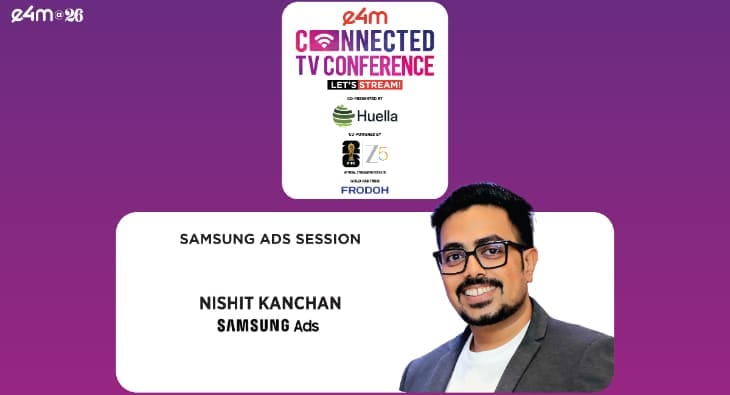

- Nishit Kanchan, General Manager of Samsung Ads India, emphasized the enduring importance of television as the primary device for family entertainment during the e4m Connected TV Conference 2026, despite the rise of multi-screen usage.
- He highlighted the evolution of connected TV advertising and content, noting that compelling content retains viewer attention on larger screens, while Samsung's advancements in display technology, such as Micro RGB, enhance consumer expectations.
- Samsung Ads currently operates 16.5 million active television screens in India, with users spending an average of 70 minutes per session, reflecting significant growth since 2022.
- Kanchan pointed out changing viewer behaviors, including the popularity of multi-view features and ad-supported streaming, with Samsung TV Plus becoming the second most-watched application on Samsung televisions, indicating a shift towards diverse content consumption.
Even as consumers spend more time across multiple screens, the television remains the centerpiece of the home entertainment experience. That was the central thought put forward by Nishit Kanchan, General Manager and Head of Revenue, Samsung Ads India, during a spotlight session at the e4m Connected TV Conference 2026, where he outlined how connected TV is evolving into a more sophisticated advertising and content ecosystem.
Positioning the television as the “billboard in your living room”, Kanchan challenged the notion that attention is inevitably fragmented across devices. While acknowledging that second-screen behaviour exists, he shared that compelling content continues to command undivided attention on the largest screen in the house.
“The TV screen or the larger screen in your household, which you also call the billboard in your living room, still continues to be the primary device which has the ability to get the entire family in front of one particular screen,” he said.
His remarks came amid broader industry conversations around measurement, attention and performance in the connected TV ecosystem. Kanchan mentioned that the quality of content often determines whether viewers continue multitasking or remain fully immersed in what they are watching.
Alongside the content story, Samsung used the session to highlight how advances in television technology are shaping consumer expectations. Kanchan pointed to the company’s recently launched Micro RGB technology, describing it as the next stage in television display innovation after OLED and QLED. “What the user wants more has always been at the core of Samsung’s DNA, and we always keep a lookout for how we can enrich the experience that they have from with their television,” Kanchan said.
For advertisers, however, the bigger story is the scale of the connected TV audience. Samsung Ads currently has 16.5 million active television screens in India, giving brands access to nearly 74 million usersHe added that Samsung serves ads across roughly five million active devices daily and that users spend an average of 70 minutes per session on Samsung televisions.
The company’s growth trajectory reflects the broader expansion of connected TV in India. “We started in 2022 with just about five million TVs, and today we are sitting at almost around 16.5 million,” Kanchan noted.
Kanchan also shared insights into changing viewer behaviour. One of the more striking findings, according to Samsung’s data, is that 83% of households owning televisions larger than 55 inches use the brand’s multi-view feature, which allows viewers to consume content from multiple sources simultaneously. Gaming is also becoming increasingly important, with 74% of gaming audiences connecting their gaming devices to televisions larger than 55 inches.
At the same time, content consumption on connected TVs continues to diversify. Kanchan said 94% of Samsung Smart TV users consume streaming applications and that the average Indian viewer watches content across five apps on television. According to Samsung’s observations, consumers spend more than five hours a day watching television content.
While marquee events such as cricket tournaments and global sporting competitions continue to drive spikes in viewership, Kanchan further highlighted that marketers should not focus exclusively on these tentpole moments.
“It is not just about tentpoles, but it is also about multiple micro-movements throughout the entire viewing experience journey of a user,” he said, referring to the consistent consumption of video-on-demand, streaming and other content formats throughout the year.
Another trend gaining momentum is FAST, or Free Ad Supported Streaming Television. Samsung TV Plus, the company’s FAST platform, now offers 184 free channels to viewers with an internet-connected television. Kanchan revealed that Samsung TV Plus has already become the second most-watched application across Samsung televisions, underscoring growing consumer acceptance of ad-supported streaming models.
Summing up Samsung’s proposition for advertisers, Kanchan said connected TV is no longer just about hardware or screen size. Instead, it is increasingly about combining premium viewing environments, audience intelligence, cultural relevance and measurable outcomes. “With Samsung Ads, you get the absolute power of an OEM ecosystem with the best kind of screen technology, reach the audiences you want to reach and back it up with deterministic results and performance,” he said.
Read more news about Digital Media, Internet Advertising, Marketing News, Television Media, Radio Media
For more updates, be socially connected with us onInstagram, LinkedIn, Twitter, Facebook, YouTube & Google News