Adidas vs Nike: How the World Cup put an off-pitch rivalry back in the spotlight
The two sportswear giants have turned the 2026 FIFA World Cup into a creative slugfest, featuring star-studded mini-movies, huge budgets & a numbers war that has reignited advertising's oldest rivalry
 by
by
Published: Jun 22, 2026 9:04 AM | 5 min read
 Follow Us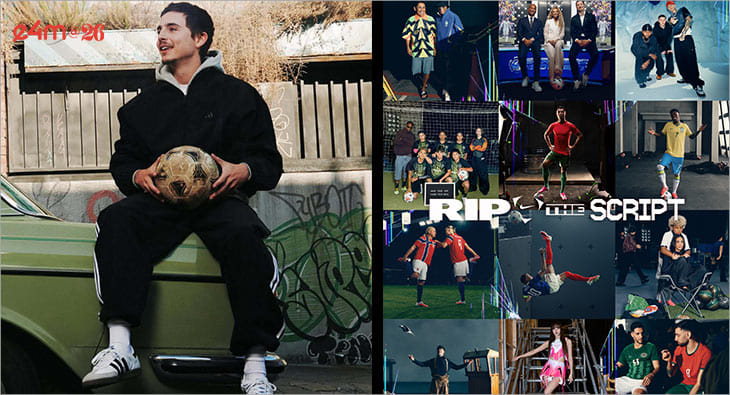

- The World Cup advertising rivalry between Adidas and Nike has intensified, with both brands launching high-budget campaigns featuring prominent celebrities and athletes to capture audience attention.
- Adidas released "Backyard Legends," a cinematic short featuring Timothee Chalamet and various football stars, while Nike responded with "Rip the Script," showcasing a star-studded cast including Cristiano Ronaldo and Kim Kardashian.
- As of now, Nike's campaign has significantly outperformed Adidas in terms of YouTube views, achieving over 77 million views compared to Adidas' 7.5 million, highlighting differing strategies in audience engagement.
- In terms of merchandise, Adidas supplies kits for 14 of the 48 World Cup nations, surpassing Nike's 12, while both brands continue to navigate the evolving landscape of sports marketing amid changing consumer consumption patterns.
The World Cup has always come down to numbers. Goals scored, points accumulated, the maths of who survives the group stage. Marketing runs on the same logic. Market capitalisation, revenue growth, units shifted. And nowhere has that numbers game been more visible this tournament than in the running battle between Adidas and Nike, fought not on pitches in Mexico City, Toronto or New York, but in edit suites, boardrooms and now, increasingly, on YouTube view counters.
The opening shot came from Adidas. In May, the brand unveiled "Backyard Legends: The Greatest Football Story Ever Told", a five-minute cinematic short fronted by Timothee Chalamet, playing narrator and ringleader to a fictional street team chasing down a legendary, unbeaten neighbourhood side. The cast reads like an awards season green room crossed with a Ballon d'Or shortlist, Lamine Yamal, Jude Bellingham and Trinity Rodman as Chalamet's recruits, Lionel Messi turning up as a self-deprecating "backup plan" alongside Bad Bunny, and David Beckham, Zinedine Zidane and Alessandro Del Piero appearing as digitally de-aged 90s icons in flashback.
The film reportedly cost in the region of £50 million to produce, the kind of budget once reserved for blockbuster trailers, not sportswear commercials. Neither brand discloses exact spend, but bills running into tens of millions are a safe assumption for both campaigns.
Nike answered with "Rip the Script," a six-minute spot that throws Cristiano Ronaldo, Kylian Mbappe, Erling Haaland and Vinicius Junior into a fictional Hollywood studio, where the footballers abandon their assigned script entirely. Around them swirls a genuinely strange ensemble, Kim Kardashian, LeBron James, Travis Scott, K-pop star Lisa, rapper Central Cee and Channing Tatum playing Haaland's stunt double in a Nordic ponytail wig. Retired greats including Ronaldinho, Zlatan Ibrahimovic, Didier Drogba and Eric Cantona round out a cast so large it borders on parody.
The view count gap
If the contest is being judged purely on YouTube numbers, there is only one winner so far. Within four days of release, "Rip the Script" had crossed 65 million views, a figure that has since climbed past 77 million. "Backyard Legends," by contrast, has struggled to clear 7.5 million views despite being live for more than a month. That is not a marginal gap. It is nearly 10x the engagement in a fraction of the time, and it has flipped the early narrative entirely. Adidas spent weeks being praised as the brand that finally cracked World Cup advertising again. Nike has since taken the conversation back simply by being louder, stranger and more clip friendly.
But the view count gap does not tell the full story, and this is where the two brands' underlying strategies start to diverge. Adidas' film is built for a single watch, a tight, linear narrative that rewards patience rather than rewatching. Nike's is built for fragments, dense with cameos and Easter eggs designed to be screenshotted, clipped and reposted across Instagram Reels, YouTube Shorts and TikTok rather than consumed start to finish on a single platform. In an attention economy increasingly defined by micro clips rather than full length views, that structural choice may matter more than the headline number suggests.
What the kit count says
Away from the films, the more conventional battlefield, replica jerseys, tells its own story. Adidas currently supplies kits for 14 of the 48 nations at this World Cup, including co-host Mexico and reigning champions Germany, edging out Nike's 12 and Puma's 11. Together, the three brands dress more than three quarters of the tournament field, a concentration that has only deepened since the field expanded from 32 to 48 teams. This is also the last World Cup as Germany's kit supplier before Nike takes over from 2027, adding a quiet symbolic weight to a tournament Adidas is treating as a send off as much as a showcase.
Money follows the players too. Cristiano Ronaldo's Nike deal, dating back to 2003, reportedly pays him a base fee of close to eighteen million dollars a year under terms first reported by Bloomberg, on top of performance bonuses and royalties tied to his Mercurial boot line. Numbers like that explain why both brands keep signing not just footballers but actors, rappers and reality television royalty. The fight for attention has stopped being a football story and become a pop culture one, with football simply the biggest stage either brand can buy into.
Beyond the films
World Cup ads have entertained, and moved product, for decades. Brazil's airport reunion spot from France '98 and Adidas' "Jose +10" from 2006, in which two children build dream teams from their favourite players, are still cited as genre defining work nearly two decades on. What changed is the speed at which today's campaigns are consumed and discarded. A single polished film used to carry a brand through an entire tournament cycle. This year, both Adidas and Nike have built theirs as the opening chapter of something larger, retail activations, capsule collections and ongoing content drops stretching the conversation across the full tournament rather than front loading it into a single launch week.
There is a financial backdrop too. Adidas reported first quarter revenue growth of 14% this year, describing 2026 as the fourth year of a turnaround plan it considers largely complete. Nike's most recent quarterly results told a different story, revenue flat on a reported basis and down on a currency neutral one, making football one of the clearest opportunities left for the brand to reassert itself in a market Adidas has spent the last year quietly clawing back.
Ultimately, neither the view count nor the kit count will settle who actually wins this World Cup commercially. That answer sits in quarterly earnings calls still months away, long after the trophy has been lifted and the films have stopped trending.
But for now, the scoreline in advertising's oldest rivalry remains unsettled. Adidas has the kit count and the craft. Nike has the noise and the numbers that travel fastest. As ever in this business, it always comes back to the numbers.
Read more news about Internet Advertising India, Marketing News, PR and Corporate Communication News, Digital Media News, Television Media News
For more updates, be socially connected with us onInstagram, LinkedIn, Twitter, Facebook YouTube & Google News