‘Advertising Plus’ era begins as digital hits 60% of ₹1.55 lakh crore market
According to Pitch Madison Advertising Report 2026, India’s ad market reached ₹1,55,105 crore in 2025 under an expanded ADEX definition, marking 12% growth over 2024
 by
by
Published: Mar 3, 2026 10:52 AM | 4 min read
 Follow Us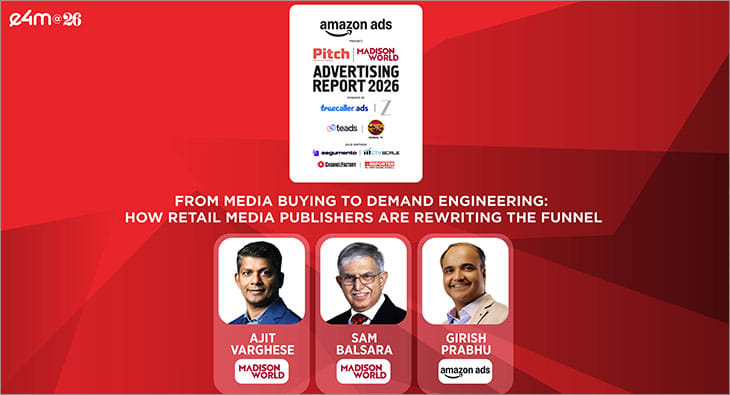

With Digital now accounting for 60 percent of India’s ₹1.55 lakh crore advertising market, the bigger shift may not be about media mix alone. It may be about redefining advertising itself, moving from awareness-driven messaging to what Sam Balsara, Chairman, Madison World, called “advertising plus”, where brand and business outcomes are inseparable.
The numbers, revealed during the Pitch Madison Advertising Report 2026 unveiled by Madison World in association with Pitch and Exchange4Media, set the stage for a discussion between Ajit Varghese, Partner and Group CEO, Madison World; Sam Balsara; and Girish Prabhu, VP and Head, Amazon Ads India, on where growth will truly come from.
According to the report, India’s ad market reached ₹1,55,105 crore in 2025 under an expanded ADEX definition, marking 12 percent growth over 2024. With Quick Commerce and MSME digital spends fully incorporated, Digital commands 60 percent of total ad spends, while Traditional media accounts for 40 percent.
From Advertising to ‘Advertising Plus’
Asked what excites him most in the report, whether it is CTV, Q-commerce, e-commerce or even the continued growth of print and OOH, Balsara refused to single out one medium.
“I think broadly speaking, we are moving from an age that was only advertising to advertising plus,” he said. “Today’s advertising man is obsessed not just with branding. He wants to drive his clients one stage closer to the sale, if not the actual sale itself.”
While acknowledging that new-age platforms attract attention because they offer immediate sales, Balsara cautioned against abandoning long-term brand building. “There is no alternative to long-term brand building. That has to remain,” he said, reiterating his belief in a 60-40 balance as a broad directional framework.
His larger concern was that performance metrics should not be mistaken for sustainable growth. Every conversion, he implied, does not automatically build a brand.
Consumption Patterns, Not Media Trends
Girish Prabhu framed the shift differently. According to him, media allocation changes are not driving behaviour. Consumption patterns are.
“Everything that we see, the share of TV, the penetration, the budget shifts, structural changes and so on, they are an outcome of a change in consuming patterns,” he said. “They are not changing because of media. They are changing because of the changes in consuming patterns.”
He cited rising time spent on mobile and pointed to emerging formats such as micro-dramas, where users are spending as much as 40 minutes per session. The attention shift, he said, is not about rejection of television but redistribution of time.
Another major shift, he noted, is the rise of MSMEs and challenger brands. Over 40 percent of what is broadly classified as retail media spend is now coming from newer brands, including D2C players looking to scale rapidly.
“These brands want to get big fast,” Prabhu said. They often launch with a single product, attempt to dominate a micro category and are less concerned about ROAS in the early stages. Their focus is on winning the category first and expanding later.
Why Full Funnel Is No Longer Just Language
The conversation moved to why full-funnel marketing has become central to boardroom discussions.
Prabhu attributed it to improved measurement. “When it is difficult to measure something, we have shortcuts, heuristics,” he said. “But when you move from the world of heuristics to reasonably accurate measurements that you can reason out and work backwards from, then the behavior changes.”
He commented that the fundamental question for any CMO is simple: Is my brand growing? What has changed is the ability to connect upper-funnel reach with intent, purchase and repeat behaviour in a unified way.
Interestingly, he challenged the traditional separation between brand and performance. Sponsored ads, often labelled as pure performance, can also build recall. When a consumer repeatedly sees a brand while searching for a category, the association strengthens over time. “The boundaries are more porous between brand and performance,” he said.
Balsara remained cautious. He suggested that while performance tools are powerful for testing and scaling, brands aspiring to move from ₹200 crore to ₹1,000 crore or beyond will inevitably need deeper memory structures and broader emotional connections.
Online Versus Offline Is a Continuum
Meanwhile, Balsara questioned why a new entrepreneur would bypass traditional retail shelves and launch only on online shopping channels.
Prabhu described it as a continuum rather than a choice. For early-stage entrepreneurs, online shopping and and quick commerce offer faster feedback loops, neighbourhood-level testing and quicker learning. However, offline presence remains critical for long-term selection and availability.
The trajectory for many brands, he indicated, is online to offline, eventually becoming omnipresent.
As the discussion closed, both leaders converged on one theme. Compartmentalisation is fading. The idea of being a search specialist, display specialist or video specialist is becoming restrictive. The future, they suggested, lies in starting with the outcome a brand wants to drive and working backwards, without format bias.
Read more news about Internet Advertising India, Marketing News, PR and Corporate Communication News, Digital Media News, Television Media News
For more updates, be socially connected with us onInstagram, LinkedIn, Twitter, Facebook YouTube & Google News
