Surf Excel Holi (2019): The ad that sparked a national conversation
How a Holi film about childhood friendship became one of the most discussed ads in recent Indian advertising history
 by
by
Published: Mar 3, 2026 8:04 AM | 5 min read
 Follow Us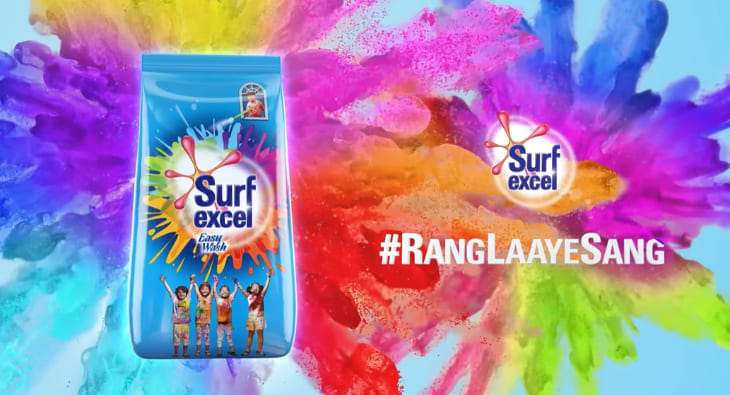

Some advertisements sell products. Some tell stories. And occasionally, an advertisement holds up a mirror to society, and society cannot agree on what it sees. Surf Excel’s Holi 2019 film belongs firmly in the third category. The 60-second spot garnered more than five million views on YouTube within days, trended on X (formerly known as Twitter), and turned a detergent brand into the centre of a wider national conversation about religion, identity and the boundaries of purpose-driven advertising.
Released just ahead of the Holi festival in March 2019, the film opens with a young girl riding her bicycle through the streets, dressed in white for the celebrations. As her clothes are gradually smeared in a riot of festival colours, she challenges the other children to throw all their water balloons and empty their stock of coloured water. Once the colour runs out, she signals to her Muslim friend, who is attempting to make his way to the mosque to offer namaaz, to step out of his home. The film closes with her smiling, seemingly content and unconcerned about the state of her clothes, as the campaign’s tagline appears: Rang Laaye Sang.
In pure craft terms, the ad was a textbook HUL production: warm lighting, child protagonists chosen for their guileless appeal, a simple narrative arc with an emotional payoff. The creative idea was, in essence, a meditation on selflessness: the ‘good stain’ being not detergent-worthy grime but the mark of a generous act. Taken as a piece of storytelling, it was uncomplicated and earnest.
What followed the ad’s release illustrated how charged India’s social and political atmosphere had become in the months leading up to the 2019 general election.
Within hours of the film going live, hashtags such as #BoycottSurfExcel and #BoycottHindustanUnilever began trending on Twitter. Some users accused the brand of deliberately portraying a Hindu child sacrificing her own festival experience for a Muslim friend, framing this as a calculated ‘anti-Hindu’ narrative. Others argued that the ad sought to advance a particular ideological agenda, describing it as contrary to the spirit of Holi. Calls to switch to rival detergent brands followed. Public figures and influencers entered the debate on both sides, further amplifying the discussion.
The criticism was not confined to a small fringe. It gained sufficient traction for the controversy to receive international coverage, including from the BBC, which noted the polarised responses the ad had generated in India. Several users described the film as an attempt to “appease” one community at the expense of another, an interpretation that some advertising professionals and social commentators questioned, arguing that the film’s central message was one of friendship and sacrifice.
While the backlash was prominent, expressions of support were also substantial and, at times, more organised. Celebrities, journalists, academics and members of the public voiced their backing for the ad, describing it as a timely depiction of Hindu–Muslim harmony. Many argued that the premise, children of different faiths looking out for one another, was not radical, but rather a reflection of the pluralism that shapes everyday life in India. Writers and former civil servants posted threads in defence of the film, and industry figures expressed support for Hindustan Unilever.
The ad’s YouTube view count rose to 5.3 million within the first few days, indicating that alongside calls for a boycott, significant numbers were watching and sharing the film.
The Surf Excel Holi campaign sits at the intersection of several tensions shaping contemporary Indian advertising. Purpose-driven marketing, in which brands incorporate social messages into their storytelling, had gained momentum throughout the 2010s, with both domestic and multinational FMCG companies using their scale to address issues ranging from gender equality to hygiene. Hindustan Unilever itself had an established record in this area, with brands such as Dove and Lifebuoy previously engaging in socially oriented campaigns.
The Holi 2019 film, perhaps more clearly than any previous campaign, highlighted the challenges of purpose-driven advertising in India. In a polarised media environment, any narrative involving religion risks being interpreted through a political lens. What the brand intended as a universal story of childhood friendship was, by some members of the audience, perceived as a statement on communal hierarchy.
From a purely commercial perspective, the controversy appeared to cause the brand no lasting harm. The view counts continued to rise, and the earned media coverage was substantial. HUL remained unperturbed, and the ad went on to become one of the most discussed pieces of Indian advertising of the decade, notable not only for what it promoted, but also for what it revealed about the society engaging with it.
Whether the Surf Excel Holi ad is viewed as a heartfelt story of communal friendship or as a provocative piece of messaging that misjudged its context, it is undeniable that it had an impact. The campaign sparked a debate extending well beyond detergent, prompting Indian advertisers, clients and consumers to consider challenging questions: What responsibility does a brand bear when its storytelling engages with sensitive social issues? Where does purpose-driven advertising end and political commentary begin? And who ultimately makes that determination?
Read more news about Internet Advertising India, Marketing News, PR and Corporate Communication News, Digital Media News, Television Media News
For more updates, be socially connected with us onInstagram, LinkedIn, Twitter, Facebook YouTube & Google News