Why Brand Modi-BJP remains India’s most powerful political force in 2026
Guest Column: Shantomoy Ray, Founder & Director of K Factor Communications, examines how Brand Modi-BJP continues to command a level of scale and public recall rarely matched in Indian politics
 by
by
Published: May 7, 2026 8:21 AM | 3 min read
 Follow Us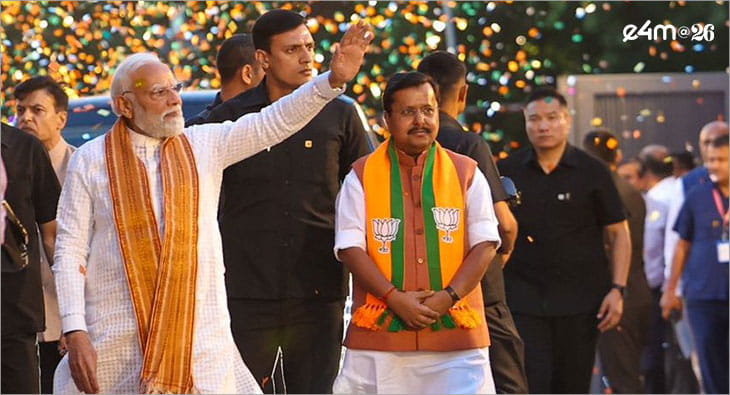

- The 2026 Indian elections highlight the dominance of the Modi-BJP brand, characterized by strong national cohesion, consistent messaging, and aspirational positioning tied to growth and ambition.
- Mamata Banerjee's All India Trinamool Congress has seen a decline in its brand strength due to perceived governance fatigue and a loss of emotional resonance among voters, indicating a desire for change.
- A new political identity, Brand Vijay, has emerged as a challenger, characterized by adaptive messaging and a focus on youth and urban appeal, but faces risks related to sustainability without institutional depth.
- The evolving political landscape in India is now a multi-brand marketplace, where different political identities compete for public trust, emphasizing the importance of continuous evolution in branding to resonate with voters.
Indian elections have evolved into a sophisticated marketplace of narratives, emotions, and leadership identities. In 2026, one truth stands clear: Brand Modi-BJP continues to operate at a level of scale, cohesion and recall unmatched in Indian politics.
This is not just political success. This is masterbrand dominance.
Brand Modi-BJP: The National Superbrand
At the core is Narendra Modi—a leader who has transcended traditional politics to become a symbol of aspiration, authority and national identity. The Bharatiya Janata Party has built a unified, pan-India narrative blending leadership, ideology and delivery.
In 2026, its strength is defined by execution:
- Consistency at scale across regions and voter segments
- Leadership as identity, with Modi as the brand’s central anchor
- Narrative control, shaping the national conversation
- Aspirational positioning tied to growth and ambition
- Credibility built over time through repeated delivery messaging
The outcome is clear: Modi-BJP functions as the default national choice architecture, setting the benchmark for political branding at scale.
Brand Mamata: From Dominance to Decline
For over a decade, Mamata Banerjee built a powerful regional brand—emotional, combative and deeply rooted in Bengal’s identity. Her party, the All India Trinamool Congress, sustained a stronghold through narrative clarity and grassroots connection.
The 2026 verdict, however, reflects a shift:
- Erosion of emotional resonance as messaging lost freshness
- Perception of governance fatigue among sections of voters
- Rising anti-incumbency after prolonged tenure
- Diminishing narrative sharpness around future direction
The result is not a collapse of identity, but a decline in forward credibility. Voters signalled a desire for change—not rejection of the past, but uncertainty about the future.
Brand Mamata remains recognisable and rooted, but now faces a clear mandate: reinvent to restore relevance.
Brand Vijay: The New-Age Challenger Brand
Emerging from the 2026 narrative is Brand Vijay a relatively newer, sharper and more agile political identity (contextually referring to leaders positioned as anti-establishment disruptors).
Unlike legacy brands, Brand Vijay operates like a startup in a legacy market:
- Highly adaptive messaging
- Digital-first narrative building
- Anti-elite positioning
- Youth and urban appeal
Where Modi represents scale and Mamata represents resistance, Vijay represents disruption.
This brand thrives on: Speed over structure, perception over pedigree, momentum over machinery.
But here lies the risk: Disruption is easy to launch, hard to sustain. Without institutional depth, Brand Vijay risks becoming a moment rather than a movement.
The 2026 elections confirm that Indian politics is now a multi-brand marketplace. Modi-BJP defines scale and national direction. Mamata reflects the test of relevance after dominance. Vijay signals the rise of agile challengers.
Each operates in a different lane but all are competing for the same thing: public trust at speed and scale. Because in today’s India, elections are not just won on performance. They are won on which brand can continuously evolve with the voter.
Read more news about Digital Media, Television Media, Out of Home Advertising, Print Media, Latest Advertising India
For more updates, be socially connected with us onInstagram, LinkedIn, Twitter, Facebook, YouTube & Google News