Kerala Elections 2026: Ad spends spike as political campaigns heat up
While digital is playing an increasingly important role in campaign strategy, Print continues to rule the political advertising scene, share industry heads
 by
by
Published: Apr 8, 2026 8:56 AM | 5 min read
 Follow Us

With just two days to go for Kerala’s high-stakes Assembly elections on April 9, the state’s media ecosystem is entering what industry insiders describe as a “mini festive season”. The Kerala elections are not just a political battleground but also a crucial revenue window for media platforms across print, television, and digital.
Notably, this year, the state is not only witnessing an intense political battle but also a surge in media and advertising activity. Several reports have estimated that election-linked outreach, spanning social media campaigns, PR machinery, and on-ground visibility, could cross ₹100 crore this cycle, highlighting how campaigning has evolved into a high-stakes, multi-platform communication exercise.
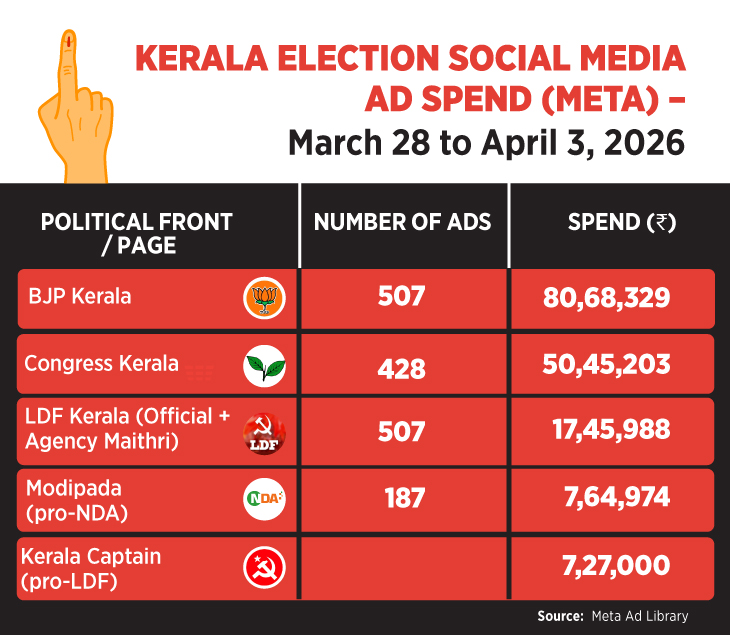
Kerala’s election campaigns are witnessing large-scale paid campaigns on social media, with all three fronts, LDF, UDF, and NDA, actively participating. According to the Meta Ad Library, in the week of March 28 to April 3, 2026, BJP Kerala spent about ₹80.68 lakh on 507 advertisements, topping the list. Congress Kerala followed with ₹50.45 lakh on 428 advertisements, while LDF Kerala’s combined spend, including official and agency-backed ads, amounted to ₹17.45 lakh.
At the same time, the spike in demand is reshaping pricing dynamics across media. While there are no formal rate hikes, effective ad rates are firming up during peak campaign periods. “The firming up of rates is largely due to reduced discounting and premiums on high-impact inventory like front-page and solus positions,” said Devika MS, Director of Operations at Mathrubhumi, adding that base rates for non-political advertisers largely remain stable.
Political advertisers, however, tend to pay a clear premium. “Political advertising rates are typically 20-30% higher than regular rates due to demand for specific time bands and inventory,” said Manoj Manoj , CEO of Radio Mango. Other categories, he added, continue at regular pricing unless inventory constraints come into play.
Print remains the king
Unlike many other regional markets, Kerala stands out for its enduring affinity for print, which continues to command a dominant share of advertising spends even in non-election months.
“Even during non-election periods, print commands nearly 50% of the commercial ad pie in Kerala due to its strong readership base,” noted Varghese Chandy, Vice President Marketing, Malayala Manorama. This dominance becomes even more pronounced during elections.
“The split typically shifts to around 60% for print, with TV and digital taking roughly 20% each,” he told e4m.
As per experts, the surge in print is driven largely by political advertisers. High voter engagement, intense competition among parties, and regulatory factors, such as the 48-hour silence period where print becomes the only permissible medium for political ads, combine to create a supply-demand imbalance that works in favour of publishers.
Digital rises, but traditional mix holds
While digital is playing an increasingly important role in campaign strategy, the overall media mix as per experts in Kerala remains largely unchanged during elections.
Television continues to attract strong political ad spends, particularly for news channels that see a surge in viewership during key campaign moments. At the same time, digital platforms are gaining traction for targeted outreach and last-mile communication.
However, print’s entrenched reach and credibility ensure it remains the cornerstone of election advertising in the state, even as digital steadily expands its share.
The effect on news broadcasters
For news broadcasters in particular, elections continue to function as a high-impact revenue cycle, often compared to a festive season that comes once every five years.
“Elections for a news channel is like a mega festival season,” said Unnikrishnan BK, Senior Vice President, Revenue Management and Strategy at Asianet News, noting that Kerala’s highly news-sensitive audience drives a surge in viewership and advertiser interest. “The state is buzzing with political activity, and campaigns are heavily skewed towards news channels during this phase.”
However, unlike earlier cycles, the revenue curve is no longer linear. After intense spending in the run-up to polling, the market typically witnesses a temporary lull. “After polling, there is a brief dip in activity, which eventually peaks again towards counting day and government formation,” he explained.
The shortened campaign window this year has also had an impact on overall ad spends. “Political campaigns had less than a month of active campaigning, which has reduced the budgets being pumped into the media,” Unnikrishnan said.
At the same time, the widening of media consumption options has fragmented attention, further influencing spend patterns.
Despite these shifts, the final leg of the election cycle remains critical. Overall, elections continue to deliver a meaningful uplift for the industry. “Election advertising typically drives more than a 12–15% jump in overall revenues, making it a clear peak season,” Unnikrishnan noted.
Radio sees sharper spikes
For radio, the election effect plays out differently, with demand concentrated around specific time bands rather than across the day.
Manoj of Radio Mango, highlighted that political campaigns tend to cluster around high-frequency bursts during peak listening hours, particularly morning and evening slots. This creates short-duration inventory pressure, unlike print where demand is more evenly spread across editions.
He also pointed out that election campaigns often come with urgency, last-minute creatives, rapid turnaround requirements, and high repetition, making radio a preferred medium for tactical messaging.
Selective participation from advertisers
Another noticeable trend is the selective participation of non-political advertisers during this period.
While categories do not completely pull out, there is a visible shift in behaviour. Brands tend to avoid high-noise environments such as front pages or prime news slots, instead opting for lower-clutter environments or maintaining baseline visibility. This results in a dual-speed market—one driven by high-intensity political spending and another that continues in a calibrated, business-as-usual mode.
As the Kerala elections enter their final phase, the advertising landscape reflects a market shaped less by broad-based expansion and more by timing, inventory control, and strategic spending.
With political advertisers dominating peak inventory, premium formats tightening, and media consumption fragmenting across platforms, the real gains are concentrated in specific windows rather than spread across the entire cycle.
Read more news about Marketing News, Advertising News, PR and Corporate Communication News, Digital News, People Movement News
For more updates, be socially connected with us onInstagram, LinkedIn, Twitter, Facebook, YouTube & Google News