Inside the Gen AI shift: Predictive CX and the future of marketing ROI
As boards demand sharper ROI, a session at the Dentsu e4m Digital Report 2026 launch highlighted how generative AI is transforming data, journeys, and customer engagement at scale
 by
by
Published: Feb 3, 2026 1:17 PM | 9 min read
 Follow Us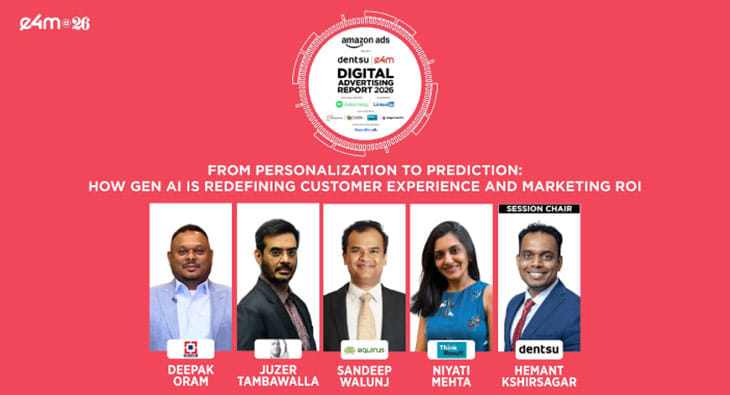

At the dentsu - e4m Digital Advertising Report 2026 launch, marketing and financial services leaders came together to discuss how generative AI is reshaping customer experience, moving brands beyond personalisation into a predictive, outcome-driven era.
Chaired by Hemant Kshirsagar, Chief Business Officer – Financial Services & Fintech, CXM, dentsu India, the session titled “From Personalisation to Prediction: How Gen AI Is Redefining Customer Experience and Marketing ROI” brought together Deepak Oram, Senior Vice President – Growth Marketing & Martech, HDFC Bank; Juzer Tambawalla, Director, Franklin Templeton; Sandeep Walunj, Chief Growth Officer, Equirus; and Niyati Mehta, Head - Strategy & Client Success, Think Result.
Opening the panel discussion, Kshirsagar invited Oram to frame the shift from personalisation to prediction.
Oram chose to begin not with Gen AI itself, but with the adoption problem surrounding AI. “AI is facing difficulties today because people are scared. People think it will take their jobs away, so they resist it,” he said, adding that this misconception is a major reason why AI adoption fails. According to him, if people are unwilling to adopt the technology, there is no way organisations can extract value from it.
From a large financial services organisation’s perspective, the real question was identifying where AI can augment people rather than replace them. Oram pointed out that financial products are not impulse purchases, emphasising the extensive due diligence involved in such decisions.
This exposes a fundamental gap in marketing today. “There are typically 100 to 200 questions that you ask before you take any loan or make any high-involvement investment,” he said. “As marketers, are we able to answer those questions across all channels, formats, and mediums?” The answer, he noted, is no.
According to Oram, it is humanly impossible for marketers to address hundreds of detailed customer queries at scale. Questions ranging from why one should buy a home, to documentation requirements, repayment impact on credit scores, and consequences of non-repayment are all part of the funnel, yet remain inadequately addressed today.
“This is where the marketer gets enabled and supercharged with AI,” he said, adding that Gen AI makes it possible to answer these questions in richer formats like video, rather than static FAQs. This, he argued, is the true value proposition of AI, enabling marketers to perform parts of their job that were previously impossible.
Building on this foundation, the discussion moved to how Gen AI alters decision-making across the customer journey. Kshirsagar noted that at a fundamental level, organisations are now able to make sense of far more data than traditionally allowed, take decisions faster and at scale, and even automate actions that were previously unviable.
Responding to which business decisions see the highest impact, Tambawalla said AI influences all aspects of the business, not just one part of the marketing funnel. “I don’t think AI impacts just one aspect. It pretty much impacts all aspects of the business,” he said, adding that restricting the conversation to a marketing funnel would be too limiting.
He also reflected on the exploratory nature of Gen AI adoption. Comparing it to traditional marketing approaches, he explained that earlier systems were largely action-based, built around predefined journeys and rule-based triggers.
“What generative AI really does is move the conversation from action to outcome,” he said. An action, he explained, does not necessarily guarantee a business outcome. Using a simple example, he said traditional prediction models assumed repeat behaviour based on past purchases. “If somebody bought an apple from Monday to Friday, your prediction would be that on Saturday also, the person will buy an apple.”
With AI, however, the prediction becomes more contextual. “You’re not just asking whether he will buy an apple, but what the apple will be used for, whether the weather has changed, or whether he might consider a grape instead,” he said. This shift is where real impact begins.
However, he cautioned that the transition requires trust. “The question is, how much do I trust it?” he said, pointing out that organisations and marketers need to evolve alongside AI. Drawing an analogy, he likened the current phase to early experiences with automobiles, when scepticism was natural. “These are early days. You take it as it moves along,” he added.
Adding a consumer marketing perspective, Mehta said that AI finally makes the long-standing idea of “consumer is king” meaningful. Speaking from her FMCG background, she said the phrase had historically been more rhetoric than reality. “Everything was mass marketing. You collected a lot of data and insights, but you were helpless in terms of actions and predictions,” she said.
According to Mehta, AI changes that equation. “Now you’re able to convert data into insights, insights into actions, and actions into predictions,” she said, calling Gen AI not just a tool, but an ecosystem that genuinely places the consumer at the centre. “We are all trying to serve that consumer together, and that’s what makes it powerful.”
As the conversation progressed, the panel turned to an earlier wave of automation in financial services and what it might signal for Gen AI’s future.
Drawing a parallel with the rise of robo-advisory a few years ago, Kshirsagar noted that while automation promised scale and efficiency, the industry eventually gravitated towards bionic or hybrid advisory models. He asked, “Will Gen AI follow a similar path of augmenting human advisors, or whether a significant portion of advisory services could shift to fully automated, Gen AI–driven models.”
Responding to this, Walunj described the current moment as a fundamental shift in thinking. “For almost half my career, I was chasing clicks. Now I am looking at predicting outcomes,” he said, calling it a complete paradigm shift.
Focusing on wealth management, Walunj explained that advisory operates on both logic and emotion. “There is a left brain and a right brain,” he said, adding that those who believe advisory can be fully automated often overlook the emotional aspects of investing. Quoting Warren Buffett, he noted, “Investing is simple, but not easy,” pointing to the role emotions and human fallacies play in financial decisions.
From his perspective, generative AI offers immense value in understanding customer context and intent. He explained that unlike static journeys of the past, AI-driven systems can factor in real-world changes such as budgets, market movements, taxation changes, and portfolio exposure. “I will change my answer,” he said, explaining how advisory recommendations evolve based on real-time signals.
In a hybrid model, Walunj said AI equips relationship managers with context before the customer even reaches out. “You’re ready with your answer,” he said, noting that while this level of preparedness was not automatable earlier, it is now possible. However, he was clear that AI does not eliminate the human element.
According to Walunj, a purely generative response may present factors for both selling and holding an asset, but only a human advisor can interpret risk appetite correctly. “My answer to one person will be completely different from my answer to another,” he said, concluding that until artificial general intelligence becomes a reality, hybrid systems will remain essential.
The discussion then shifted to marketing accountability and how AI-driven tools are reshaping outcome measurement.
Kshirsagar pointed out that boards today demand clear visibility into returns. “Show me, on every dollar or rupee spent, what is the outcome,” he said, adding that the quality of customers often matters more than volume.
From an ad tech perspective, Mehta said the real differentiation lies behind the scenes. “Like any ecosystem, there is a backend and a frontend,” she said, noting that while outcomes are visible and glamorous, the backend determines performance. According to her, the foundation, i.e. primary data and system architecture, is what drives personalised outcomes rather than mass-level results.
She emphasised that strong backend systems are where the most significant evolution is happening and where real value is being created. To illustrate this, Mehta cited a recent campaign for a premium automobile brand. With a modest ₹10 lakh awareness budget, the campaign not only drove store footfalls but resulted in the sale of two high-end vehicles within a month. “If you look at ROI, it’s sky-high,” she said, adding that such outcomes are possible only when the underlying ecosystem is built on a solid foundation.
The panelists next discussed the CFO lens and how Gen AI investments are justified internally.
Asked about high-impact use cases, Oram explained that marketing at HDFC Bank functions as both brand and channel, enabling end-to-end customer conversion. This creates a “railroad” from digital engagement to revenue. “It is nothing but a funnel,” he said, outlining how interactions at the top translate into business outcomes at the bottom.
However, Oram stressed that the real challenge lies in the middle of the funnel, where the creative, orchestration, and optimisation take place. “One of the biggest challenges today is how quickly you can iterate a non-working campaign into a working campaign,” he said, noting that inefficiencies often lead to either over-optimising what already works or neglecting what doesn’t.
AI enables marketers to move from limited segmentation to exponential scale. “What if you make the segments 10,000 and the channels eight or nine?” he asked, adding that such complexity allows funnels to adapt faster and serve customers in formats they prefer, such as video instead of text.
Oram was sceptical about AI-led brand campaigns delivering ROI but firm about its value in continuous iteration and optimisation. “This middle part is where the segmentation can now just explode,” he said. Once that happens, funnel performance improves dramatically. “From our calculations, the ROI is not even funny,” he added, pointing out that token costs are negligible at scale for large brands.
Finally, the discussion turned to existing customer journeys.
Tambawalla said the distinction between prospective and existing customers is minimal in financial services. “Both are very important,” he said, though existing customers naturally carry greater significance. From a business standpoint, he framed Gen AI’s impact across two dimensions namely growth and cost savings.
“If you help CFOs save costs, there is a certain positivity to that,” he said, adding that personalised, large-scale human engagement is virtually impossible in the industry today.
Tambawalla shared that his organisation is testing generative AI tools that can engage customers in a customised, timely, and frequent manner. “If I can do that at one-tenth of the cost,” he said, “it adds significant value to my bottom line.”
Read more news about Digital Media, Internet Advertising, Marketing News, Television Media, Radio Media
For more updates, be socially connected with us onInstagram, LinkedIn, Twitter, Facebook, YouTube & Google News