Journalism is also about giving credit where due: Alok Mehta
Alok Mehta, veteran journalist, broadcaster and Padma Shri awardee, discusses his new book, ‘Revolutionary Raj: Narendra Modi’s 25 Years’, with e4m
 by
by
Published: Feb 19, 2026 5:08 PM | 6 min read
 Follow Us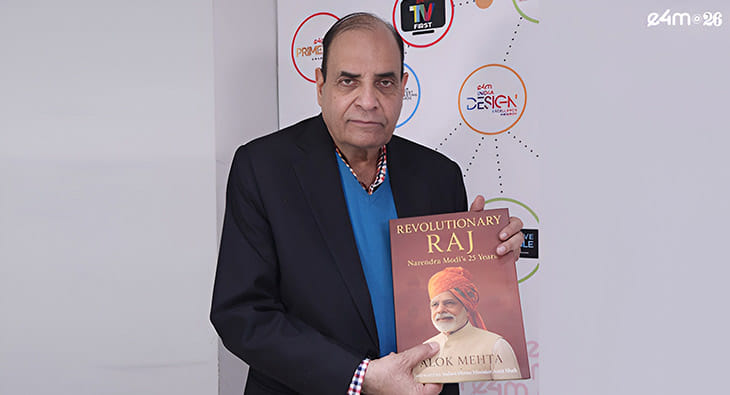

Veteran journalist, broadcaster, author and Padma Shri awardee Alok Mehta speaks to e4m about his new book Revolutionary Raj: Narendra Modi’s 25 Years, the challenges of documenting a sitting Prime Minister, journalism versus endorsement, governance metrics, media criticism and how India’s political evolution must be viewed through lived social transformation.
Q: You have recently authored Revolutionary Raj: Narendra Modi’s 25 Years. What led you to document this political journey, and how did the book take shape?
The background of this book goes much deeper than the present moment. When Narendra Modi first emerged prominently in public life, one of his major missions was connected to the Narmada project. At that time, I realised there was no comprehensive book examining the civilizational, religious and social importance of Narmada beyond welfare narratives. So I wrote Naman Narmada, and when I sent it to him, he himself wrote the foreword.
Later, during discussions with my publisher, Sanjay Arya of Shubhi Publications, we explored documenting broader social reforms in India. The publisher deserves significant credit for encouraging this project. Shubhi Publications normally does not focus on political books; they publish works on philosophy, culture and religion. But since I had been closely observing Modi’s journey for decades, the idea evolved into documenting transformation rather than politics.
Initially, I resisted limiting the story to ten years of prime ministership because Modi’s administrative learning began in Gujarat. Before that, he was an organisational worker travelling extensively across India during RSS years and even through the Emergency period. I was myself posted in Gujarat and Ahmedabad during that time and observed the environment closely.
So the book attempts to trace continuity, from organisational struggle to governance, from social reform thinking to systemic change. That is why the title became Revolutionary Raj.
Q: The word “Raj” is powerful and controversial. Why did you choose this term?
People often misunderstand the word. In India, and even historically under British rule, we used the term “Raj,” but it does not necessarily mean monarchy.
I grew up in a village where my father was a teacher. There was no electricity, no drinking water, no roads, nothing. Through that experience I understood Panchayati Raj, a concept associated with Mahatma Gandhi, which refers to participatory governance rooted in grassroots realities.
So when I use “Raj,” I do not imply a ruler or king. It represents governance that serves society. For example, if I jokingly describe someone as a “media baron,” it does not mean he rules people; it means he contributes significantly to shaping a sector.
Similarly, “Revolutionary Raj” refers to governance emerging from a deep understanding of India’s roots. Modi travelled extensively across the country long before becoming Prime Minister, he himself has said he visited nearly 90 percent of India even earlier. He experienced local realities firsthand, whether travelling in Kashmir or working across states.
That grassroots exposure influenced policies such as housing, gas connections, women’s empowerment and digital modernization.
Q: As a journalist, how did you separate professional objectivity from the risk of appearing as an endorser of a sitting Prime Minister?
I have been a journalist across multiple formats, news agencies, newspapers, magazines and television. My principle has always been that journalism must analyse both positives and negatives.
Daily journalism allows criticism. But analytical work must also recognise achievements.
From Indira Gandhi’s era onward, even during the Emergency, I wrote critically but in a sober tone. The role of journalism is not only opposition; it is analysis.
In this book, I have highlighted governance outcomes. That does not mean I avoid criticism. Even recently, after meeting the Prime Minister and Home Minister, I wrote articles pointing out implementation gaps in education and cultural ministries.
So appreciation and critique are not contradictory, they are complementary responsibilities.
Q: Some critics argue that the book highlights achievements but avoids contentious issues. How would you respond?
Every book has a defined scope. A coffee-table book differs from investigative journalism.
If you publish a housing magazine, you discuss housing challenges; if you produce a media book, you analyse media systems. Similarly, this book examines social reforms and governance transitions.
In other writings, including my earlier works, I have addressed critical aspects as well. But here the focus is transformation, comparable to documenting reformers like Swami Dayanand, Mahatma Gandhi or Raja Ram Mohan Roy.
My concern is that we increasingly evaluate governance only through negativity. Journalism must also document constructive developments.
Q: When you describe governance as “revolutionary,” what metrics are you using?
Certainly measurable ones- economic change, welfare delivery and digital transformation.
Initially, even I doubted whether digital systems would work in India. How would small shopkeepers or vegetable vendors adapt? But today even rickshaw drivers and domestic workers use digital platforms and create videos themselves. That is social change.
Gas connections, housing schemes, water access, these are transformative if you have personally seen villages without basic facilities, as I have.
Industrial governance has also evolved. Earlier, business approvals required informal payments and long delays. Today many industrialists say approvals happen faster. Foreign diplomats and companies have acknowledged implementation improvements.
Of course, challenges like price rise exist. But every country faces issues, I have lived in Germany and travelled widely in the United States and Britain. Even advanced systems struggle, including healthcare systems like the NHS.
So revolution must be evaluated comparatively and contextually.
Q: How do you assess PM Narendra Modi’s relationship with the media, given criticism that he avoids press conferences?
Media relationships have always been complex. Even during Indira Gandhi’s era there were pressures, though visual media did not exist then.
Modi communicates differently. Through monthly addresses and targeted interviews, he speaks directly to citizens. During the 2024 elections, he gave numerous interviews across states — possibly more than many earlier prime ministers.
Access also depends on journalistic intent. If interviews aim only to create confrontation rather than dialogue, leaders may hesitate. Communication requires responsibility on both sides.
Historically, media influence and proximity to power existed long before today. Even during earlier decades, journalists sometimes received incentives for favourable coverage. So the debate about media bias is not new.
Q: You have covered nearly every Prime Minister since Indira Gandhi. Where do you position Narendra Modi historically?
I have reported on Indira Gandhi, Morarji Desai, Charan Singh, Narasimha Rao, I.K. Gujral, Deve Gowda, Atal Bihari Vajpayee and Manmohan Singh, among others.
Each had strengths. Nehru had vision. Narasimha Rao enabled economic reform. Manmohan Singh was an outstanding economist, though perhaps less politically rooted.
What distinguishes Modi, in my assessment, is a combination of grassroots political understanding and modernization vision. Importantly, no personal corruption allegation against him has been proven.
While systems may still have corruption, personal integrity at the leadership level matters historically.
Read more news about Digital Media, Television Media, Out of Home Advertising, Print Media, Latest Advertising India
For more updates, be socially connected with us onInstagram, LinkedIn, Twitter, Facebook, YouTube & Google News