Hiveminds Ecommerce Conclave 2026: What Q-Comm & D2C leaders are really thinking about
The 4th edition of the HiveMinds Ecommerce Conclave brought together 200+ CMOs, brand heads, D2C founders, and platform leaders
 by
by
Published: Apr 1, 2026 1:25 PM | 5 min read
 Follow Us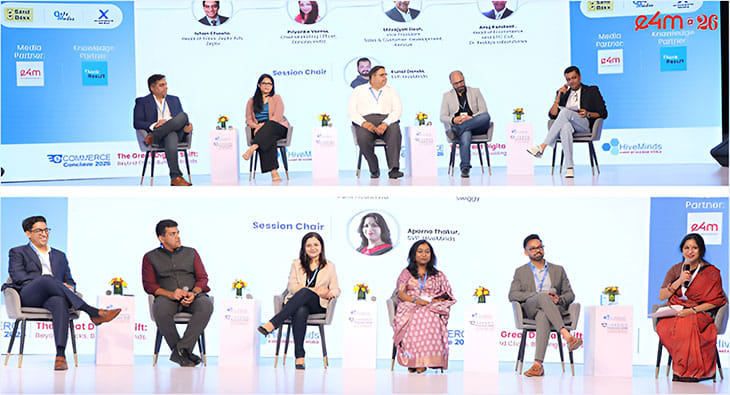

Quick Commerce: Habit Engine or Commoditization Trap?
The quick commerce panel, moderated by Kunal Danda (SVP, HiveMinds), featured Ishan Chawla (Head of Sales - Zepto Ads, Zepto), Priyanka Verma (CMO, Danone India), Shivajyoti Dash (VP Customer Development, Kenvue), and Anuj Kandwal (Head of Ecommerce and DTC CoE, Dr. Reddy's).
The most revealing data point came from Zepto: quick commerce is roughly a 50-50 split between planned purchases and impulse buys. The platforms are not passive fulfillment engines - they are active merchandising systems that change the app layout by time of day, building use cases around breakfast, indulgence, and evening occasions. This makes qcom a category-shaping tool, not just a delivery channel.
Priyanka Verma from Danone framed the opportunity and the risk in a single phrase: quick commerce is a "double-edged sword." It is one of the most powerful habit engines in nutrition because it eliminates procrastination - a consumer can order a protein supplement in 10 minutes instead of waiting for Monday to start a health journey. But it also threatens brand commoditization if brand building is restricted to the platform alone. Her advice: decouple brand equity from platform presence. "These platforms enhance our ability to communicate, not replace it."
Shivajyoti Dash from Kenvue offered a healthcare lens: trust is industry-agnostic, but urgency is now the baseline consumer expectation. "Everything is urgent now. If I don't take care of my consumer, someone else will." Kandwal from Dr. Reddy's agreed that convenience is breaking traditional loyalty - the entry barrier into a consumer's home has never been lower for new brands.
The panel's sharpest exchange was on who owns the consumer. Ishaan Chawla from Zepto noted that on qcom, consumers complete transactions in under 30 seconds, making the gap between brands that are advertised and brands that are remembered decisive. New-age brands like Raw Pressery (now doing upwards of INR 100 crores largely on the back of quick commerce) are proof that visibility plus product truth can disrupt legacy categories. Verma had the closing word: "Algorithms control our consumers to the extent that we allow them to. If you focus on building equity, platforms become a partner, not a threat." Reliability, not speed, emerged as the true new luxury.
D2C: Beyond the Growth Phase
The closing panel, moderated by Aparna Thakur (SVP, HiveMinds), brought together Chinmay Katdare (Partner, Epiqcapital), Dhruv Agarwal (Director and CEO, Stahl Kitchens), Swati Dayani (Chief Transformation Officer, Cipla Health), Abhishek Shetty (Marketing Head - Swiggy Instamart & Private Brands, Swiggy), and Sayantani Das (Head of Marketing, Jumboking).
Chinmay Katdare from Epiqcapital (investors in Lenskart, Mamaearth) was direct: the single metric that drives everything in D2C is customer retention. "Valuation is an outcome, not a metric. If you have great customer retention, you will have lower CACs, higher frequency, and better economics." The founder matters enormously, but retention is the clearest proof of product-market fit.
Dhruv Agarwal from Stahl Kitchens challenged the conventional D2C obsession with repeat purchase. For premium, long-shelf-life products, the goal should be repeat usage, not repeat buying. "It's not about continuous purchase. It's about making sure the product becomes part of your everyday rituals." Stahl's strategy of renaming generic cookware (sauce pots become biryani pots, omelet pans, fish pans) is a masterclass in solving specific consumer problems to expand the ecosystem organically.
Swati Dayani from Cipla Health brought the healthcare perspective: in categories where adherence matters, a solution-first approach beats a product-first one. "If you've known your consumer at their weakest and solved their problem, trust and retention are just outcomes." She noted that the critical moment in healthcare is the phase where things get worse before they get better - and brands that hold the consumer's hand through that phase earn a lifetime relationship.
Abhishek Shetty from Swiggy Instamart offered a platform-level reality check: "Volume growth without good-quality value is very expensive vanity." The brands winning on quick commerce are not those chasing reach but those obsessing over specific customer cohorts - identifying which consumers are willing to trade up, advocate, and repeat, and scaling from there. He also noted that regional brands are outperforming legacy players when their product truth transcends geography.
Sayantani Das from Jumboking provided a real-world illustration of how offline brand memory translates online: in Mumbai, stores at commuter hubs act as passive ads, so online orders are driven by recall rather than discovery. In new markets without that presence, the economics are fundamentally different - requiring platform investment and selective discounting while staying mindful of franchise partner profitability.
The thread connecting both panels was clear: in a world of compressed funnels, 30-second transactions, and algorithm-driven visibility, the brands that endure will be those with a defensible core - whether that is product innovation, expert credibility, cultural context, or channel advantage. Speed and convenience have lowered the barriers to entry, but retention, trust, and brand memory remain the only sustainable moats.
About the HiveMinds Ecommerce Conclave
The 4th edition of the HiveMinds Ecommerce Conclave was held in Mumbai on 27 March 2026, bringing together 200+ CMOs, brand heads, D2C founders, and platform leaders for an afternoon of practitioner-led conversations on the future of digital commerce in India.
Read more news about Industry Briefing, Internet Advertising, Marketing, PR & Corporate Communication, Television Media
For more updates, be socially connected with us onInstagram, LinkedIn, Twitter, Facebook YouTube & Google News
