As brands build in-house creative teams, agencies face a ‘reset’: Panelists at Goafest
At Goafest 2026, marketers and agency leaders debated whether the shift signals a structural reset for agencies or an evolution in how brands and creative partners collaborate
 by
by
Published: May 22, 2026 1:06 PM | 7 min read
 Follow Us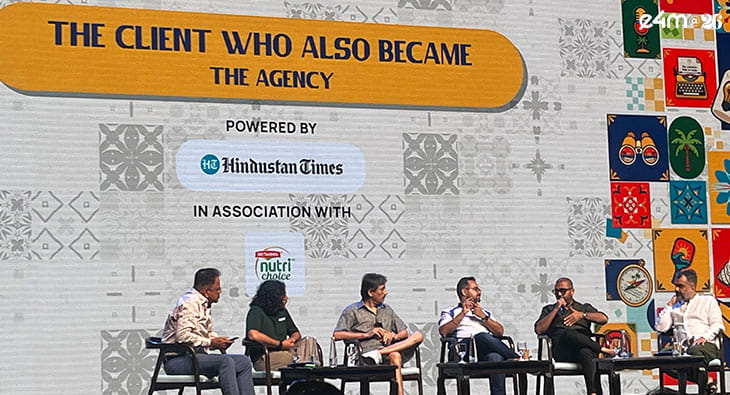

- At Goafest 2026, industry leaders discussed the trend of brands developing in-house creative capabilities, questioning whether this signifies a structural reset for agencies or an evolution in brand-agency collaboration.
- The panel emphasized that traditional boundaries between advertisers, agencies, and media companies are dissolving, driven by the need for speed, real-time consumer insights, and the influence of artificial intelligence.
- Speakers noted that while in-house creative teams can enhance agility and relevance, external agencies still provide valuable outside perspectives and creative conflict essential for brand development.
- The discussion concluded with a consensus that the future of marketing will require a hybrid approach, balancing in-house capabilities with agency partnerships, focusing on growth, relevance, and meaningful collaboration.
As brands increasingly build in-house creative and content capabilities to keep pace with rapidly evolving consumer behaviour, marketers and agency leaders at Goafest 2026 debated whether the shift marks a structural reset for agencies or simply an evolution in how brands and creative partners collaborate.
The session, titled “The Client Who Also Became the Agency: When Brand Owners Take Creative Into Their Own Hands,” brought together Raj Kamble, Founder & CCO, Famous Innovations; Gaurav Ramdev, CMO - India & South Asia, Visa; Ajay Kakar, Head – Corporate Branding, Adani Group; Chandan Mendiratta, Chief Brand Officer, Zepto; and Harsh Deep Chhabra, Global Head – Media, Godrej Consumer Products Limited. The discussion was moderated by Rohit Ohri, Founder, Ohriginal.
Setting the tone for the discussion, Ohri said the traditional boundaries between advertisers, agencies and media companies were increasingly dissolving as brands moved from campaign-led communication to always-on content ecosystems. He noted that artificial intelligence, real-time consumer behaviour and the growing need for speed were fundamentally altering how brands approached creativity and media. Referring to global trends, Ohri pointed out that a growing number of marketers worldwide were considering bringing creative capabilities in-house over the next year.
Offering the agency perspective, Kamble argued that the conversation around in-house versus external creative setups was not entirely new, noting that agencies and brands had experimented with hybrid working models for years.
“I think the biggest struggle around this whole inside agency, outside agency, I don't see the difference. This is not new,” Kamble said.
Referring to examples such as Nike and Apple, Kamble said strong brands are often built through close partnerships between founders and agencies, but still require external creative voices capable of challenging business decisions objectively.
“Steve Jobs can easily start an in-house agency and build a brand. But he needs somebody who can tell him what's wrong, bluntly,” he said.
Kamble also suggested that many in-housing decisions are increasingly being driven by cost optimisation and operational convenience. According to him, agencies continue to offer value through outside-in thinking, creative conflict and collaborative debate, which are often difficult to replicate within client organisations.
Responding to Kamble’s observations, Mendiratta said Zepto’s in-house structure was shaped by the operational realities of quick commerce, where brands need to respond to cultural moments and consumer conversations almost instantly.
“As far as the second part of the question that you asked, is the trend going to grow? I believe so. I think brands will do this in-house more often,” Mendiratta said.
Explaining Zepto’s approach to content creation, he said the platform’s relevance extends beyond large annual festivals and campaigns into everyday consumer moments.
“We are celebrating World Idli Day, World Dosa Day. Yesterday was International Tea Day. Because we have so many product categories listed on Zepto, we want to be relevant. As a category, we are relevant five times a day. You open a quick commerce app five times a day, which means ideally I should be making content five times a day,” Mendiratta said.
He added that Zepto had created nearly 30 films in three-and-a-half months through its in-house setup in partnership with brands listed on the platform, highlighting how speed and agility had become critical for modern brand-building.
Bringing in the perspective of a legacy advertiser, Chhabra said the move towards stronger internal capabilities at Godrej Consumer Products Limited was primarily driven by business alignment and scale. He noted that the company had scaled from being among the top 20 advertisers in the country to becoming one of India’s top four advertisers, with advertising investments and campaign volumes rising significantly over the past few years.
According to Chhabra, the number of campaigns executed every month had increased from roughly 10 to nearly 30, making it increasingly important for media and creative teams to operate closer to business priorities, growth KPIs and internal data systems.
Chhabra, who recently exited GCPL and is set to join Sony Pictures Networks India as Head of Strategy and New Business, said the role of internal teams was ultimately tied to business outcomes rather than industry recognition.
“As far as I was concerned, from day one, it was amply clear that while all of this is important, what we are here for is in the service of the shareholder. And shareholders genuinely care for growth,” Chhabra said.
He added that while agency and client-side cultures differ significantly, the primary responsibility for brand teams remains market performance and sales impact.
“What matters is, are we winning in the marketplace or not?” Chhabra said, adding that businesses are ultimately focused on marketplace growth, visibility and shareholder value rather than awards alone.
Ramdev brought in the perspective of global operating models, drawing from his experiences at The Coca-Cola Company and Visa. He explained that while Coca-Cola’s OpenX structure evolved around consistency and scale across markets, Visa’s current focus is centred on staying culturally relevant and agile in real time.
“At Visa, the idea is to be relevant at the speed of thought,” Ramdev said.
According to him, brands today need to react to culture and consumer behaviour almost instantly, while balancing long-term strategic campaigns with fast-moving daily content. Ramdev added that the future operating model for brands would likely be a hybrid between traditional agency structures and agile in-house systems.
Meanwhile, Kakar argued that despite the rise of in-housing, agencies continue to remain essential to brand-building, particularly for companies that do not consider creativity and communications to be core operational functions.
“This industry has built brands. But this industry should continue to build brands,” Kakar said while defending the long-term relevance of agencies.
At the same time, he acknowledged that changing expectations around speed, relevance and execution had exposed gaps in traditional agency relationships.
“So sit across the table and talk to each other. Don’t compromise would be my request or suggestion,” Kakar said during the discussion around evolving agency-client dynamics.
Kakar also argued that agencies and brands need to focus more on meaningful conversations and audience relevance rather than only impressions and reach metrics. Discussing the growing influence of platforms such as Meta and Google, he described them as tools that both agencies and brands must learn to leverage effectively.
As the session moved towards closing remarks, the panelists broadly agreed that while agency structures and operating models would continue to evolve, the importance of growth, partnership and relevance would remain central to the future of marketing.
Summing up his view on the future of agencies, Ramdev said, “I think in the age of specialisations, the deeper the agency has specialisations in, the better the relevance would be.”
Kamble, meanwhile, argued that the future value of agencies would depend less on corporate structures and more on trusted partnerships between clients and creative leaders.
“The best value is whichever client can find a partner. A partner he can call and say, ‘This is my problem. Can you solve it?’” Kamble said.
Closing the session, Kakar urged agencies not to over-fragment themselves across multiple specialist verticals and teams.
“I plead towards the agency side, do not fragment yourself. Because we used to go to one person who managed everything for us. Now we don't know who all are we going to,” he said.
Read more news about (internet advertising India, internet advertising, advertising India, digital advertising India, media advertising India)
For more updates, be socially connected with us onInstagram, LinkedIn, Twitter, Facebook Youtube & Whatsapp
