Will AI discovery change OTT economics before it changes CPMs?
As conversational discovery enters streaming platforms, agencies and CTV leaders debate whether better engagement signals translate into stronger inventory quality and effective yield
 by
by
Published: Mar 6, 2026 9:25 AM | 7 min read
 Follow Us

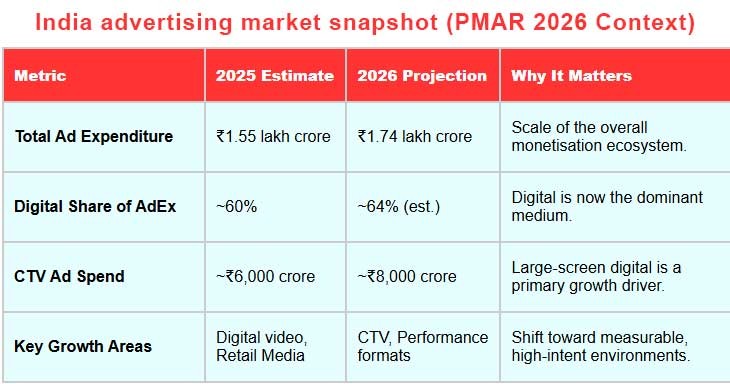
India’s advertising market is no longer tentatively digital. It is decisively so. According to the latest Pitch Madison Advertising Report 2026, India’s overall advertising expenditure crossed approximately ₹1.55 lakh crore in 2025 and is projected to reach roughly ₹1.74 lakh crore in 2026.
Digital accounts for 60 percent of that pie and is expected to edge even higher this year. Within that, connected TV and large-screen digital formats are among the fastest-growing segments, with CTV ad spends estimated at around ₹6,000 crore in 2025 and projected to approach ₹8,000 crore in 2026.
At the same time, streaming platforms globally are experimenting with a new layer in the discovery process. From Netflix’s natural-language search experiments to Amazon’s voice-led recommendations and AI-assisted browsing interfaces on connected TVs, discovery is gradually shifting from category browsing to conversational intent.
That shift raises an important monetisation question. If artificial intelligence can meaningfully improve how viewers find and engage with content, what does that do to the economics of streaming inventory?
The intuitive answer might be higher CPMs. Better discovery leads to longer sessions. Longer sessions lead to deeper engagement. Deeper engagement, in theory, justifies stronger pricing.
Early experiments in India, where conversational discovery layers are beginning to appear within major streaming ecosystems, have intensified the debate around whether AI can influence engagement depth and inventory economics.
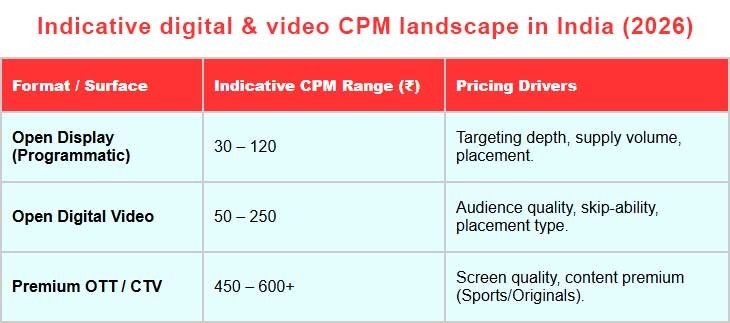
In a market where digital CPMs are under pressure and inventory supply continues to expand, even a marginal structural uplift in attention could be significant. Indicative video CPMs in India can range widely depending on format and targeting, with open digital video often priced between roughly ₹50 and ₹250 per thousand impressions.
Premium OTT and CTV environments typically command higher rates, justified by targeting precision and screen quality. In that context, any development that enhances predictability and session stability naturally invites questions about pricing power.
But the industry consensus emerging so far is more measured. The first impact of AI-driven discovery may not be higher CPMs, but better inventory quality, stronger engagement signals and improved effective yield.
Prabhvir Sahmey, Founder and CEO at Stratpulse Techlabs who has previously held leadership roles at Samsung Ads and Google, does not see an immediate connection between AI-led discovery and inventory repricing. “I don’t think it will impact CPM for inventory,” he says.
In his view, the more immediate impact lies in improved discovery within increasingly dense streaming libraries. AI-powered search and recommendations can make it faster for viewers to find relevant content, reducing browsing friction and keeping audiences engaged for longer sessions.
That distinction shifts the conversation from pricing to engagement quality. AI-led discovery may first operate as a session stabiliser rather than a rate accelerator.
Muralidhar T, Senior Vice President, Media Delivery and Operations India at WPP Media, frames the shift through a buyer’s lens. If AI enhances session predictability and completion rates in OTT environments, he says agencies will see it as “a structural uplift in inventory quality.” Smarter recommendations and sequencing can keep audiences engaged longer, reduce drop-offs and improve delivery consistency, significantly lowering wastage.
This elevates not just the quantity but the quality of each impression. Ads are delivered in more stable, attentive viewing sessions, increasing completion rates and strengthening campaign reliability. “Better engagement enhances delivery integrity, turning impressions into higher-quality brand opportunities,” he says.
Even if the sticker CPM does not rise, effective CPM can improve. When AI reduces browse-and-bounce behaviour and increases completed views, the effective cost per completed impression declines. In that sense, AI-led discovery may enhance yield before it influences rate cards. “The real value lies in quality amplification, not immediate pricing recalibration,” he notes.
That emphasis on quality over rate inflation is telling. In a digital ecosystem that now accounts for the majority of India’s ₹1.74 lakh crore projected ad market, pricing discipline remains strong. Buyers demand measurable uplift before agreeing to premiums. A promise of smarter discovery is not, in itself, sufficient.
For advertisers, the real evaluation framework must therefore shift from novelty to incrementality.
“Measure incremental engagement and outcomes, not just reach,” says Muralidhar. Advertisers should assess AI-enhanced discovery by measuring the incremental lift it provides over traditional targeting across reach, engagement, session completion and conversions. Since adoption is still evolving, structured A/B tests, holdout groups and cross-funnel benchmarking are essential to validate true incremental value. The focus should remain on business impact per rupee spent, not simply broader exposure.
If agency leaders see AI as an amplifier of inventory quality, the device layer introduces another dimension.
In a market where digital inventory is abundant and budgets are scrutinised, that predictability may be the real competitive advantage. With CTV projected to approach ₹8,000 crore in ad spends this year and digital firmly entrenched as the dominant medium, even marginal improvements in effective yield can translate into meaningful revenue outcomes at scale.
Abhijeet Rajpurohit, COO and Co-founder of CloudTV, views AI-led discovery at the operating system layer as a deep engagement engine. As an OS layer, he explains, the primary objective is to enable frictionless discovery of content and features for end users.
Leveraging AI to understand audience behaviour and preferences powers a hyper-personalised recommendation engine that can significantly deepen engagement. Over time, he suggests, this discovery layer can evolve into a contextual advertising surface that delivers non-intrusive, value-driven ad experiences native to the user’s TV journey.
Discovery, he argues, has always been central to monetisation. Instead of interrupting users with ads while they browse, platforms can allow them to engage with promotional content by choice, seamlessly integrated into the discovery flow.
On Connected TVs, this could take the form of sponsored discovery placements, contextual audience clusters and improved monetisation of long-tail and regional content. Predictive commerce signals add another layer. For example, increased cricket viewership can be mapped to related categories such as fantasy gaming or fintech, enabling more contextual and high-intent advertising opportunities.
Here, the monetisation shift is less about raising CPMs on traditional pre-roll inventory and more about expanding the monetizable surface area itself. Sponsored placements within discovery flows, contextual alignment at the OS layer and predictive commerce signals introduce new formats that may coexist alongside standard video ads.
In a post-DPDP environment, that shift carries additional relevance. With India’s Digital Personal Data Protection framework now fully operational, advertisers face tighter consent and purpose limitations around first-party and behavioural data. AI-led discovery creates a complementary pathway through contextual intelligence. Instead of targeting based solely on persistent user profiles, platforms can align ads with real-time queries and content context. Contextual targeting anchored in what a user is actively searching for or watching may prove more privacy-resilient than identity-heavy targeting stacks.
Taken together, the industry perspectives suggest a layered transformation. AI-led discovery improves content surfacing and extends reach beyond owned platforms. It enhances session stability and reduces volatility in engagement. It opens up new contextual advertising surfaces within the discovery journey. What it does not yet do, at least in the near term, is automatically trigger pricing resets.
In practical terms, that may still be economically meaningful. If AI-driven discovery reduces drop-offs and increases completion rates, the effective cost per completed view could decline even if headline CPMs remain unchanged. Campaign reliability improves. Wastage declines. Attention becomes more stable. Over time, those improvements can build advertiser confidence and justify selective premiums in high-attention environments.
But that sequencing matters. Performance precedes pricing. Predictability precedes performance. AI’s immediate contribution appears to lie in strengthening predictability.
The streaming endgame, then, may not be about charging more for impressions. It may be about making each impression more defensible.
If AI-led discovery succeeds in delivering sustained, measurable improvements in engagement depth and session stability, pricing dynamics may eventually follow. For now, however, senior industry leaders are clear. This is a quality upgrade and a distribution play before it is a pricing revolution.
In India’s rapidly expanding digital advertising economy, that distinction could make all the difference.
Read more news about Digital Media, Internet Advertising, Marketing News, Television Media, Radio Media
For more updates, be socially connected with us onInstagram, LinkedIn, Twitter, Facebook, YouTube & Google News