AdDissect: Ching’s new Rs 150-crore ad and the evolving scale of advertising production
AdDissect breaks down standout ads—unpacking creativity, culture and craft. The first edition kicks off with Ching’s Desi Chinese’s campaign featuring Ranveer Singh and other celebrities
 by
by
Published: Oct 24, 2025 8:33 AM | 5 min read
 Follow Us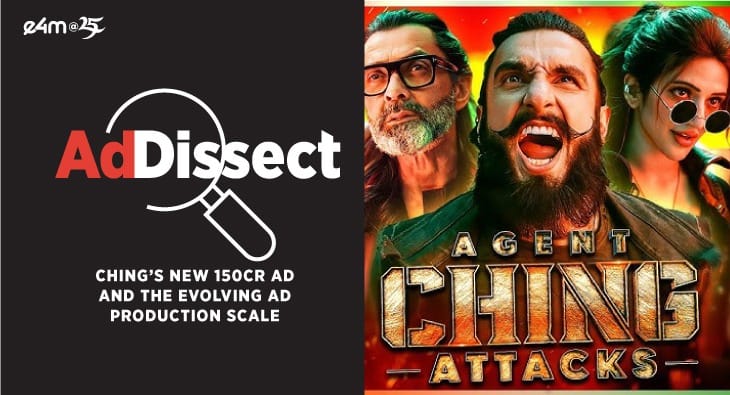

Welcome to AdDissect, e4m’s new weekly series where we break down one standout advertisement, exploring its creative choices, cultural context, production craft, and what it says about the future of brand storytelling. Each edition goes beyond the surface of “what worked” to unpack how today’s most ambitious campaigns are reshaping advertising as a creative and commercial industry.
We begin with one of the most talked-about ads of the week and probably the year, Ching’s Desi Chinese’s latest campaign featuring Ranveer Singh, Bobby Deol, and Sreeleela, directed by Atlee and his brand-new ad-production house, A for Studios. Mounted reportedly at a massive Rs 150 crore budget, this eight-minute spectacle feels less like a brand film and more like a theatrical release.
Read On: Is Indian advertising trading depth for viral moments?
The film’s own YouTube description sets expectations high: “Blockbuster Director Atlee makes his advertising debut, bringing his signature scale and magic to the screen.”
That’s exactly what unfolds. Atlee, known for Jawan, Mersal and Theri, brings his grand cinematic grammar to advertising for the first time. The result: a high-octane, visually explosive, emotionally charged short film that reimagines the conventions of a commercial.
Ranveer Singh reprises his role as “Agent Ching,” a flamboyant spy determined to save the world’s sense of taste from Bobby Deol’s menacing “Professor White Noise,” who plans to erase flavour from existence. What follows is an eight-minute swirl of action, comedy, slow-motion hero shots, and visual bravado, all anchored around the idea of “flavour as resistance.”
Atlee’s direction blends film emotion with advertising intent. His own words underline the creative intent, “For me, love is the secret ingredient. Ching’s wanted something India won’t just watch, but love, and that’s why I said yes to my first ever ad. Ranveer’s madness, Bobby sir’s magic, and Sreeleela’s freshness, we’ve cooked this with a lot of heart.”
Read On: Navigating cultural representation: The new creative dilemma in advertising
Every element of the film screams scale, from the world-building and stunt choreography to the elaborate sets and cinematic lighting. The soundtrack, by G.V. Prakash Kumar, carries Atlee’s signature emotional pulse, while Ranveer’s energy drives the narrative.
Sreeleela’s presence adds freshness and balance to the chaos, while Bobby delivers a stylised antagonist performance that continues his recent transformation as a screen villain. It’s clear that Atlee hasn’t treated this like a “commercial gig,” but like another entry in his filmography.
The result is a crossover between entertainment and marketing: a product film with the texture of a theatrical trailer.
The Ching’s campaign is also a glimpse into a changing creative economy.
Advertising today is no longer restricted to quick recall spots; it’s increasingly about creating content worth talking about. And long-form, cinematic storytelling has become a new currency for visibility.
By bringing a blockbuster director like Atlee into advertising, Ching’s demonstrates how brands are now investing in “event advertising”, single, high-impact pieces of content designed to dominate social conversation and cultural timelines. The earlier My Name is Ranveer Ching campaign in 2014 had already hinted at this ambition, but this new film pushes the idea to its logical extreme.
The reported Rs 150-crore scale has naturally raised eyebrows, but more than a budget flex, it signals a mindset shift. The collaboration represents the merging of India’s two biggest storytelling ecosystems: cinema and advertising.
Read On: Beyond Cravings: The rise of purpose-driven food advertising in India
This is prestige advertising, where the value lies as much in cultural impact as in traditional ROI. Brands are no longer asking, “Will this sell more packs?” but rather, “Will this make us part of the cultural conversation?”
It’s also a sign of the changing audience, one that consumes brand films, trailers, and OTT shorts with the same curiosity. In such an environment, the line between a brand message and a cinematic moment becomes intentionally blurred.
The Ching’s ad also reignites an important industry discussion, about how budgets are evolving in an era of both creative abundance and financial scrutiny.
While most marketers are under pressure to do more with less, there’s a counter-trend emerging at the top end: fewer but bigger campaigns that rely on scale and storytelling to cut through media clutter. For some brands, the return on such investments is not immediate sales, but long-term brand equity, earned media, and cultural imprint.
As marketing mixes evolve, a Rs 150-crore ad might sound extravagant, but in a world where attention is the scarcest commodity, high-impact creative events like these can serve as brand-building anchors, the kind that shape consumer perception for years.
Whether this becomes a new model or remains a one-off milestone, Agent Ching: The Secret Ingredient sets a benchmark for what Indian advertising can look like when cinematic ambition meets brand intent.
It’s not just a film selling flavour, it’s a reminder that storytelling, scale, and emotion still have the power to make a brand unforgettable.
Read more news about Internet Advertising India, Marketing News, PR and Corporate Communication News, Digital Media News, Television Media News
For more updates, be socially connected with us onInstagram, LinkedIn, Twitter, Facebook YouTube & Google News