Navigating cultural representation: The new creative dilemma in advertising
As brands navigate a divided social landscape, the line between respect and controversy grows thin. Deepika Padukone’s Abu Dhabi ad shows how creative intent can be overshadowed by public reactions
 by
by
Published: Oct 14, 2025 8:33 AM | 8 min read
 Follow Us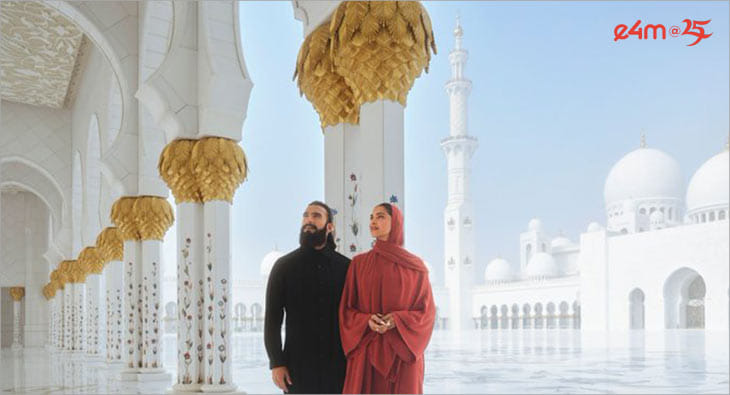

The latest Visit Abu Dhabi campaign featuring Ranveer Singh and Deepika Padukone has reignited a familiar debate in Indian advertising circles. The ad shows Padukone wearing a hijab while visiting a heritage site in Abu Dhabi, a simple gesture of respect for local customs that has somehow become a flashpoint for online outrage.
Social media erupted with criticism, with users calling her a "fake feminist" and questioning why she doesn't promote Indian religious sites with the same enthusiasm. Comments ranged from "What happened to 'My Choice'?" referencing her 2015 feminist video, to "They never promote India like this," and even more inflammatory accusations of "Islamic grooming." It's a pattern the industry has seen before, and one that's forcing creative teams to second-guess every cultural reference, every visual choice, every word.
Read On: Festive marketing offensive: Should brands stay away from religion?
Sumanto Chattopadhyay, freelance Creative Director and former Executive Creative Director at Ogilvy South Asia, cuts through the noise with characteristic clarity. "When foreigners visit Indian temples, they're often asked to cover up, or even wear Indian clothing. Nobody protests that. It's simply about respecting the customs of the place. That's exactly what Deepika Padukone was doing when she wore a hijab at a mosque in the Abu Dhabi ad. And might I add, she absolutely rocked the look."
His observation hits at the heart of the matter. Context is supposed to matter. When tourists visit Indian temples, they're asked to dress modestly, sometimes even to wear traditional Indian clothing. Nobody bats an eyelid. It's understood as basic courtesy, a mark of respect for the sanctity of the space. But when an Indian celebrity does the same abroad, it can sometimes be perceived differently, sparking debate and varied reactions.
This isn't an isolated incident. The backlash echoes the controversy around Fabindia's "Jashn-e-Riwaaz" Diwali campaign, which was pulled after protests over its use of Urdu words. What was intended as a celebration of India’s diverse traditions instead faced significant public debate. The campaigns themselves were not inherently problematic; rather, the context in which they were received influenced the reactions.
The context trap
The Visit Abu Dhabi campaign was not intended to make a political statement. Like any destination marketing effort, it aimed to showcase the cultural fabric of the place being promoted. Padukone wore an abaya because it was appropriate for the setting. The creative team recognised that authentic representation involves respecting the customs of the destination.
Chattopadhyay doesn't mince words about what's really driving the backlash. "Sadly, brands in India have begun to police themselves to avoid controversy, when what they should be doing is taking a principled stand against the bigotry that breeds such protests."
When creative teams start self-censoring
The impact of these controversies goes beyond campaigns being pulled; it also affects the ideas that never leave the boardroom. Agencies are increasingly conducting internal reviews focused less on creative quality and more on minimizing potential backlash. Questions like “Is this word appropriate?” or “Could this visual cause offense?” are becoming common, and as a result, creative opportunities are becoming more limited.
Brands have begun to self-regulate, often scaling back ideas in advance to minimise the risk of backlash. This cautious approach contrasts with the advertising industry’s traditional role of pushing boundaries, sparking conversations, and reflecting the world as it is.
Read On: Is ‘attention’ becoming advertising’s new currency?
The perception economy
Divisha Iyer, Vice President of Fluence & Represent at Schbang, captures the shift that's fundamentally altered how campaigns are conceived and received. "In today's world, creative intent and audience perception coexist but not on equal footing. What a brand or talent sets out to express and what people take away from it can be two very different things. The speed and scale of social media mean that perception often becomes the reality, regardless of context or intent."
Social media has fundamentally changed the game. Creative intent and audience perception exist in separate universes now, and perception almost always wins. What a brand sets out to say and what people take away from it are often unrelated. The speed at which outrage spreads means that context gets lost in the noise. A campaign can be algorithmically assassinated before anyone's had a chance to actually watch it, let alone understand what it was trying to do.
But Iyer is clear that this new reality doesn't mean retreat. "That doesn't mean creativity should be censored; it just means that awareness and sensitivity have become part of the creative process. As advertisers and marketers, our job is no longer just to craft the message, it's to anticipate how it might be seen, shared, and sometimes, misunderstood."
This doesn’t mean brands should retreat into safe, sanitised messaging. Rather, the creative process has evolved. Awareness and sensitivity are now integral to the craft of creativity. Agencies must anticipate not only how a campaign will be received, but also how it may be shared, interpreted, and sometimes misused. While challenging, this is the reality of working in a highly connected and polarised environment.
Read On: Rewriting the Rules: How hybrid formats are redefining Indian advertising
Who gets to be outraged?
Harish Bijoor, Brand Guru & Founder of Harish Bijoor Consults Inc., takes a pragmatic view on navigating this landscape. "Outrage is the right of any individual who wants to be outraged. To that extent, advertising agencies and brands must care more for the largest common denominator audiences which are specific to them. To that extent, they just might have to ignore elements that sit on the fringe and complain."
Bijoor's take on the Abu Dhabi campaign is unequivocal. "If you look at the Abu Dhabi ad and Deepika Padukone in an abaya, I do believe it was all about context. It's after all an ad that wants to promote Abu Dhabi and to that extent, whatever you wear out there needs to have context within the cultural, political, social and economic context of the land. So, to that extent, I think Deepika did what she did as did Ranveer. Reading too much in this is not a great thing to do for the moment."
The Visit Abu Dhabi campaign was aimed at travellers interested in experiencing different cultures and appreciating the importance of respecting local customs. Much of the backlash came from audiences outside the campaign’s intended target. Agencies now face the challenge of discerning between constructive criticism and background noise. Not every controversy requires a response, and not every complaint warrants a change in direction.
Reading the Room in a Polarised Landscape
The reality that agencies must contend with is that India's social and political landscape has become increasingly polarised. What might have passed as respectful representation a decade ago now requires layers of strategic consideration. Campaigns targeting global audiences that feature Indian talent must consider how those visuals will be perceived back home, where context often takes a backseat to instant reactions.
Anadi Sah, National Creative Director and Co-Founder at tgthr, a full-funnel ad agency, lays out the operational realities facing agencies today, saying, "In the present polarised environment and with the rise of engineered activism tied to cultural and religious contexts, brands and agencies must exercise extra caution when developing localised or global campaigns. There is an absolute need to be thorough with societal and cultural beliefs, examining not just the message but also the representatives who carry them on screen, as there is a high risk of misinterpretation, contradictory beliefs, and ideological backlash."
The operational demands have become more complex. "It is crucial in any such exercise to lay down a stringent strategic framework and checklist that ensures authenticity, respect, and trusted collaboration. As a core practice, every agency and brand must have a deep understanding of local cultural and religious practices, nuances, and sensitivities. The campaigns must be reviewed by diverse audiences within the team. Consultations with religious and cultural scholars or local experts are crucial for validation," Sah explains.
He emphasises the importance of staying true to brand values while avoiding potential flashpoints. "Brands should adhere to their own core values and universal human values, avoiding the selection of specific rituals or symbols that could be easily misinterpreted or challenged. Engagement must be genuine; brands should never force-fit themselves into customs or rituals that might be objectionable to any community, religion, or sect. Even with careful planning, a contingency plan to address potential controversies or backlash swiftly and effectively is essential."
This doesn't mean creativity should be censored or that brands should avoid cultural themes entirely. The creative process now demands a more sophisticated understanding of how messages travel, mutate, and get interpreted across different audience segments. Agencies need diverse voices at the table during ideation, not just as a box-ticking exercise, but as essential contributors who can flag potential pitfalls before they become full-blown crises.
Where do we go from here?
The advertising industry is at a crossroads. One path leads to safe, sanitised work that avoids controversy but may fail to inspire. Brands that take a clear stance may not appeal to everyone. The challenge lies in deciding whether to uphold those principles or yield to the loudest voices.
Cultural respect isn't a PR liability. It's a basic human value, one that should be celebrated, not condemned. When an Indian actor wears a hijab at a mosque in Abu Dhabi, it reflects a gesture of respect rather than a political statement. The very fact that this explanation is necessary speaks volumes about the times we live in, rather than the campaign.
Advertising has long served as a mirror to society, sometimes showing uncomfortable truths. In a field driven by communication, speaking up is the greatest opportunity.
Read more news about Internet Advertising India, Marketing News, PR and Corporate Communication News, Digital Media News, Television Media News
For more updates, be socially connected with us onInstagram, LinkedIn, Twitter, Facebook YouTube & Google News
