Journalistic authority is no longer defined by prime time: Rahul Shivshankar
Rahul Shivshankar, Editorial Affairs Director at CNN-News18, speaks about newsroom priorities, the debate around loud television, the changing meaning of prime time, the role of AI, and more
 by
by
Published: Apr 17, 2026 9:27 AM | 12 min read
 Follow Us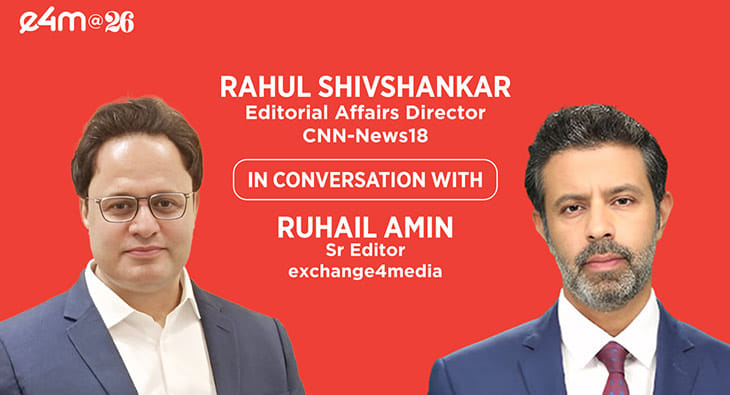

At a time when television news is being pushed to rethink its format, tone and relevance in a digital-first ecosystem, Rahul Shivshankar believes the fundamentals have not changed. Now serving as Editorial Affairs Director at CNN-News18, he sees the future of a winning news brand resting not in noise or novelty, but in credibility, factual rigor and lasting viewer trust.
In this conversation, Shivshankar speaks about newsroom priorities, the debate around loud television, the changing meaning of prime time, the role of AI, the question of objectivity and why legacy television still matters in an age dominated by digital platforms and creator-led news cultures.
You have recently taken over as Editorial Affairs Director at CNN-News18. As you begin leading the newsroom end-to-end, what are your top priorities?
There are really three things that matter to me at this point. The first is growth, because every newsroom has to remain competitive and relevant in a rapidly shifting media environment. The second is credibility, which has to be protected very zealously. And the third is impact, because stories must shape the conversation in some meaningful way. That, in turn, improves reach, deepens viewer engagement and gives people a reason to come back to you.
These three things work in tandem. Without credibility, there can be no impact. Without impact, there can be no growth. That is the framework I am working with. We are also a legacy brand and we carry the CNN association, so there is responsibility attached to that identity as well.
A common criticism of television news is that the intensity of presentation can sometimes overpower the substance of the story. How do you look at that concern? Do you think news television has, at times, leaned too far into that style?
I think one has to place that question in the context of the country we live in and the nature of our democracy. India is a deeply expressive society. There is a lot happening around us, and sometimes you do have to be loud to be heard. In many ways, loudness is an extension of democratic freedom. We are a contested democracy, and in such a space, passionate and zealous expression is inevitable.
If you look at Parliament, for example, it is noisy, often chaotic, but it is also where important democratic work gets done. Even outside politics, public discourse in India has always been more energetic, more animated, more expansive. That is part of the culture. So, some amount of loudness comes with the territory.
That said, there is a difference between being loud in order to express yourself and being loud in order to shout someone down. The former is part of democratic energy. The latter is problematic. The real challenge is in maintaining that balance. There have certainly been times when television news has crossed that line, but I also think the medium has evolved and there has been some reining in over time.
Do you think part of that evolution is also tied to the fact that television news in India is still relatively young compared to older broadcast cultures in the West?
Absolutely. If you look at the West, live television and talk radio have existed for decades, going back to the 1950s and 1960s. Those media cultures had time to evolve, experiment, overreach and then self-correct. India’s private electronic media landscape is much younger. In a real sense, it has only been around for about 25 years.
Before that, the dominant experience was state broadcasting. So, when private television news expanded, it did so very quickly and under intense competitive pressure. Naturally, there were phases of excess and phases of correction. The West also had its own rambunctious periods, and there too, viewers eventually pushed back when they felt the media had crossed the line. India is going through a similar maturation. We have learned very quickly, and we are still learning.
We now live in a digital-first news universe. In that environment, how do you view the traditional idea of prime time? Does it still carry the same significance?
I think the definition of prime time has changed dramatically. Traditionally, prime time carried prestige because it was associated with the biggest audience on television and, by extension, with the most experienced anchors. But that old hierarchy is breaking down.
Today, someone can build a strong audience on YouTube or on another digital platform without having spent decades in the profession. That does not automatically make them credible, of course, but it does show that audience behaviour has shifted. Appointment viewing is no longer what it once was. Viewership is fragmented, and content travels across platforms all the time.
My biggest learning after returning to lead a newsroom is this: all time is prime time. Every moment matters because everything you say can be clipped, shared, amplified and judged digitally. So, it is no longer just about one coveted evening slot. You have to be at the top of your game at all times. On television, on digital, in every appearance, every hour matters now.
In that sense, credibility matters more than seniority or even the traditional prestige attached to a particular slot?
Absolutely. Credibility is not a function of age. You can spend 30 years in journalism and still not command trust if you are careless with facts. On the other hand, someone younger can build credibility if they are faithful to fact and conduct themselves with seriousness in the newsroom and on screen.
So yes, hourly differentiation has changed. The old idea that prime time alone defines journalistic authority is now tired. The real differentiator is whether the viewer trusts you.
In a fast-moving news cycle, what matters most to you?
Speed matters, but never at the cost of accuracy. Personally, I do not obsess about being first. If you have an exclusive, you will be first by default. But if something is moving fast and the facts are still unstable, I would rather hold back than rush into a wrong story.
Let me put it this way: sometimes even a source that appears authoritative can get it wrong. In such moments, the pressure to run with something because everyone else is doing it can be intense. But I would still prefer caution. I would rather let others break it and wait until I am absolutely certain.
At the end of the day, credibility matters more than speed. Speed can be dangerous. If you are accurate and factual, and if your story is built on hard facts, then you can still tell it beautifully and people will come to you, whether you are first or last. That is precisely why I have always returned to the idea of the hard fact. Every strong argument, every durable story, is built on that foundation.
Is English television news under pressure to reinvent itself?
Yes, certainly. The first requirement now is relevance. Many of the older formats do not work in the same way anymore. Audiences increasingly want reality. They are less attracted to news that feels overly structured, excessively curated or too processed.
I often compare it to processed food. When something is over-treated, it loses nutrition. News can suffer from the same problem. If it is too massaged, too spun, too carefully manufactured, people begin to feel that it has lost its meaning. They want transparency. They want emotion and opinion in a form that still remains truthful, intelligible and responsible.
That is one part of the reinvention. The other is editorial range. For a long time, television was dominated by politics, politics and more politics. India remains intensely political, and politics will always matter, but audiences now engage with many other themes, and digital creators have shown that there is a large appetite for unconventional subjects and more grounded human stories.
The interview culture itself has changed. Earlier, there was a fixation on top politicians, celebrities and cricket stars. Today, some of the most compelling conversations come from people with real stories, people connected to life and society in more immediate ways. Television needs to keep adapting to that shift.
AI has entered the newsroom in a big way. How do you see it changing television news?
At the level of field reporting, AI has clear limitations. A reporter on the ground will always see and sense things that AI cannot. The human reporter remains indispensable at the frontline of news gathering.
Where AI can make a real difference is inside the newsroom. There are many functions that are process-driven and time-consuming: translation, research support, script checking, copy flow and similar tasks. AI can replicate or accelerate several of these processes. In that sense, it can be a force multiplier. It can help news organisations do more in less time.
But it still requires oversight. You need experienced people to review what AI produces, to ensure the facts are correct, the framing is sound and the perspective is not distorted. AI cannot yet independently generate reliable journalism. Nor can it offer the kind of historical perspective, judgment and analysis that good editors and reporters bring to the table.
And when it comes to on-air personalities, I do not see AI replacing anchors in any meaningful sense. Viewers connect with people, with spontaneity, with intellectual rigor, with emotional intelligence. Those are profoundly human attributes. AI, at least for now, is too synthetic for that. It may assist, but it cannot substitute the human presence that serious journalism still depends on.
One debate that returns again and again is around objectivity. Many anchors and editors are asked where they stand. Is there anything wrong with taking a stand?
I think human beings take positions, consciously or unconsciously. That is simply part of the human condition. If a child falls into a tube well or innocents are dying in a war, how long can one hide behind a mechanical notion of objectivity? Emotion does enter the journalist’s internal world.
The key is to ensure that emotion does not cloud judgment to the point where fact is abandoned. You can take a stand, but the stand must rest on a solid factual foundation. Two lawyers can read the same FIR and reach two different conclusions. That happens because interpretation varies, even when the factual material is the same.
It is similar in journalism. You may choose one side of an argument, but not by distorting fact. You must acknowledge that the other side exists. You must allow it to be heard, especially in a debate format. Then the viewer can say, this is a healthy, constructive exchange and now I can make up my own mind.
So yes, a journalist can take a stand. But that stand must emerge from hard facts, not from fantasy, prejudice or rhetorical excess.
After two decades of rapid change, does television still carry the kind of influence it once did, or do you believe its impact is gradually fading?
I would actually argue that television remains highly relevant, perhaps even more so in certain ways, because the information ecosystem has become so crowded and so unregulated. There are now countless YouTube channels, Instagram creators, viral posts and anonymous forwards competing for attention.
In that environment, legacy media still has a place if it can deliver on three things: credibility, rigorous fact-checking and scale. That is where a television newsroom differentiates itself. A legacy news brand carries institutional experience, editorial systems and legal accountability. It verifies, checks and is answerable.
That matters enormously. If you receive something on WhatsApp, for instance, you often do not know who created it, where it came from or whom to question if it turns out to be false. There is no real line of accountability there. In formal media, however imperfectly, there are standards and there are consequences. That remains a major distinction.
So yes, television still matters, but only if it does its job honestly and maintains standards.
News consumption is also increasingly personality-driven. Audiences often follow anchors as much as they follow brands. Do you see that as a defining trait of the current media landscape?
It certainly exists, but it is no longer unique to television. Personality-led followings now exist across YouTube and other platforms as well. People build audiences around voice, style, quirks and consistency.
But personality without credibility has a shelf life. Someone may attract huge attention briefly with sensational or viral content, but over time people begin to examine whether that person is actually trustworthy. If they are repeatedly found to be misleading, their authority weakens, even if the entertainment value remains.
A real media personality is not created overnight. It comes from remaining relevant over a long period, from developing a connection with audiences, and above all from staying rooted in fact. That is the point at which a personality becomes durable rather than merely fashionable.
Finally, what, in your view, will define a winning news brand in the years ahead?
Credibility, credibility and credibility. That is really it.
There was a phase when sensationalism, rhetorical flourish and narrative manipulation attracted attention. But I think that phase is fading. People increasingly want to know. That is the operative word: know. They want news that helps them make sense of events, not just react emotionally to them.
That is also why the CNN-News18 positioning has been built around that promise. You can only make sense if your argument is robust, fact-based and credible. Going forward, that will be the defining differentiator for any serious news brand.
Read more news about Television Media, Digital Media, Advertising India, Marketing News, PR and Corporate Communication News
For more updates, be socially connected with us onInstagram, LinkedIn, Twitter, Facebook YouTube & Google News