Rebirth of linear TV: Valentina Kulikova on future of Smart TV, magic of content in AI age
Media expert Valentina Kulikova explains how television is evolving amid internet competition, AI disruption, and the science of creating hits
 by
by
Published: Jan 21, 2026 11:01 AM | 10 min read
 Follow Us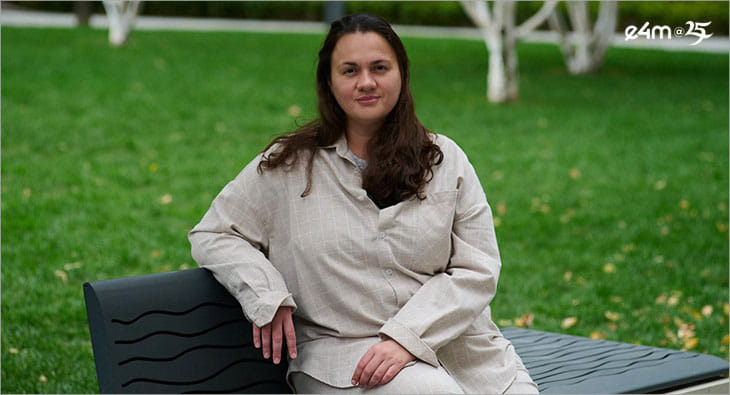

In an era when we scroll through news feeds faster than we can process them, television seems like something from the last century to many, especially the younger generation. But the magic of the ether hasn't disappeared. Television projects still attract millions of viewers and millions of views on platforms, create common topics of conversation, and shape cultural codes.
How does television withstand fierce competition from the internet, how has it changed in the age of artificial intelligence, and what are the laws that govern the creation of hits? We addressed all these questions to someone who knows the industry from the inside. Valentina Kulikova is a media manager, operations director, and strategic consultant in the field of media. She has over 15 years in the industry, managing large-scale projects with budgets exceeding $150 million and teams of over 300 people.
She held the position of Deputy CEO of FRIDAY! TV channel, played a significant role in launching Saturday! TV channel, and oversaw the production launch of over 50 TV shows. Valentina was previously a member of the Organizing Committee of the XXII Olympic Winter Games and XI Paralympic Winter Games of 2014 in Sochi, working in the Communications Department, heading Official Information Resources and overseeing the Organizing Committee’s official media content production across the pre-Games period, the Olympic Torch Relay, and Games time. Since 2021, she has been advising international media and digital companies as a strategy and operations consultant.
Valentina, how did you end up working in television? Was this your dream, your goal?
Actually, I'm a mathematician by education; my specialization is mathematical methods in economics. I never aimed to work in television; I worked in a completely different field, in a Moscow branch of an international company. In that company, I rose to the position of deputy CFO in a year and a half. It was my first job, and it wasn't easy to decide to leave when the opportunity to work in television came up. And my bosses tried to keep me, even doubling my salary to get me to stay. But here, I could say, the forces of nature intervened. One late evening, I was sitting in the office, pondering what decision to make. There was a thunderstorm, and suddenly a window in the office blew open, and a gust of wind ripped down part of the suspended ceiling – right above my desk, I barely had time to duck. I'm not a superstitious person, but I saw it as a sign: maybe it's time to try something new. I had such a strange path to television, but as soon as I got there, I fell in love at first sight.
What were your first impressions when you found yourself in this new world?
I joined the NTV channel's Prime Broadcasting Department in August 2007, becoming the program manager of the information and analytical television project "Programma Maximum." But at the same time, I immediately got involved in the New Year's project pre-production. Therefore, I was facing a nearly round-the-clock work schedule for the coming months. On the one hand, it was a challenge because I didn't expect such a pace in the first months. On the other hand, it was so interesting that it was worth all the effort, time, and nerves.
You were a member of the organizing committee for the Sochi Olympics and headed the information resources department of the communications block. How did you end up on the team for such a significant event, and what was your role?
One morning, after seeing another piece of news about preparations for the Olympics, I thought about how massive this event was and caught myself thinking that I really want to be involved in it, and perhaps my skills and experience could be useful there. I understood how challenging this project was, but an opportunity like this comes along once in a lifetime. I remember telling everyone for several months that I wanted to work for the Olympic project – and at some point, I heard that they were looking for a specialist with a profile similar to mine for the team, and I was able to secure an interview for that role.
I was involved in official media communications, oversaw the production of official content, developed the production plan, distribution model and led the creation of content for the Olympic Torch Relay. We created the main route content in a media truck that traveled along the torch relay route, right ahead of the torchbearers: It ran for 123 days and covered more than 65,000 kilometres across all 83 regions of Russia – the longest national relay ever held for the Winter Games. The media truck is a mobile production studio: we filmed along the entire route and edited there as well. Where the medical truck couldn't reach, film crews went by boat or helicopter.
What's your fondest memory of working at the Olympics?
I'm often lucky with my team, but I've been doubly lucky with the Olympic project. We worked like a well-oiled machine, and everyone felt like we were working on a great, outstanding project. I believe that's what motivated everyone the most.
You played an important role in the development of two leading entertainment television channels, “FRIDAY! TV” and “Saturday! TV,” which featured many highly discussed and rated television projects. How would you describe your contribution to the development of the channels?
I’d describe my contribution as part of the broader team effort – the project succeeded because we all pulled in the same direction. When I joined FRIDAY! TV channel, it was in its active development phase – a rapidly growing startup with big ambitions to become a leading player in the entertainment segment. My task was to establish processes, channel creative energy in the right direction, and help unite people around a common goal.
I understood that it was very important to involve people in the project's development because the best results can only be achieved when the team truly loves their project and is motivated to develop it. We established team processes, launched two new content-production studios, and expanded internationally. I was responsible for launching the channel’s international broadcasting, which expanded to 15 countries at its peak.
Both channels, “FRIDAY! TV” and “Saturday! TV” have become strong and recognizable brands with an impressive audience in just a few years. What do you think is the secret to the success of these channels?
Right, both channels delivered significant results in the entertainment segment. Saturday! TV channel broke into the market with remarkable speed: a 58% increase in audience share, 50 million viewers, and a 160% jump in sponsorship revenues over two years. FRIDAY! TV channel cemented its status as one of the most dynamic entertainment brands in the country. Since its launch, the channel has consistently grown ratings and audience share, even when overall TV viewing in Russia declined. In 2019, it was the only federal multi-genre channel in the top 10 to show rating growth, and by the first half of 2022 its share was 53% higher than at launch. Its digital content has attracted 2 billion views, and by 2025 it has grown to become one of the top two entertainment channels in the country in its target audience.
The main secret, in my opinion, lies in the combination of vision, team, and deep work with the audience. We were incredibly lucky with our CEO, Nikolay Kartozia. He is a visionary who understands perfectly where the industry and the brand itself are headed. A strong team of like-minded individuals was assembled who shared the same values, understood the essence of the brand, and genuinely loved the projects they were creating. And after that, it all comes down to consistency and attention to detail: quality planning, a deep understanding of the market, and continuous study of the audience.
In your opinion, is there a formula for a successful project, or is it a new experiment every time? What makes a TV show a hit?
First, having a clear format that aligns with the audience's values. Secondly, and I'll never stop saying this: a great team that loves the project and understands the format. Well, "magic of content" – the creative component that elevates everything else. I also consider so-called impact storytelling to be an ingredient for success: when content doesn't just fill your time and allow you to "switch off," but also evokes emotions, makes you think, provokes lively discussions, and even leaves a mark on your life – for example, if you somehow identify with the show's characters.
If television used to be the main source of information and entertainment content, today YouTube and social media are increasingly taking on this role. Does classic TV have a future, or has it been completely replaced by digital media?
The channels I worked on were never traditional TV channels: on Saturday! TV channel, for example, the hosts were successful bloggers and social media influencers. On FRIDAY! TV channel, we launched the world's first official TikTok show on television, a joint project with TikTok's international office. It was a unique format: the participants were popular TikTokers, and their videos were judged by a star-studded panel. We tried combining television content with internet formats, especially during the COVID era when there was a particularly strong need to experiment with formats.
In this case, I'm not just considering television as one of the ways to distribute content; it's delivering content to the viewer in a linear programming format. Let me explain what I mean: so much different content is being produced now that it's increasingly difficult for viewers to choose what to watch. Choice takes time, which is why people are increasingly relying on recommendation algorithms. And this is where television becomes an alternative. Linear programming, Smart TV streams, and FAST channels are bringing comfort back to the viewer – when everything has already been chosen, selected, and structured for them. This isn't an outdated form; on the contrary, it's a response to choice overload.
You are currently working as a strategic advisor, and your activities are still related to television broadcasting. But how much has television itself changed in recent years? Specifically, how has artificial intelligence impacted the work of media companies, and what transformations related to it can we expect in the near future?
Actually, AI has been used on television for quite some time, and back in 2019, at the FRIDAY! TV channel where I worked, my team, in collaboration with GPM Data, introduced an AI-based video tagging system technology that allowed us to speed up content processing tenfold. We started the project in 2019 and it was launched later in 2023. In the creative industries, tools that can free the team from routine tasks and free up time for more complex creative challenges are very useful, and that's what makes AI tools valuable.
Regarding concerns about some professions being taken over by artificial intelligence, I don't think there's anything to worry about, because according to research, it will create just as many new professions in the process. Of course, there are many ethical considerations, such as the risk of deepfakes, and these issues need to be carefully addressed. Overall, AI is another challenge for the industry, but it’s already being integrated at scale and is quickly becoming an industry standard — shaping both operational processes and monetization models to drive maximum efficiency. We are living in times of change, and that is always difficult on the one hand, but also exciting.
Disclaimer: The views expressed here are solely of the participants and do not in any way represent the views of exchange4media.com.
Read more news about Industry Briefing, Internet Advertising, Marketing, PR & Corporate Communication, Television Media
For more updates, be socially connected with us onInstagram, LinkedIn, Twitter, Facebook YouTube & Google News