The Troubleshooter: Inside Ajay Padmanabhan’s comms & reputation management journey
Ajay Padmanabhan, VP & Head-Corp Comm & PR, IntelliSmart Infrastructure shares his communications journey, leadership experience, insights on building strong brands, the impact of AI, and more
 by
by
Published: Jan 29, 2026 12:21 PM | 9 min read
 Follow Us
Excerpts:
How did you come across the communications industry, and what inspired you to join it?
"Life me ye nahi kar raha hu toh kuch nahi kar raha hoon” - With this realization I entered into the industry…
My entry into PR was quite accidental and not by choice. I actually started out in a very different space. I did my graduation in mathematics and then went on to pursue my CA course. From there, about 24 years ago, I started a tech company with a friend. We ran it for almost seven years, but eventually realised that things weren’t going the way we had planned. So we made a conscious decision to step away from it.
After that, I joined CII, and that’s when Perfect Relations happened. I’d say it was pure serendipity. I was looking for something exciting, and during that phase, I had a conversation with Mr. Rajesh Guram, one of the regional heads at Perfect Relations, now Dentsu Creative. He made PR sound incredibly exciting. He was my first boss in public relations and a mentor to me. The way he explained the communication industry made it all come alive. I quit my job and joined Perfect Relations, which truly became my learning ground. I learned the ABCs of PR there around the legendary Dilip Cherian, along with some amazing leaders like Valerie Pinto.
I’ve never had any shame in asking for help or saying, “I don’t know”, something I still do even today. If someone can help, why not ask? Perfect Relations really shaped who I am today as a PR professional. I spent four and a half years there and I truly define it as one life-changing experience.
.jpg)
From the agency side, how did you experience the shift to the corporate communications world?
From the agency side, my move to Suzlon was a big learning curve. It’s a great brand with some of the most brilliant people I have worked with and every day was inspirational. Like many large organisations and brand, Suzlon faced constant scrutiny and issues driven by vested interests, which is common once brands grow bigger. They were looking for someone with crisis management and stakeholder capabilities, and I had the opportunity to work with an amazing leader like Nick Archer, who brought global exposure and a very strategic mindset. Chintan Shah, a well-respected industry veteran, taught me the nuances of strategy, advocacy and policy engagement.
What I brought with me from the agency to the corporate side was a strong skin-in-the-game approach. I had learned that many organizations still drive their communication positioning purely based on coverage, without looking at the larger narrative or the full spectrum of stakeholders. You must treat all stakeholders intelligently, super intelligently. We’re also at a time when there are no walls. You can’t hide anything. Anything you do or say must be done with the mindset that it’s happening in public.
At Suzlon what stood out was that PR was seen as a strategic function, not just press releases and coverage. Working there felt like moving from a degree to a post-graduation. I kept learning, understanding the importance of corporate communication, narrative-building, positioning, and leadership impact. Despite challenges, Suzlon stayed clear on its story, maintained stakeholder trust, and that’s where I truly learned the ropes of corporate communication.
How has your journey been at IntelliSmart Infrastructure?
It’s been a rollercoaster. IntelliSmart is driving by far one of the largest digitalisation drives in utilities anywhere in the world, in terms of size and scale. This initiative is empowering nearly 25 crore homes, along with commercial establishments, government bodies, schools and colleges. From the start, we knew this was an ambitious change-led project, and change is never easily accepted.
We kept our messaging simple and honest, mapped the stakeholders. Approached stakeholders very differently, right from communities, who are our biggest stakeholders, to elected leaders, government and DISCOM officials, ministries and policymakers, while also navigating vested interests. A big enabler has been leadership with a clear vision and trust. My MD & CEO, Mr Anil Rawal is a visionary leader, guiding us in navigating this program with clarity and foresight. He understands the strategic importance of corporate communications & PR and leverages it as a key driver of trust and transformation. When objectives are clear, you are trusted and given the freedom to deliver, it allows you to truly leverage your skills and make an impact.
You’ve managed reputation and crisis management across sectors. What strategies work best for building and sustaining a strong brand image in today’s challenging environment?
Every brand, big or small, is constantly under attack. Fast and effective redressal is critical today because people won’t wait. Reputation management isn’t just about reacting when something happens; it’s about preparedness. You need to plan, prepare, and practice, something most organisations don’t do.
Second, while PR and corporate communications teams are custodians of the brand, every employee is a brand ambassador and their conduct matters.
Third is proactiveness. We’ve traditionally been reactive, defending and clarifying after an issue arises. Today, your guard has to always be up. Threats can come from completely unknown quarters, even short sellers, impacting even the biggest brands. So, you need a ready crisis plan, risk matrix mapped, a clear message house, internal and external communication strategy, mock drills, active monitoring, and a proactive mindset to understand who could come after you and prepare for it. In today’s environment, offense often becomes the best defence. That’s the mindset organisations need to adopt to protect and preserve trust and reputation.
.jpg)
In today’s digital-first environment, there is a lot of fear around AI taking over jobs and replacing communication professionals. How do you see AI impacting the communication industry?
AI is an inevitable truth and it’s already here. The future we keep talking about has arrived, so the real question is whether you want to fight it or make it your ally. Today, decision-making across functions is data-driven, and communication is no exception. Earlier, marketing and communications teams were dominated by creative and language experts. Now, in large marketing teams, a significant portion consists of data professionals, and nobody imagined these skills would become central to marketing.
AI is real, and it may replace human roles in many sectors. But PR is different. It can’t be replaced because of one simple thing: jugaad. PR thrives on connecting invisible dots, improvisation, instinct, emotion, and lived experience. It’s not binary or black and white. You can load machines with data and past experiences, but ultimately, it’s the people, men and women in the room, who define outcomes.
If anything, PR is one sector where, if we ride the AI wave and treat it as an enabler, we can do wonders. But machines completely take over our profession? An emphatic, No. That’s not happening.
.jpg)
In today’s ever-evolving communications landscape, storytelling has become an integral part of every strategy. What are the key components of storytelling that professionals should integrate while curating their narratives?
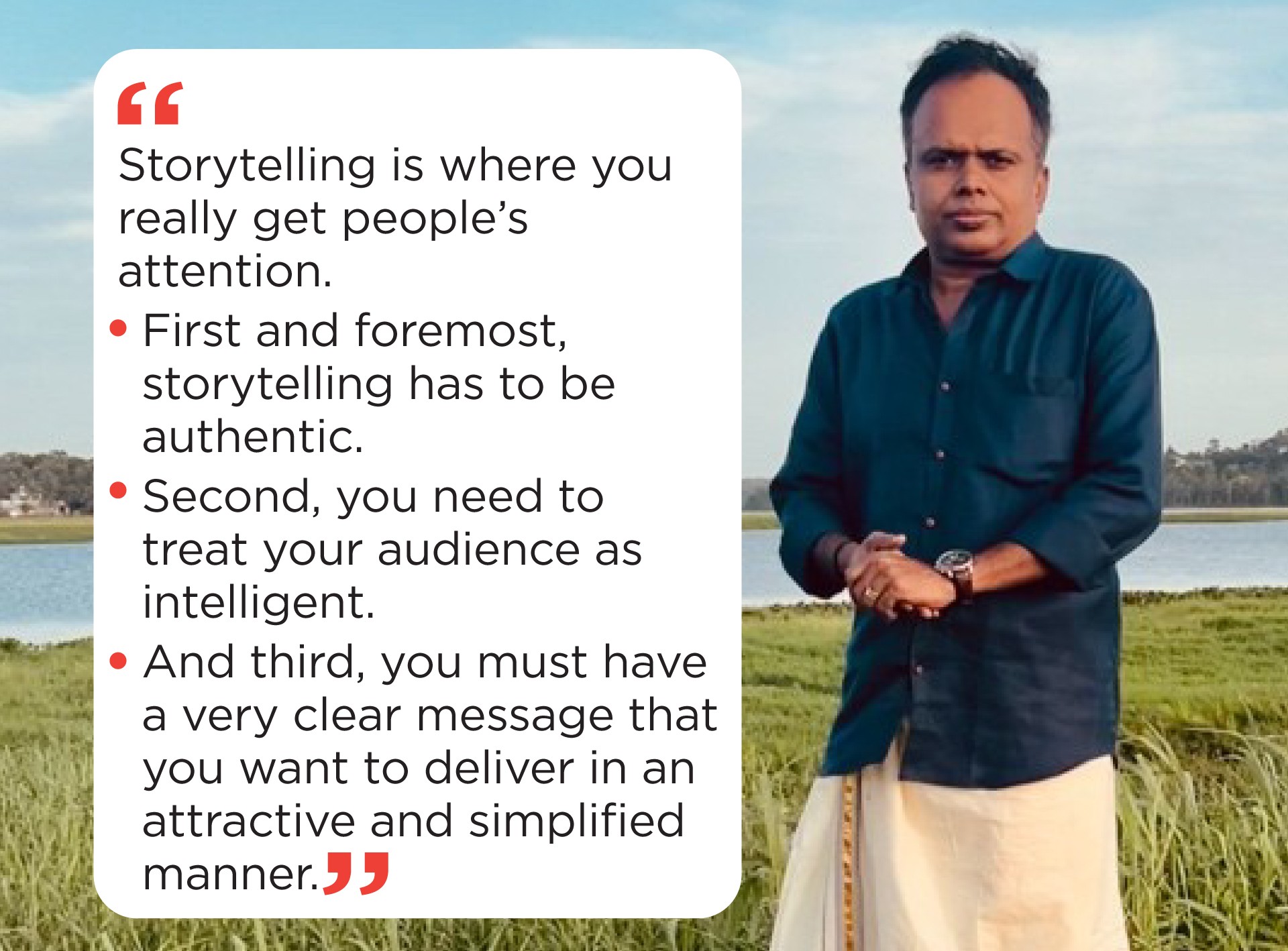
If you look at why podcasts have seen such a surge in listeners, it’s because most of them are strong storytellers who present ideas in an interesting manner.
A lot of times, storytelling takes a beating because it becomes overly orchestrated. That spontaneity, genuineness, and authenticity matter. When you bring in these elements, it really works. Audiences are diverse in nature, but everyone loves a good story. If you look at any culture or civilisation, our ancestors have always relied on storytelling. There is always a message embedded somewhere, and that understanding comes through stories. The inherent emotion, authenticity, empathy and embedded message, the formula hasn’t changed. The way we present it or curate it for a certain audience may have evolved, the logistics may have changed, but fundamentally, storytelling remains the same.
As we look at the future, what are some of the trends or developments that excite you most about the communications industry?
First is transparency and the lack of it, or erosion of it, will be the most expensive pay out for any organisation. Moreover, going forward, decisions backed by data are going to be the new game.
Most importantly, this is one segment where we should not look at replacing people with machines. Communications professionals are intrinsic to the success of organisations. Irrespective of the challenges, they are always out there fighting for the organisation. That spirit and the importance of their role need to be acknowledged. They deserve a seat at the big table.
I’ve experienced this first-hand in Suzlon. I joined as an AGM, and within a short span, I was given the responsibility of leading public relations for the India Business because the leadership saw the value this function brings. Leaders at the top need to recognize how to leverage communications effectively.
Going forward, this function will become even more critical. No matter your size you are big, small, or medium, thanks to the growth of social media, you are constantly going to be under attack. You need a strong line of defence that prepares and protects you, ensures you are understood, and makes sure your messages and narratives are clearly delivered.
What are some of the key lessons from your journey that you would like to pass on to aspiring professionals entering the communications industry?
.jpg)
We often hear about work-life balance, but this is one domain where you have to find your 100% work and 100% life and balance them together. I started my journey as an entrepreneur with very little money, but with some good friends and a strong belief that you can do anything if your mind is set to it. The learning was tough, the climb was steep, but one thing I learned early on is that worrying doesn’t improve the situation.
Most importantly, ask for help, shamelessly. I have no hesitation in saying that. People are willing to help; you just have to ask. Be open to saying, “I don’t know, help me understand.” That’s the message I’d like to leave with the younger professionals who are planning to enter this warrior clan.
Read more news about PR and Corporate Communication News, Internet Advertising, Marketing News, Digital Media News, People Movement News
For more updates, be socially connected with us onInstagram, LinkedIn, Twitter, Facebook YouTube & Google News