Is CTV overhyped? Auto marketers debate the Bharat growth play
Auto marketers debated whether CTV and digital OOH are truly driving growth in Bharat, at the e4m Automotive Marketing Summit
 by
by
Published: Mar 6, 2026 12:19 PM | 12 min read
 Follow Us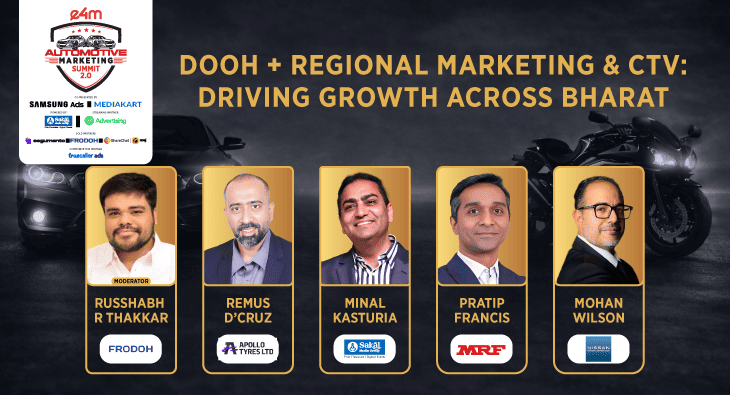

India may have 600 million smartphone users, but only a fraction of them are actually transacting. So where should auto brands place their bets: legacy print, high-impact DOOH, or the sharply targeted promise of Connected TV (CTV)?
At the e4m Automotive Marketing Summit, brand leaders debated whether CTV is the future of automotive marketing or simply the industry’s latest obsession.
Under the theme “DOOH + Regional Marketing & CTV: Driving Growth Across Bharat,” the panel moderated by Russhabh R Thakkar, Founder & CEO, Frodoh explored how language, localisation, data, and content authenticity are redefining growth strategies in India’s most competitive category.
It featured insights from Remus D’Cruz, Global Head – Brand Strategy, Apollo Tyres; Minal Kasturia, National Sales Head, Sakal Media; Pratip Francis, Head of Brand Marketing, MRF Tyres; and Mohan Wilson, Director – Marketing & Corporate Strategy, Nissan Motor Corporation.
Thakkar set the context by drawing an analogy around the growth of regional consumption and the rise of CTV (Connected TV) and digital out-of-home formats. He pointed out that consumers in the 35–40 age bracket have traditionally grown up watching television and reading print. “Now that consumption has increased on CTV and they’re watching ads on OTT, which is a completely new medium, a new screen, and they are also seeing ads on digital out-of-home in bars, restaurants, signals and malls.” he said.
He opened the discussion by asking the panel what the single biggest shift in regional demand and consumption has been, and how that impacts media allocation across print, linear TV, CTV and out-of-home.
D’Cruz said that media mix decisions depend on the campaign and business priorities at hand. “Going regional, depending on the product category, is something that’s becoming increasingly important for us,” he said.
He added that digital has expanded the scope for personalisation. “The fact that digital gives you the space to personalise content definitely helps. That’s the shift we are seeing in our organisation, where we’re going regional and are able to personalise content both for the consumer as well as for our business partners.”
Wilson echoed the importance of regional marketing, especially beyond metros. “In metros, we build a lot of national communication. We build aspiration. But when we come to tier-two, tier-three, tier-four markets or smaller regional markets, we see more customers wanting communication in a locally relevant way,” he said. That, he explained, means going far more vernacular than before.
Referring to a recent launch, Wilson noted that Nissan created 22 different print editions and adopted fully localised communication in digital as well. While consumers in smaller markets still look to metros for aspiration, he stressed that language, themes, activation and storytelling must reflect local realities. “We can see a big shift towards localisation when it comes to marketing, and across segments as well,” he said.
Francis offered a different lens, explaining that MRF broadly categorises tier-one metros separately from the rest of India. “We are seeing a clear divergence when it comes to media consumption,” he said. However, unlike some brands, MRF does not differentiate creative across regions. “We stick to the same creative, one of the reasons being consistency, but we use different media vehicles for rural parts of the country versus metro cities.”
He observed that while English newspaper readership may be declining, vernacular publications are gaining ground. “We tend to focus more on that for the rest of India,” he said.
On DOOH, Francis admitted that the brand has not fully committed yet. “We haven’t really jumped onto that bandwagon because we see a lack of transparency,” he said, pointing to issues around share of voice and measurement in an unorganised market. “How do you track it? That’s where there is a lack of transparency which we are not comfortable with as a brand.”
On CTV, however, MRF takes a sharper segmentation approach. Rather than differentiating by region, the brand distinguishes between premium and non-premium audiences.
Building on the CTV discussion, Thakkar highlighted that while India may have 500–600 million smartphone users, the transacting audience is closer to 60 million, roughly in line with the CTV user base. He asked Wilson whether there is a clear mix between linear and CTV buys.
“For us, it’s very important to be very targeted,” Wilson responded, noting that Nissan is a niche brand in India. “When we go to TV, we usually do CTV. That’s much more important because targeting is much clearer. We have data-driven insights in terms of planning content.” He added that content consumption itself is shifting. “You can see a big shift towards CTV and CTV content consumption.” For Nissan, connected TV plays a central role in planning, targeting and deriving insights to shape marketing strategy.
From a regional publisher's standpoint, Kasturia pointed to data to illustrate consumption nuances. “If you look at four-wheeler sales and minus taxis and commercial vehicles, Pune is larger than Mumbai,” he said. For certain brands targeting commercial operators, Mumbai may be critical. But for others, he suggested, Bharat might deliver more than India in specific cases. “Marketers have to look at these data points and see whether Bharat is delivering more than India in that particular case,” he noted.
The conversation then moved to dealers as a key touchpoint, with Thakkar asking whether dealers actively push brands to invest in regional media and CTV.
“The dealer is never happy. He’ll always want everything and more,” D’Cruz said candidly. While dealers expect visibility across media, he views them as conversion points and opportunities for engagement. “I look at it as an ego play. How do I get him involved in the communication?” he said, citing campaigns where dealers are integrated into creative assets. Leveraging digital tools and AI integrations on platforms like WhatsApp, Apollo Tyres has experimented with embedding dealers into ads.
Francis, however, clarified that MRF does not factor dealers into ATL strategy. “We don’t really consider the dealer when we look at ATL strategy or tactics,” he said. Instead, the brand’s communication is product-specific and platform-led. Highlighting the relatively small base of private car owners in India, he said that CTV is used strategically to target four-wheeler owners. “We cater the creative to the audience and where they are,” he explained.
Wilson noted that dealers ultimately seek visibility and showroom traffic. “As long as we can contribute to that, dealers are happy,” he said. That includes multi-channel visibility across digital, social, print, out-of-home and CTV.
He also distinguished between traditional and digital OOH based on context and attention span. On highways, where attention spans are limited, static OOH works best for awareness and simple calls to action. In experiential environments such as airports, digital OOH enables deeper engagement and can drive consumers into digital ecosystems through microsites or social extensions.
When asked how brands move beyond reach and impressions to justify sustained investment in CTV and digital OOH, Wilson emphasised a full-funnel KPI framework. “We look at the full funnel, from awareness to purchase, in terms of showroom traffic or call centre enquiries,” he said.
Beyond lower-funnel metrics, Nissan also tracks brand sentiment and search behaviour. “Reach can sometimes be misleading. It’s important to understand whether it is driving traffic or helping create a certain level of brand sentiment.” A full-funnel approach helps assess both short-term performance and mid- to long-term impact on business outcomes.
Next, the discussion shifted to attribution. The moderator asked the panelists if CTV is still largely wishful thinking for many marketers, or can its impact be clearly measured?
D’Cruz acknowledged the complexity of measurement in high-involvement categories. “Unlike quick commerce or fantasy gaming, this isn’t an instant purchase,” he said, explaining that immediate reactions are unlikely.
Instead, Apollo Tyres focuses on long-term brand equity. “What we are looking to do through our campaigns is build equity, build that share of heart. It’s not going to be measured in terms of pure value immediately. You give yourself a window and then look at what your market share increase is. That’s the true measure of any campaign.”
He cautioned against over-reliance on surface metrics. “Impressions and engagement rates are largely a function of how much money you’re willing to spend,” he said. While categories offering instant incentives can see real-time attribution, automotive and tyre purchases require patience.
D’Cruz also highlighted how regional storytelling has been consciously embedded into campaigns. Referencing a recent initiative, he explained that there was a deliberate effort to ensure a north-south-east-west representation. “There was a thought process to have that connect: a story from Punjab with a rural play, someone from central India, from Bombay, and so on,” he said, adding that regional content nuances may not always be visible to everyone but do exist within specific cohorts.
The conversation then widened to whether marketers might be over-indexing on CTV and digital OOH at the cost of legacy formats.
Kasturia chose not to directly address whether the industry is overestimating growth in new formats, but made his stance clear. “Legacy media is here to stay,” he said. Citing research, he noted that over 72% of consumers are more likely to respond to or make purchase decisions when addressed in their own language. “People in India are very proud of their language, especially in Bengal, Maharashtra and South India,” he said, adding that regional identity continues to shape media effectiveness.
From an automotive standpoint, he pointed out that the sector is one of the largest and fastest-growing verticals for legacy brands like Sakal.
Thakkar then turned the discussion towards improvement, asking what media platforms could do better to support marketers.
Any platform that enables deeper audience understanding adds value, said Wilson. “As a marketer, I always ask: who is the audience and how can I target them best?” he said. With multiple audience cohorts in each campaign, media selection depends on targeting capabilities, consumer insight tools, and measurement frameworks. “Understanding who is watching, how to target them, and how to measure that is very important. Then we can make informed decisions.”
He added that even traditional formats now require digital integration. “When we do print, we connect it with digital and social,” he said. While reaffirming the importance of print in India, Wilson stressed that campaigns must mirror how consumers actually consume media today, which is in a connected manner.
Francis shifted the focus to industry-level measurement challenges. “I think the time has come for all of us to come together and ask for an IRS again,” he said, referring to the Indian Readership Survey, last conducted in 2019. He questioned the absence of updated readership data, especially after COVID disrupted print consumption patterns.
“In digital, you get data. In DOOH, you get data. Even in traditional OOH, there are trackers,” he said. “But why is no IRS being done? Why is no one asking for it?” For Francis, the lack of updated readership research is concerning. He urged the industry to collectively demand updated metrics.
D’Cruz agreed that print and traditional media continue to play an important role in the ecosystem. “I won’t say we’re over-indexing,” he said. He acknowledged MRF’s consistent print presence, describing it as “clockwork, religiously consistent”, suggesting that such regularity indicates effectiveness. However, he admitted that quantifying the extent of impact remains difficult.
As the session neared its close, the panel summarised what would truly distinguish their brands in regional Bharat.
Wilson emphasised experimentation. “Unless you do things differently and test and trial, you won’t really stand out in how you communicate and in achieving business aspirations.”
Francis offered a striking example that reshaped MRF’s digital thinking. Citing data shared by Google, he revealed that the largest auto influencer in India is not a mainstream automotive publication or well-known reviewer, but a YouTube channel called “Promotes Life”. The creator, based in a rural part of the country, posts long-form tractor videos that garner up to 180 million views.
“He is the most subscribed, most followed, most watched auto influencer in the country,” Francis said. The insight forced the brand to reassess assumptions about digital consumption.
Kasturia distilled the regional play into a simple principle. “If you want to reach India or Bharat, you have to communicate with your target audience in their language,” he said. While mediums may vary, be it CTV, legacy media or digital, local influence and regional language will remain critical drivers.
Closing the discussion, D’Cruz brought the focus back to fundamentals. “The most important thing is content,” he said. Authenticity, clarity of target group, and relevance of storytelling must precede media selection. “If you don’t get the content and authenticity right, then the media you choose doesn’t matter. Start in the right space, get your TG right, and make sure you have the right content. Everything else will flow.”
Read more news about Marketing News, Advertising News, PR and Corporate Communication News, Digital News, People Movement News
For more updates, be socially connected with us onInstagram, LinkedIn, Twitter, Facebook, YouTube & Google News