Disrupted start, December recovery: What Q3 says about FMCGs
After a GST-disrupted October and patchy November, India’s FMCG majors closed Q3 FY26 on firmer ground, with December-led recovery lifting revenues and profits
 by
by
Published: Feb 18, 2026 9:04 AM | 6 min read
 Follow Us

India’s FMCG majors ended Q3 FY26 with steady year-on-year growth, with performance shaped by both GST-related adjustments and consumer demand trends. While most companies reported improved revenues and profits, management commentary across the board suggested October was disrupted, November was partly impacted, and December delivered the clearest signs of recovery. The result is a quarter that looks positive in the headline numbers, but mixed underneath, with divergence across categories, margin profiles and advertising strategies.
Topline growth was broad based
Among the largest players, ITC reported revenue from operations of Rs 21,706 crore in Q3 FY26, up from Rs 20,349 crore in Q3 FY25. Hindustan Unilever (HUL) followed with Rs 16,197 crore, compared to Rs 15,322 crore a year ago.
Patanjali reported revenue of Rs 10,483 crore, up from Rs 8,996.9 crore, reinforcing its position as a high-scale FMCG player.
In the next cohort, Nestlé India reported Rs 5,667 crore versus Rs 4,779.7 crore in Q3 FY25, while Tata Consumer Products posted Rs 5,120 crore versus Rs 4,443 crore. Britannia grew to Rs 4,969.8 crore from Rs 4,592.6 crore.
Among personal care and home care focused companies, Godrej Consumer Products (GCPL) reported Rs 4,099 crore versus Rs 3,768.4 crore. Dabur grew to Rs 3,559 crore from Rs 3,355 crore, and Emami posted Rs 1,151.8 crore compared to Rs 1,049.4 crore. P&G (India) remained largely flat at Rs 1,262 crore versus Rs 1,248 crore.
The topline picture indicates a fairly wide based recovery, but it also highlights the scale gap in Indian FMCG. The largest companies continue to add significantly more revenue in absolute terms, even when growth rates are similar.
Read: HUL Q3 FY26 ad spends pegged at Rs 1,522 cr; PAT down 30% YoY
Nestlé India Q3 FY26 ad spends rise 42% YoY
Patanjali Foods reports over 16% revenue growth in Q3 FY26
P&G Hygiene and Health Care: Ad spends down 8% in Q3 FY26
Profitability was largely positive, but not uniform
Most FMCG companies reported profit growth in Q3 FY26, signalling that operating conditions improved through the quarter after the GST transition disruption.
Nestlé delivered one of the strongest jumps, with PAT rising to Rs 998 crore in Q3 FY26 from Rs 688 crore in Q3 FY25. Britannia also reported higher profit at Rs 682.14 crore versus Rs 582.3 crore. Tata Consumer grew PAT to Rs 402.8 crore from Rs 299.8 crore, while Dabur reported Rs 553.6 crore versus Rs 515.8 crore.
Godrej Consumer Products posted PAT of Rs 498 crore, up from Rs 459.3 crore. Emami reported Rs 319.4 crore versus Rs 278.9 crore, and P&G reported Rs 301 crore compared to Rs 268 crore. Patanjali also saw a sharp rise in PAT to Rs 593.4 crore from Rs 370.9 crore.
At the top end, however, the picture was mixed. ITC’s PAT was flat at Rs 5,018 crore compared to Rs 5,013 crore last year, while HUL saw PAT decline to Rs 2,118 crore from Rs 3,027 crore, despite revenue growth.
Overall, the quarter reflected a broad profit recovery across the FMCG set, with a few large-company exceptions that stood out in an otherwise positive trend.
Advertising spend trends remain mixed
Where advertising data was available, spending was generally higher, though not consistently across all companies.
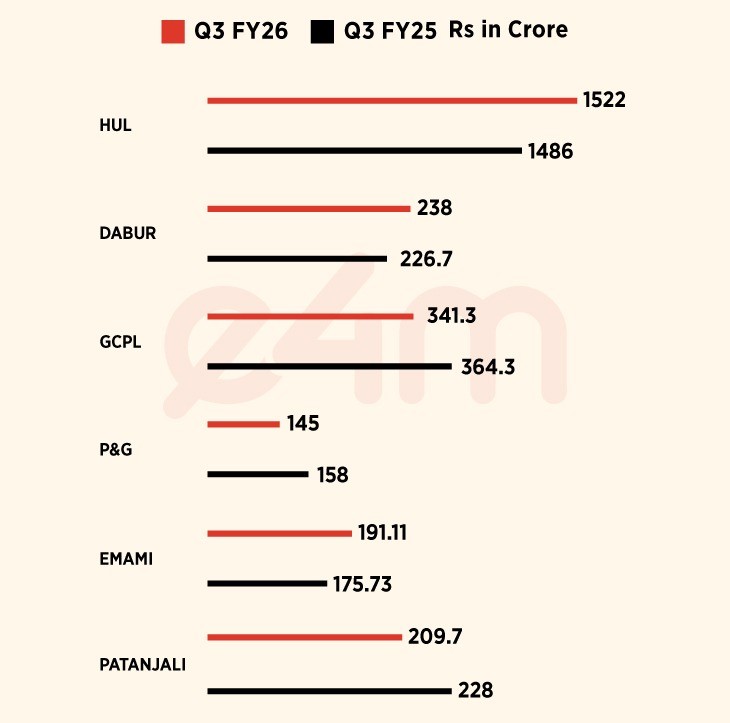
HUL reported ad spends of Rs 1,522 crore in Q3 FY26, up from Rs 1,486 crore in Q3 FY25. Dabur increased advertising to Rs 238 crore from Rs 226.7 crore. Emami raised advertising spends to Rs 191.11 crore from Rs 175.73 crore.
GCPL reduced advertising spends to Rs 341.3 crore from Rs 364.3 crore, even as revenue and profit rose. P&G also reduced ad spends to Rs 145 crore from Rs 158 crore.
Nestlé reported a 42% year-on-year increase in advertising, signalling a meaningful step-up in brand investments, though an absolute number was not provided in the dataset.
Tata Consumer’s management commentary also highlighted higher advertising and sampling, particularly for Capital Foods in the south and east, where it is still building consumer familiarity.
Overall, Q3 FY26 indicates that FMCG companies remain willing to invest in brand building, but there are clear signs of sharper efficiency and more selective spending, especially among personal and home care players.
GST cuts helped demand, but transition hurt October
Across earnings commentary, GST cuts emerged as the defining factor for Q3 FY26.
GCPL MD & CEO Sudhir Sitapati said most companies would report better results than the previous quarter due to GST. However, he flagged soaps as a category that remained affected and said the company saw the strongest benefits only towards the end of the quarter. He also noted that a cold winter and GST transitions meant the company got the best momentum only by December.
Britannia CEO Rakshit Hargave called the GST move beneficial in the medium to long term, but said the market was in a transition phase with prices in a state of flux.
Dabur CEO Mohit Malhotra described demand as gradually recovering following the GST rate cuts. He said October faced headwinds due to GST transition and trade disruptions, November was also impacted, and December was far stronger. He added that demand should improve further in Q4.
Emami’s management also noted sequential improvement after GST 2.0 disruptions, and expressed confidence that with GST at 5%, the company could return to close to double-digit growth. Emami also highlighted rural as the next key growth driver.
ITC, in its media statement, pointed to a broader macro environment turning supportive, citing lower inflation, interest rate reductions, income tax cuts, government expenditure, GST cuts and the India-EU Free Trade Agreement as tailwinds.
The management commentary makes it clear that Q3 FY26 was not a clean demand quarter. It was a quarter of transition, where execution, trade normalisation and pricing adjustments influenced performance.
Rural confidence is returning
While the quarter was affected by transition disruptions, management tone on rural demand was more optimistic than in recent periods.
Dabur said both urban and rural were improving and that GST cuts were helping consumer sentiment across categories. Emami said rural, which had been under pressure, was showing growth and that the company’s next growth drivers were expected to come from rural markets.
This shift matters because rural demand often drives volume recovery in FMCG, especially when affordability improves.
Food and staples delivered steadier momentum
The results also suggest that food-focused players had a cleaner quarter in terms of profit growth.
Nestlé and Britannia both reported strong PAT growth alongside revenue expansion. Tata Consumer also reported strong profit growth and highlighted increased investments to expand Capital Foods in regions where the brand is still building penetration.
Personal care and home care categories, meanwhile, appeared more exposed to GST transition issues and pricing volatility, with soaps specifically flagged by GCPL.
What Q3 FY26 signals for Q4 and beyond
The Q3 FY26 numbers suggest the FMCG sector is moving into a more supportive phase, but the recovery is not uniform.
The quarter reinforced that scale remains a major advantage, with ITC and HUL continuing to dominate revenue. At the same time, several mid-sized companies delivered strong profit growth, indicating improved operating leverage and better demand conditions in specific categories.
Most importantly, management teams across companies appear aligned on one expectation. If GST transition disruption fades and inflation continues to cool, Q4 should show stronger volume-led growth than Q3.
Q3 FY26, therefore, stands as a transition quarter that was directionally positive, but still not fully stable. The next quarter will be crucial in confirming whether the recovery visible in December can sustain across categories and markets.
Read more news about Marketing News, Advertising News, PR and Corporate Communication News, Digital News, People Movement News
For more updates, be socially connected with us onInstagram, LinkedIn, Twitter, Facebook, YouTube & Google News
