Beyond Impressions: Why business outcomes now define FMCG’s digital playbook
Industry players say attention is now a precursor to measurable business outcomes in a digital-first ecosystem, and this reflects a recalibration within FMCG marketing
 by
by
Published: Feb 17, 2026 8:25 AM | 7 min read
 Follow Us

As India’s FMCG sector accelerates its migration to digital media, the debate is no longer about allocation but evaluation. With the category steadily recalibrating spends away from television and toward platforms such as Google, Meta and Amazon, the central question confronting marketers is clear: what now defines effectiveness?
For decades, FMCG advertising success was measured largely by reach and frequency. Gross Rating Points were the currency of growth, especially for mass brands dependent on scale distribution. But as digital takes a larger share of the media mix, those legacy yardsticks are being re-evaluated against more granular, performance-linked signals.
Industry leaders said that the shift is not a simple replacement of one metric with another. Instead, measurement frameworks are becoming layered and more closely aligned with business outcomes.
Reach still matters, particularly for large national brands in categories such as personal care, food staples and household products where penetration growth remains critical. However, marketers argued that reach without quality exposure is no longer sufficient. Frequency, too, is being scrutinised more sharply, with digital allowing tighter caps, sharper optimisation and real-time adjustments.
What is gaining prominence, however, is the ability to tie media exposure directly to business outcomes. Sales lift studies, conversion rates, cost per acquisition and return on ad spend are increasingly central to performance reviews. With retail media networks and quick commerce platforms offering closed-loop attribution, FMCG marketers are able to track consumer journeys more precisely than television ever allowed.
This shift in evaluation mirrors a parallel shift in spending.
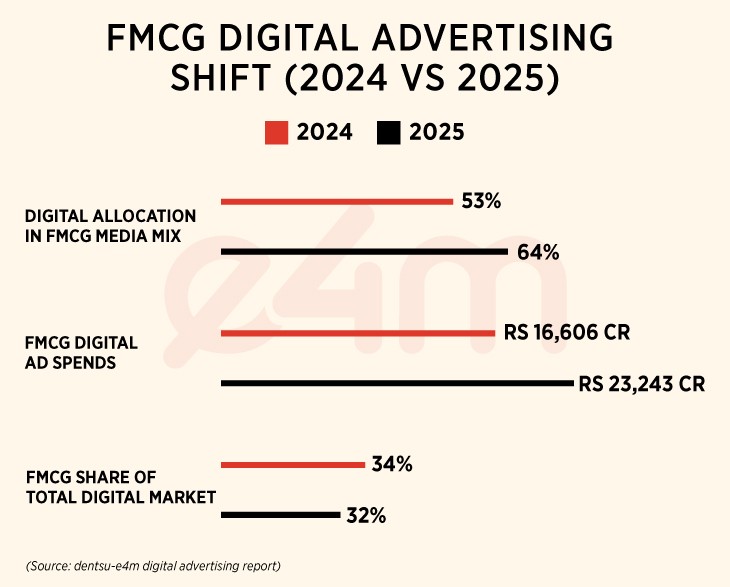
According to the dentsu-e4m Digital Advertising Report, FMCG advertisers accelerated their digital push between 2024 and 2025, turning what was once a gradual transition into a structural reset. Digital allocation rose from 53% in 2024 to 64% in 2025, decisively overtaking television and marking a clear shift in internal media priorities.
The scale of this pivot is significant given FMCG’s dominant role in India’s advertising economy. In 2024, the category was the largest contributor to digital advertising, with spends of Rs 16,606 crore, accounting for 34% of the overall digital market, even as media plans remained hybrid. By 2025, digital spends surged to Rs 23,243 crore. While FMCG’s market share eased marginally to 32% amid faster expansion in other sectors, the real story lay in budget redistribution, with nearly two-thirds of FMCG advertising spends now anchored on digital platforms.
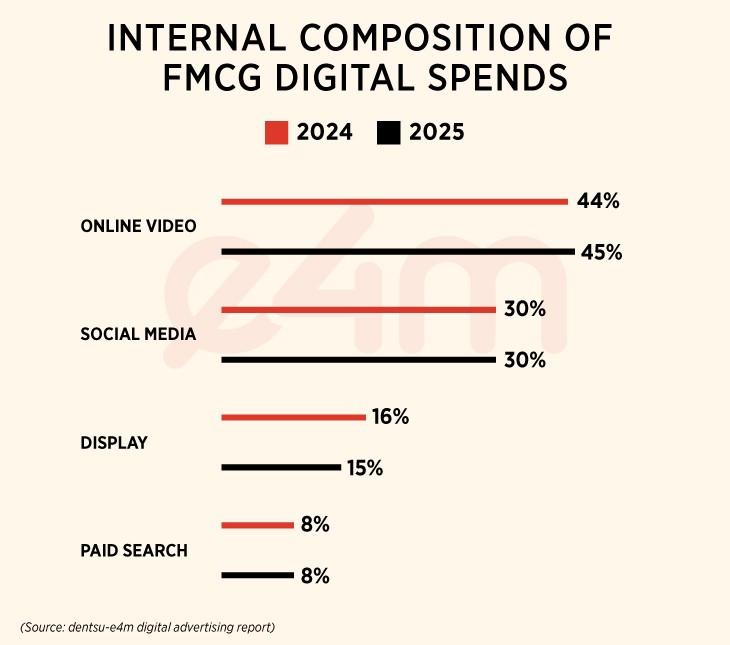
The internal composition of those digital budgets further underscores this evolution. In 2024, online video accounted for 44% of FMCG digital spends, followed by social media at 30%, display at 16% and paid search at 8%. By 2025, advertisers doubled down on high-impact formats: online video inched up to 45% and social media held steady at 30%. Together, the two formats comprised nearly three-fourths of digital spends. Display dipped slightly to 15%, while paid search remained unchanged at 8%, reinforcing their supporting, performance-oriented role within the mix.
Against this backdrop, marketers are rethinking what truly signals effectiveness.
Ankit Agrawal, Director, Mysore Deep Perfumery House & Zed Black said, “For us, engagement and attention matter the most. Reach alone doesn’t mean much if people aren’t truly connecting with the brand. The real impact happens when audiences engage with the product and resonate with the brand’s ideology that’s where the magic begins. Once that connection is built, performance outcomes become the true measure of effectiveness, with everything else falling into place after that.”
This emphasis on engagement reflects a broader recalibration within FMCG marketing, where attention is increasingly being treated as a precursor to measurable business outcomes rather than a soft branding metric.
Similarly, Pawan Jagnik, Head of Marketing–India at Pladis Global, says that while marketers track a range of digital metrics, from reach and frequency to attention and performance outcomes, the ultimate test of effectiveness remains unchanged. “We may evaluate multiple metrics, but it eventually boils down to one question: is it moving the needle on consumer sentiment, awareness and revenue indicators, both in the short term and the long term?”
In other words, while the dashboard may look more complex, the underlying question remains simple: is marketing translating into growth?
Raja Chakraborty, CMO, Continental Coffee, has a sharper performance view, arguing that attention is far more important than reach in a digital-first ecosystem. For performance-led campaigns, he said, outcome metrics such as click-through rates become more relevant, as digital enables marketers to measure whether advertising is actually nudging consumers toward purchase. In this context, reach alone becomes the least important metric unless it translates into measurable engagement and action.
“Reach is the least important metric on digital. If your ad is grabbing attention, whether it is nudging them to check your brand and purchase it is more important in digital, and the good part is that it's all measurable,” he said.
From the agency side, the conversation is also about efficiency and scale. Kartik Mehta, CBO and Head of Asia at Channel Factory, pointed to the growing use of AI-driven automation tools to optimise campaigns at scale. While human teams can optimise limited line items, AI systems are capable of driving efficiencies across far larger volumes. However, he cautioned that efficiency extraction has limits. “Marketers and agencies need to understand that media isn’t free. If a tool delivers 10% media efficiencies, it is unrealistic to expect it will deliver 20% next, then 30% thereafter. Efficiency stabilises at some point, and agencies need to have that conversation with clients.”
Adding a broader strategic lens, Vishal Shrivastava, Head of Business Strategy at AnyMind Group India, framed the shift toward digital measurement as fundamentally outcome-led.
While campaign objectives may vary, he noted that the underlying driver behind the reallocation of FMCG budgets is the ability to directly link media investments to business results. Indian marketers have always prioritised outcomes, but what has changed is the ability to demonstrate them with precision. Metrics such as cost per acquisition, return on ad spend, conversion rates and customer lifetime value have moved from performance dashboards into core business conversations and quarterly reviews.
He pointed out that traditional television was effective at delivering scale through reach and frequency, but the link between exposure and sales was often inferred rather than definitively measured. Digital platforms, by contrast, enable marketers to track the full consumer journey from awareness to consideration, trial and repeat purchase, creating clearer attribution models.
This accountability, he suggested, is the primary reason budgets have shifted, not cost efficiency alone. From an agency and brand standpoint, metrics are increasingly evaluated on whether they tie back to revenue growth, shelf movement or market share gains. Reach is prioritised when it can be correlated with downstream conversion. Attention is valued when it translates into measurable recall and purchase intent. Frequency quality matters when it improves acquisition efficiency rather than simply inflating impression counts.
In this framework, effectiveness is no longer defined by exposure alone, but by demonstrable commercial impact.
“Everything has to connect to business impact now. The agencies winning FMCG mandates are the ones who've figured out how to make that connection clear. The ones still leading with impressions and awareness without tying it to outcomes? They're struggling to hold onto clients,” he explained and added that we see this playing out in real time through our platforms, the shift in what agencies ask for, what they measure, what they report back to clients. It's all outcomes-driven now.
The shift is no longer about where FMCG brands advertise, but how clearly they can prove impact. In a digital-first era, effectiveness begins and ends with measurable commercial outcomes.
Read more news about Marketing News, Advertising News, PR and Corporate Communication News, Digital News, People Movement News
For more updates, be socially connected with us onInstagram, LinkedIn, Twitter, Facebook, YouTube & Google News
