Winning the modern customer in a fragmented, full-funnel world
In a world where funnels no longer flow top to bottom, attention is mobile-first, and trust defines transactions, marketers at e4m IBC 2026 examined what it truly takes to win the modern customer
 by
by
Published: Feb 12, 2026 1:08 PM | 15 min read
 Follow Us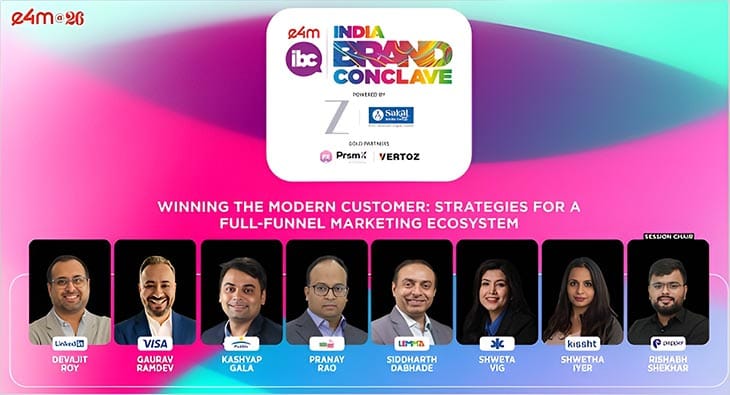

At the India Brand Conclave 2026, marketing leaders from digital lending and payments to FMCG, media, and personal care, discussed how brands must move beyond linear thinking to build full-funnel systems that are measurable, emotionally anchored, and deeply integrated.
Moderated by Rishabh Shekhar, Co-Founder and COO, Pepper, the panel titled “Winning the Modern Customer: Strategies for a Full-Funnel Marketing Ecosystem” featured Kashyap Gala, Senior Vice President - Consumer Products, Pidilite; Devajit Roy, Head of India, Growth & Mid-Market - Marketing Solutions, LinkedIn; Pranay Rao, VP – Marketing, Sebamed India; Gaurav Ramdev, Head of Marketing - India & South Asia, Visa; Siddharth Dabhade, Chief Business Officer, Lemma; Shweta Vig, Marketing Director – India, Kimberly Clark; and Shwetha Iyer, SVP and Head of Marketing, Kissht.
Shekhar opened the session, asking the panel about the biggest customer shift that marketers are still underestimating.
Kashyap Gala pointed to a behavioural reality that is impossible to ignore. “The biggest shift we are notably seeing is the amount of time everyone is spending on mobile phones,” he said, adding that brands must be present where consumers spend the longest time.
Working with iconic brands that interact with consumers daily, Gala noted that while Pidilite continues to be known for its iconic advertising, the company has made a “dramatic shift” in recent years towards digital-first thinking. However, he stressed that this does not mean limiting efforts to digital alone.
“It is equally about being present at all relevant touchpoints,” he said, explaining that the objective is to leverage different touchpoints to deliver compelling storytelling and intercept consumers in the best possible manner. “From traditional media to aggregation points such as transit hubs, the focus is on presence with purpose.”
Ramdev took the argument further by challenging one of marketing’s most established frameworks. “The typical funnel that we always imagine a consumer takes from top to bottom is dead,” he said.
In his view, funnels today move sideways. A large section of consumers may sit at the top, some in the middle, while others may have already transacted and experienced the brand. In such an ecosystem, campaign objectives must be clearly defined and measurable.
“There is no use spending money to take one particular customer from the top of the funnel to the bottom at all costs,” Ramdev said. While visually the funnel may appear hierarchical and one-directional, in reality, he argued, it is “completely fragmented”.
Drawing from his FMCG experience, he added that the traditional product discovery journey has shifted significantly. “In the D2C universe, consumers may try a product even before they fully understand the brand’s heritage or legacy. You can start at any part of the funnel based on the objective of the marketing campaign,” he said.
When asked about the single anchor that categories such as personal care should bet their marketing efforts on, Rao underscored the importance of effectiveness and transparency.
“In my category, effectiveness and transparency are what consumers are looking at more and more,” he said. With multiple brands making claims, often without adequate substantiation, and a constant influx of new players, the burden of proof has intensified.
For Sebamed, delivery must be demonstrable. “We believe that if somebody tries the product, they stick to it,” Rao said, adding that driving trials is therefore central to the model.
As ingredient awareness rises, with consumers actively discussing elements such as ceramides, Rao highlighted a growing challenge. Sometimes, he suggested, the science of the ingredient does not fully correlate with the finished product. Bridging that gap between ingredient awareness and product efficacy is now one of the biggest tasks in personal care marketing.
From the lending side of things, Iyer addressed the deep-rooted trust barrier in digital finance, noting that Indians are often emotional about money and debt carries social stigma.
For her, the anchor is preserving customer dignity through experience. “Help her keep her dignity intact by offering a very superior experience,” Iyer said, referring to seamless journeys across product interfaces and touchpoints.
She emphasised the need for a degree of personalisation without becoming intrusive. “That entire mania around hyper-personalisation has calmed down. We need to strike the balance,” she said, especially given data security implications in financial services.
“Transparency is non-negotiable. If details are being fetched from DigiLocker or bureau checks are being conducted, customers must be informed upfront. As long as you are an ally and hold the customer’s hand through the journey with as little friction as possible, you have checked most of the boxes,” she added.
Shifting the conversation to media ecosystems, Dabhade explained how Out of Home (OOH) is evolving within a programmatic, outcome-led environment.
“OOH plays a very interesting role. It really stands out and has a high impact,” he said, adding that the transition from static to digital screens is making the medium even more powerful.
As a touchpoint, OOH breaks clutter because of its real-world presence and impact. However, traditional OOH faced limitations, particularly around tracking.
“One of the challenges was that you did not have real-time tracking,” Dabhade said. By integrating digital screens into programmatic ecosystems such as Google DV360, brands can now manage OOH alongside broader branding campaigns and track performance daily.
“If I am spending one crore, I know I am getting one crore worth of impact,” he said, highlighting the value marketers place on accountability.
Historically, OOH operated in silos, making it difficult to understand who had been impacted or to draw those audiences into the digital funnel. Dabhade explained, “Through data partnerships and proprietary tools, brands can now identify cohorts near specific screens and retarget them on mobile.”
This integration enables mid-funnel and bottom-funnel actions, as well as outcome-based measurements such as brand lift studies. OOH when made programmatic and connected to digital funnels becomes “much more outcome-oriented and result-oriented”.
Offering a digital platform perspective, Roy identified two key shifts.
“The first is around what brands are doing differently on digital platforms like ours,” he said. Increasingly, thought leaders within organisations are stepping forward to speak about their products in alignment with communication strategies.
“If you have a founder, a marketing leader, or a CTO talking about the product, its features, what it can solve, or the moat as we call it, it intensifies the conviction of that brand,” Roy said. This alignment strengthens trust and credibility.
The second shift lies in measurement. As brands move from awareness to consideration to demand generation, attribution becomes critical.
“If brands are able to tie back that conversion or that offline store sale to an impression the same audience was exposed to, whether in a 60-day or 90-day window, then marketing dollars become much more efficient,” he said.
With sophisticated measurement in place, ROI and ROAS calculations become significantly more powerful. For Roy, the industry is clearly moving towards stronger thought leadership combined with deeper measurement capabilities within the digital ecosystem.
Translating Science, Driving Sufficiency, and Building Trust Across the Funnel
As the discussion moved to categories often described as having a “silence problem”, the focus shifted to how brands translate science into reassurance, while balancing quarterly targets with long-term brand equity.
Shweta Vig addressed the structural realities of the baby care category head-on. “Babies can’t articulate discomfort,” she said, but pointed to two universal truths: parents want the best for their child regardless of income, and the threshold for product failure is extremely low. “A failure can immediately lead to deselection,” she noted.
These fundamentals shape every marketing decision. “Science is the proof of product performance, but reassurance comes from the experience itself. It is very important that your promise and your product can really deliver the entire experience,” Vig said.
On balancing short-term and long-term investments, Vig emphasised translation. Features such as absorbency and softness must be expressed in occasions and need states that resonate. “Consumers are buying uninterrupted sleep. They are buying dryness,” she said.
She explained that long-term investments, typically brand building, are guided by sufficiency metrics. The question is how many consumers need to be reached to achieve goals, and what that translates to in dollar investment. Short-term allocations, too, are driven by sufficiency against immediate goals rather than fixed percentages.
Most importantly, she argued, the two are sequential, not adversarial. “Long form drives short form,” Vig said. The team tracks brand fundamentals closely: are searches rising, is organic revenue share improving, is ROAS getting better? “They are not enemies. They just have to be balanced to drive overall brand goals,” she added.
Turning to mass categories with expansive distribution networks, Gala outlined the key moments that matter for Pidilite brands.
“For brands like ours, which are household names, be it Fevicol, Fevikwik, or Dr. Fixit, beyond awareness generation through mass media, that’s where the journey really starts,” he said.
In their case, education is a critical middle-funnel intervention. Gala highlighted consumer education and what the company calls “user marketing”, i.e. educating middlemen, contractors, and users. “We don’t just engage with them but rather we educate them. We are partners with them on a day-to-day basis,” he said, noting the existence of dedicated teams for this effort.
In the craft and stationery business, the approach is more ecosystem-led. Recognising increased mobile consumption among children, the brand chose not to compete with the device but to offer a compelling alternative. “How do we not fight with the mobile phone, but give a better and more interesting option?” Gala asked.
The result was an ecosystem called Fevicreate, offering nearly 10,000 recipes, videos, and pieces of content to encourage creative expression. From there, the experience extends offline through a network reaching around 20,000 schools and approximately three million children, with workshops tied to festivals and occasions.
The loop is closed with meaningful solutions such as curated kits that enable children to create while learning subject-based concepts.
After this, the conversation pivoted to payments in the era of UPI and rising consumer expectations.
Ramdev described payments as one of the most competitive spaces today, with new ecosystems constantly emerging. While declining to comment on competition, he emphasised that digital payments in all forms are critical for the broader ecosystem.
For Visa, however, what has not changed is more important than what has. “Trust is a moat that we continue to invest behind,” Ramdev said. “In a cultural context where money is deeply personal, building trust in payments remains foundational.”
From a behavioural standpoint, once trust is assured, the conversation moves to security, convenience, and speed. Speed, he noted, is now assumed as part of the experience.
What differentiates the experience further are rewards. “Trust is expected. Speed is a given. But rewards are something that you delight them with,” Ramdev said. These three vectors shape the brand narrative.
Addressing misconceptions around LinkedIn’s role in the funnel, Roy identified cost perception as the first barrier.
“We keep getting a pushback that we are expensive,” he said. “While the dashboard may suggest higher costs, advertisers are shifting from vanity metrics to value-driven outcomes.”
Even if cost per acquisition appears higher, marketers are asking whether the platform generates a stronger pipeline and closes more business. “Are they able to answer the tough questions my CFO is going to ask?” Roy said, referring to publishers across the digital ecosystem. In his view, cost is no longer the primary barrier, measurement is the deciding factor.
The second misconception is that LinkedIn is only effective for bottom-funnel demand generation. Roy countered this with data. “Brands that adopt a structured full-funnel strategy on the platform see their eventual cost per conversion reduced significantly.”
“Imagine a campaign run only on the bottom funnel compared to one structured appropriately across the funnel. The eventual goals are three times lower,” he said, adding that LinkedIn should not be seen as a platform only for conversions, but as one that supports the full funnel when architected strategically.
From Distress to Aspiration, and Connecting the Dots
As the session drew towards its close, the conversation turned to digital credit journeys and how borrowing in India is shifting from distress-led decisions to planned life choices.
Iyer agreed that borrowing is no longer confined to emergency situations. “It’s not distress borrowing anymore,” she said, linking the shift to broader changes in consumer behaviour, particularly in the way people search.
“The way users search has completely changed,” Iyer noted, pointing to the rise of answer engines such as ChatGPT, Perplexity, and Gemini. “Consumers are no longer navigating traditional search engines in the same way. They go directly to answer engines.”
This fundamentally alters funnel design. By the time a person enters the funnel, she is often already aware of how borrowing works, what a credit score is, and what KFS means. “There is no need for you to explain how borrowing works,” Iyer said. What must change instead is the emotional anchor.
At Kissht, that shift has translated into a stronger emphasis on education and emotion. Even in fintech, she argued, education remains critical. But beyond that lies persona-level understanding, i.e. what drives individuals and how they feel about money.
In a move that reflects this philosophy, the company onboarded a psychologist. “Why will a fintech brand onboard a psychologist?” Iyer asked rhetorically.
The brand has created content around conversations couples avoid: how to split expenses, how to discuss money with a partner, what to do if one gets fired, whether there is an emergency fund, and how to support aging parents with health insurance.
“None of this, she clarified, is directly about borrowing,” she said. “But by focusing on money as a broader life theme, and the emotions attached to it, we build trust.” As product awareness and transactional understanding increase, communication shifts towards aspiration and emotional resonance rather than purely functional explanations.
The discussion then moved to category shifts, particularly between technology launches and science-led FMCG brands.
Rao described a stark difference in launch dynamics. “In tech, your launch date is one of the peaks. About 20% of your sales happens on that day,” he said. Hype-building before launch becomes critical, especially when consumers may purchase without ever physically experiencing the product.
Recalling a launch where 65,000 phones were sold in 60 minutes, Rao highlighted how influencer ecosystems are built to ensure that people test, feel, and speak about the product before it goes live.
In FMCG, however, the structure is different. While the traditional awareness–consideration–purchase funnel exists, digital commerce has introduced new entry points. Consumers may directly search for a product on Amazon or Flipkart, altering media strategies and KPIs.
Despite these structural differences, Rao maintained that first principles remain constant. “Media mix modelling, commonly used in FMCG, can also be applied to tech,” he said, noting that learnings move across categories, from outdoor experimentation in tech to social media strategies adopted in his current role.
On the question of what silos most undermine omnichannel strategy, Dabhade returned to integration.
Using the example of a phone launch campaign with Asus, he explained how OOH and digital retargeting were connected. Audiences impacted by static and digital screens were later retargeted, generating leads and demonstrating how silos can be reduced.
“Launches are a great way for OOH to spread buzz,” Dabhade said. “But the real value lies in pulling those audiences back into the funnel and driving measurable ROI.”
He cited another example with Amazon Prime Video, where social media engagement around a web series was amplified in real time through OOH. User-generated responses were extended beyond digital channels, creating a bridge between social media, digital branding, and physical screens.
“We are in this age of digital and AI where dots have to be connected,” he said, arguing that capabilities now exist to reduce silos significantly. The task is to use them cohesively.
Finally, returning to the theme of making invisible problems visible, Vig shared a specific example. “Our point of difference was absorption and speed of absorption, but consumers did not perceive slow absorption as a problem. They were using their old brands and were happy with it,” she said.
To prompt re-evaluation, the team dramatised the risk of slow absorption. The creative device was the “Gilo Monster”, intimidating but not frightening, running behind an uncomfortable baby. When the baby wears Huggies, the monster is defeated.
“It’s an example of a creative device and a problem reframe,” Vig said, tying the execution back to the broader strategy the brand sought to drive.
Across categories, lending, technology, FMCG, payments, and media, the panel underscored a common thread of how higher awareness demands deeper emotional anchoring, measurement must connect channels; and silos can no longer survive in an ecosystem designed for full-funnel integration.
Read more news about Marketing News, Advertising News, PR and Corporate Communication News, Digital News, People Movement News
For more updates, be socially connected with us onInstagram, LinkedIn, Twitter, Facebook, YouTube & Google News
