The industry needs reinvention, not pessimism: Dr Annurag Batra at Goafest
Dr. Batra’s session became one of the most talked-about conversations at the festival as he laid out why advertising industry is not in decline, but in the middle of one of its biggest reinventions
 by
by
Published: May 22, 2026 9:06 AM | 5 min read
 Follow Us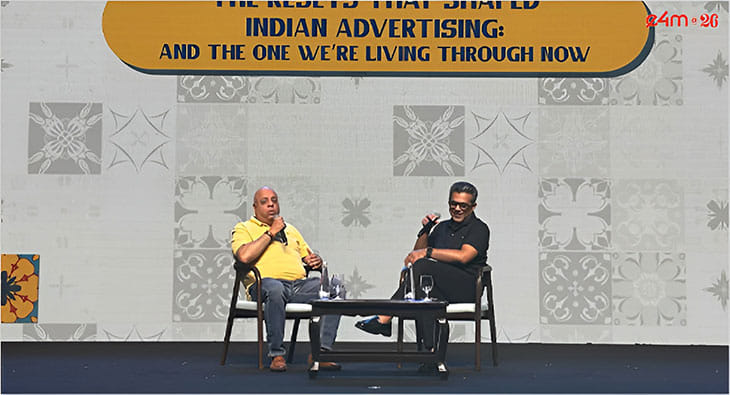

- Dr. Annurag Batra, Chairman & Editor-in-Chief of BW Businessworld Group, presented an optimistic outlook for the Indian advertising industry at Goafest, asserting it is undergoing significant reinvention rather than decline.
- He highlighted that the Indian advertising market is valued at nearly Rs 1.75 lakh crore and is expected to exceed Rs 2 lakh crore soon, emphasizing the growing reliance on advertising by businesses and brands.
- Batra called for a stronger narrative around the advertising sector and noted the industry's evolution towards hybrid organizations that integrate technology, strategic consulting, and creative capabilities, driven by AI advancements.
- He underscored the importance of experiential marketing and live events, predicting that as technology grows, the value of human interaction will increase, while also addressing the need for agencies to adapt structurally and culturally to remain competitive.
At a time when conversations around AI disruption, layoffs and shrinking agency margins dominate industry discourse, Dr Annurag Batra, Chairman & Editor-in-Chief of BW Businessworld Group and e4m, delivered a powerful and optimistic vision for the future of Indian advertising during a high-energy session at Goafest alongside Dheeraj Sinha, CEO of McCann Group.
The session, titled “The Resets That Shaped Indian Advertising — And the One We’re Living Through Now,” became one of the most talked-about conversations at the festival as Dr Batra laid out why the advertising industry is not in decline, but in the middle of one of its biggest reinventions.
Positioning India as one of the brightest global growth stories for advertising, Dr Batra highlighted that the Indian advertising industry currently stands at nearly Rs 1.75 lakh crore and is poised to cross Rs 2 lakh crore in the coming year.
“Advertising is growing. More and more businesses and brands are using advertising to build their brands and businesses,” he said, firmly rejecting the pessimistic narrative often surrounding the sector.
Throughout the session, Dr Batra repeatedly argued that the industry’s biggest challenge is not growth, but storytelling about itself.
“The only issue we have is, I don’t think we are doing a good job at building a narrative about our own industry,” he remarked, calling on agencies, media platforms and industry leaders to collectively create a more confident narrative around advertising’s future.
Drawing from decades of observing the industry, Dr Batra said advertising agencies of the future will no longer resemble traditional creative shops. Instead, they will evolve into hybrid organisations that combine creator economy capabilities, strategic consulting, AI expertise, media intelligence and first-party data advisory services.
One of the defining moments of the session came when Dr Batra described the ongoing convergence of Silicon Valley, Madison Avenue and Hollywood.
“This industry, for the first time in 30 years, is seeing the convergence of technology, advertising and entertainment content,” he said, arguing that the next generation of agencies will be those capable of integrating all three worlds seamlessly for clients.
Dr Batra also pointed to global holding company movements and AI acquisitions as evidence that the transformation is already underway. Referencing major investments by global networks into AI and digital transformation, he stressed that agencies now need to fundamentally rethink the business they are in.
Another major theme of his session was entrepreneurship.
From independent agencies to meme-specialist firms and IP-led businesses, Dr Batra argued that Indian advertising is currently witnessing a fresh entrepreneurial wave. He highlighted emerging niche businesses — including agencies focused entirely on meme culture and experiential IPs like horror conventions — as examples of how the ecosystem is rapidly diversifying.
“You don’t have to be locked into one model anymore,” he said, adding that entrepreneurial energy within the advertising and marketing services ecosystem remains extremely strong.
The conversation also turned sharply toward AI and the urgency for agencies to upgrade themselves structurally and culturally.
Dr Batra narrated how even large corporate CEOs are privately experimenting with AI tools to understand how the technology can transform productivity and creativity.
According to him, the advertising industry has significantly underinvested in learning and development over the years and now needs aggressive “retooling” to remain future-ready.
“We are not investing enough in upgrading the backbone of our agencies,” he observed, while emphasising that inspiration alone will not be enough in the AI era.
Dr Batra also offered one of the strongest endorsements of experiential marketing and live events during the session, arguing that the growth of AI will ironically increase the value of human touch.
“The more technology grows, the value of human touch grows,” he said while discussing the post-pandemic rise of hospitality, conferences and experiential businesses.
Citing the booming hospitality sector and growing appetite for real-world gatherings, he described experiential as one of the most powerful narrative-building tools available today.
In a striking observation that drew applause from the audience, Dr Batra described the current government as an “events ki sarkar,” pointing to the increasing use of conferences, summits and large-scale experiences to shape narratives around governance, technology and policy.
The session also explored the future economics of advertising agencies.
Dr Batra acknowledged that agencies will inevitably become leaner as AI automates operational functions and productivity increases. At the same time, he maintained that the need for advertising and strategic brand-building will only intensify as India’s consumer economy expands further.
He also raised concerns around investor sentiment toward global advertising holding companies despite strong sector fundamentals. Referencing firms like WPP and Publicis, Dr Batra argued that agencies today increasingly resemble “cloud kitchens” operating multiple brands with shared backend systems, and therefore need stronger differentiation and sharper future-facing narratives.
Importantly, Dr Batra repeatedly stressed that the industry must stop indulging in excessive negativity.
“I think we have to do less negative self-talk,” he said, while urging the ecosystem to embrace change rather than resist it.
As the session drew to a close, Dr Batra also praised Goafest and the Abby Awards for continuing to unite the industry during a period of enormous transition.
He described Goafest as a platform that successfully creates community, energy and collaboration beyond conference halls, while also positioning the Abby Awards as an important source of recognition and encouragement for industry professionals.
Read more news about (internet advertising India, internet advertising, advertising India, digital advertising India, media advertising India)
For more updates, be socially connected with us onInstagram, LinkedIn, Twitter, Facebook Youtube & Whatsapp
