The Invisible Sponsor: How Mandira Bedi kept India’s women’s cricket alive
Mandira Bedi became the team’s ‘invisible sponsor’ by sacrificing her entire endorsement fee to keep the game alive
 by
by
Published: Nov 4, 2025 2:52 PM | 3 min read
 Follow Us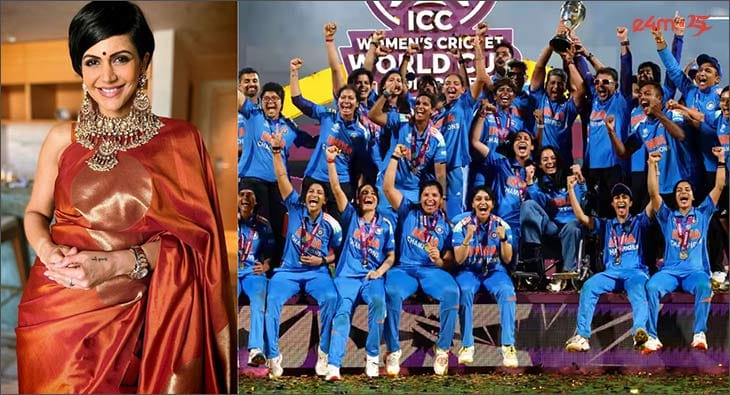

In the high-stakes world of international cricket, where sponsorship deals run into millions and teams jet off to global tournaments in style, it's easy to forget the gritty beginnings that shaped the sport's underdogs. For the Indian women's cricket team in the early 2000s, those beginnings were marked by scraped-together funds, self-funded travels, and a relentless fight for recognition.
Amid this struggle, one Bollywood star stepped up in the shadows, sacrificing her own earnings to keep the team's dreams alive. That star? Mandira Bedi, an actress, TV host, and cricket commentator who quietly became the "invisible sponsor" that helped propel women's cricket in India from obscurity to Olympic glory.
Read On: World Cup win: Top players poised for 10–20% rise in endorsement values?
The Era of Scarcity
The early 2000s were a period of immense financial hardship for women's cricket in India. The Women's Cricket Association of India (WCAI), which managed the team until the BCCI took over in 2006, had virtually no funding. International tours were a constant ordeal, with players sometimes having to pay their own way to represent the country. In one instance, a former player recalled that for a tour of New Zealand, the team had to stay at the homes of multiple NRI families as there were no funds for hotel accommodation.
The Gesture That Changed Everything
Bedi’s involvement was more than a one-time donation; it was a sustained effort between 2003 and 2005 to raise the profile of the sport. She personally approached companies and brands, urging them to back the women in blue.
Bedi's pivotal act of generosity came after shooting a commercial for Asmi Jewellery, a prominent diamond brand. In a move that stunned those in the know, she donated her entire endorsement fee to the WCAI. The funds? Straight to booking those elusive plane tickets for the England tour.
The exact sum remains undisclosed—likely to keep the focus on the impact rather than the figures—but in an era when women's sports sponsorships were non-existent, it was a lifeline.
Read On: How Women’s World Cup final became India’s biggest brand game
From Shadows to Stadiums: The Ripple Effect
Bedi's contributions between 2003 and 2005 weren't just financial—they were foundational. By securing sponsorships and amplifying the team's narrative, she helped shift perceptions. What started as a trickle of corporate interest soon became a flood, paving the way for the professionalization of women's cricket under the BCCI. Without her "invisible" interventions, tours like the one to England might have been cancelled, stunting the growth of stars who would later dominate the global stage.
Fast-forward to 2025, and the fruits of those early labours are impossible to ignore. India's triumphant ICC Women's World Cup victory —crowned with a historic final against South Africa—has been hailed as a seismic shift. Bedi, ever the cheerleader, captured the moment on Instagram: “You didn’t play for a nation, you moved it.” In her reflection, she highlighted the broader legacy: empowering young girls to dream beyond societal barriers, turning cricket kits into symbols of possibility.
View this post on Instagram
A Legacy of Quiet Power
Mandira Bedi's story is a reminder that true heroism in sports often happens off the field, away from the cheers and the cameras.
As India's women continue to redefine cricket's boundaries, one can't help but wonder: How many more Mandira Bedis are out there, working in the wings to lift others up? In her honour, perhaps the next generation will ensure no team ever has to beg for a ticket to the top.
Read more news about Digital Media, Television Media, Out of Home Advertising, Print Media, Latest Advertising India
For more updates, be socially connected with us onInstagram, LinkedIn, Twitter, Facebook, YouTube & Google News