India needs an independent voice on global stage; PTI ready to fill that role: Vijay Joshi
PTI CEO & Editor-in-Chief, Vijay Joshi, spoke exclusively to e4m on the news agency completing 77 years, the evolving media landscape and other aspects of journalism
 by
by
Published: Sep 11, 2024 8:22 AM | 8 min read
 Follow Us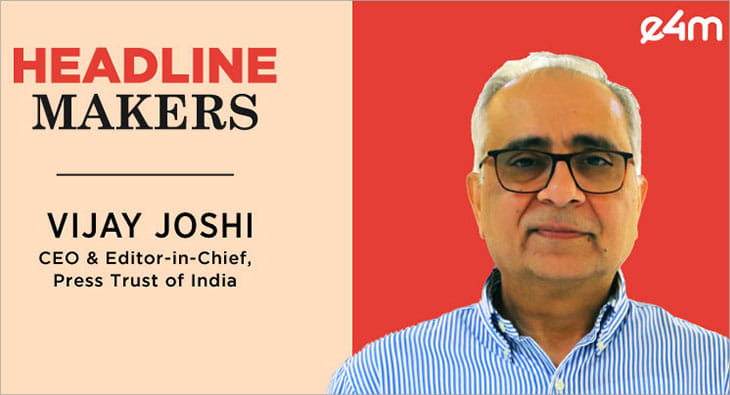

As the Press Trust of India (PTI) marks 77 years of its journey, CEO & Editor-in-Chief, Vijay Joshi, reflects on the agency’s journey, guiding philosophy, and future vision.
In this exclusive interview, Joshi discusses PTI's commitment to factual reporting, the challenges of modern journalism, and how PTI has adapted to evolving technologies like AI and digital news services.
Excerpts from the conversation:
PTI has completed 77 years, which is a significant milestone. What has been the guiding philosophy behind PTI’s work, and how has it maintained its credibility over the years?
PTI’s origins trace back to pre-Independence India when newspapers were served by an agency called Associated Press of India (API). It was owned by the British agency Reuters and while API did cover the Indian independence movement, Indian newspaper owners realized that the country needed its own voice in journalism. This led to the establishment of PTI on August 27, 1947, just 12 days after Independence. It took over the operations of API and officially began operations in January 1949, marking the birth of what is now the most trusted news agency in India. In short, we are the gold standard of credible news in India.
As the CEO of PTI, I am incredibly proud of our 77-year journey. PTI has always been a beacon of credibility, impartial and reliable journalism throughout its history. We are deeply committed to facts and every news is verified thoroughly before it goes to our subscribers. Even when there is pressure to break news, we follow a strict protocol of double or triple-checking our information. We do not publish anything without verification. For instance, during a recent case, everyone was reporting on the alleged death of a high-profile individual from the entertainment industry, but since we couldn’t confirm it from credible sources, we chose not to run the story. As it turned out, the reports of her death were greatly exaggerated. This dedication to accuracy, even in the face of immense pressure, has helped us build trust over 77 years.
One of the issues facing journalism today is the rise of fake news. How has PTI tackled this problem?
Fake news is one of the biggest challenges we face today, especially with the rapid spread of misinformation through social media and digital platforms. At PTI, we’ve turned this challenge into an opportunity by setting up a dedicated Fact Check news desk, which is now one of the most highly recognized in the country. Our team uses technology and rigorous journalistic practices to verify stories and debunk misinformation. It’s not just about being a good journalist anymore — you need to employ technology to detect if a photo is morphed, if an audio clip has been tampered with, or if a video has been doctored. We use all these tools, along with the journalistic DNA of verification, to ensure that we don’t fall prey to fake news.
How has the media landscape evolved in India, particularly in terms of news coverage from small towns and rural areas?
Covering smaller cities and towns presents unique challenges, but it’s something we prioritize at PTI. We have stringers in every district in India, and often more than one reporter in larger districts or cities. These local journalists help us provide comprehensive coverage, ensuring that even the most remote parts of India are not left out of the national conversation. The challenge often lies in resources and infrastructure, but our stringers and reporters are well-trained and follow PTI’s rigorous standards for reporting. Ensuring impartial and reliable coverage from these areas is crucial because they are often underserved by mainstream media.
With digital journalism booming, what role do technology and AI play in PTI’s operations, and how are you adapting to these innovations?
Technology and AI are undoubtedly shaping the future of journalism, and we’re keen on staying ahead of the curve. Currently, we’re experimenting with AI for tasks like generating headlines, but we’re still in the early stages of that. We don’t use AI-generated headlines. We only compare them with the human effort to see how evolved it is. In many cases, AI produces concise and effective headlines, but we feel it’s not yet ready to fully replace human judgement, especially when it comes to nuanced stories. In the future, AI will play a much bigger role in journalism, but we are cautious about letting it control editorial decisions without oversight. Technology will continue to evolve, and we need to ensure we use it responsibly, always putting credibility and accuracy first.
What are the specific challenges of covering international news from India, and how does PTI navigate these?
Covering international news is both a challenge and an opportunity for us. India, like many countries, tends to be inward-looking, and foreign news typically gains attention only when there’s an Indian angle, such as Indians being affected by conflicts abroad, or Indians doing well in other countries. Establishing foreign correspondents in every country is resource-intensive, so most news outlets – in India as well as other countries – usually rely on international agencies like AP, Reuters and AFP for global coverage. However, these agencies tend to present news from a Western perspective. This presents a gap that PTI can fill, by offering a perspective from the global South. We aim to leverage PTI’s credibility to become a more prominent player in the international news space, but it will require significant investment.
Speaking of the current media ecosystem, how do you see the overall state of media in India, particularly with regard to news agencies?
The media landscape in India has changed significantly. When I started in journalism in 1985, there were only two news agencies, PTI and UNI, which were the primary sources of news. Competition between the two existed, but it was healthy and focused on delivering accurate, timely information. Today, the nature of competition has shifted to breaking news first. The drive to be the fastest can lead to mistakes, and that can erode trust in some quarters of the media. However, at PTI, we maintain a strong commitment to credibility. We don’t rush stories out the door until we’re satisfied with their accuracy.
PTI recently launched a video service. Can you share how that’s been received and what are your future plans for digital expansion?
We launched PTI’s video service in January 2023, and the response has been phenomenal, especially from digital platforms. For many years, there was a virtual monopoly in the video news service sector, and PTI’s entry has provided a much-needed alternative and competition. Competition is good for the customer because it provides a choice. Our focus at PTI has been on using technology to offer different types of content, such as live streams, raw footage, and voice packages, which are ready for immediate use. This has been particularly popular with digital customers who appreciate the ease of use and the variety of content we offer. As digital journalism continues to grow, I see enormous potential for our video service to expand even further.
How do you ensure that PTI’s standards of journalism remain high, particularly with younger reporters coming into the field?
Training and development are integral to PTI’s operations. When a journalist joins us, we expect them to have some experience, but they often need to unlearn certain practices. Our training is ongoing and happens on the job, with senior reporters and editors guiding the newer ones. We also organize workshops. Recently we concluded training for one batch on defamation and copyright. We have also provided training in new media skills like mobile journalism to all our text and photo journalists. Our goal is to ensure that every PTI journalist is equipped, not just with the necessary skills but with a strong ethical foundation. Agency journalism is unique because we serve such a vast number of subscribers, and an incorrect story can have enormous repercussions.
Finally, what is your vision for PTI in the years to come?
My vision for PTI is for it to stand alongside the world’s top news agencies, like AP, Reuters and AFP, in terms of quality and influence. I am standing on the giant shoulders of my predecessors who have built up this incredible organisation over 70 odd years. While respectful of the heritage, I am focused on the future, focused on building a culture of learning, culture of respect for colleagues and a culture of commitment to truth. But above all, our focus will be to serve our customers faithfully and sincerely. We exist because of them. I also want to point out that India is a global superpower, and with that has come a growing interest in what’s happening in India. PTI has the potential to be the voice of India on the global stage by providing a credible, independent perspective that the world can rely on. We’re not there yet, but with our history, reputation, and the talent we have, I’m confident we will reach that level one day.
Read more news about Digital Media, Television Media, Out of Home Advertising, Print Media, Latest Advertising India
For more updates, be socially connected with us onInstagram, LinkedIn, Twitter, Facebook, YouTube & Google News