MIB Secretary Chanchal Kumar urges media industry to invest in original IP, back creators
Speaking at CII Big Picture Summit, Kumar said that the next phase of growth would depend on the industry’s ability to connect creative talent, technology, IP and international markets
 by
by
Published: Oct 15, 2026 12:17 PM | 6 min read
 Follow Us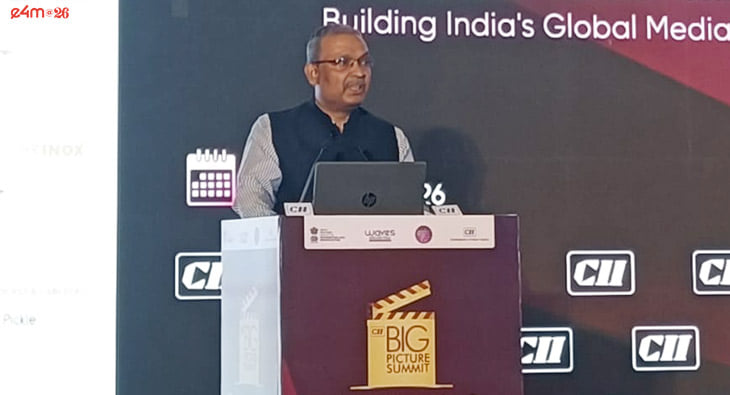

- Information and Broadcasting Secretary Chanchal Kumar emphasized the need for India's media and entertainment industry to expand beyond its domestic audience and invest in original intellectual property to become globally competitive, during the CII Big Picture Summit 2026.
- The sector has grown to ₹2.78 lakh crore in 2025, with digital media revenues exceeding ₹1 lakh crore and live events experiencing a 44% growth, but future growth will depend on connecting creative talent with technology and international markets.
- The government is initiating several programs, including the Indian Institute of Creative Technology (IICT) and the WAVES Bazaar, to enhance skills, facilitate international partnerships, and support emerging creators in the media landscape.
- Kumar highlighted the importance of stronger anti-piracy measures and the responsible use of AI in the creative process, urging industry players to invest in original content and support diverse talent from various regions of India.
India’s media and entertainment industry must move beyond its large domestic audience base to build globally competitive companies, invest in original intellectual property (IP) and create sustainable revenue models, Information and Broadcasting (I&B) Secretary Chanchal Kumar said at the CII Big Picture Summit 2026.
Addressing the industry at the summit, Kumar said India’s media and entertainment sector had reached ₹2.78 lakh crore in 2025, growing 9%, with digital media revenues crossing ₹1 lakh crore and live events registering 44% growth.
He said the next phase of growth would depend on the industry’s ability to connect creative talent, technology, intellectual property, capital and international markets.
“The next phase requires a strong intellectual property, sustainable revenues, disciplined investment, and the ability to build audiences across the markets all over the world,” Kumar said.
The government’s role, he added, was to create an enabling ecosystem for creativity to translate into scalable businesses, while entrepreneurs, creators, studios and industry players would be responsible for building globally competitive companies.
Referring to Prime Minister Narendra Modi’s call at the World Audiovisual and Entertainment Summit (WAVES) 2025 to “create in India, create for the world”, Kumar said the challenge was to transform India from one of the world’s largest content markets into a hub for the next generation of global media companies.
The changing economics of entertainment, he said, were reshaping how content was produced, distributed and monetised. Audiences now move between films, streaming platforms, creators, gaming, live events and connected television, often within the same day.
Globally, media companies are reassessing their business models as digital platforms compete for consumer attention, traditional businesses adapt to changing viewing habits, and artificial intelligence (AI) transforms production workflows, localisation and distribution.
India’s advantages include its large domestic market, cultural diversity, storytelling traditions and young creative workforce. However, converting these strengths into lasting economic value will require greater investment in original content, stronger intellectual property protection and the ability to reach audiences beyond domestic markets.
Government pushes WAVES, IICT and creator initiatives
Kumar outlined several government initiatives aimed at strengthening India’s creative economy and connecting domestic talent with global markets.
The next edition of WAVES is being planned for October 2027 in Mumbai, he said, inviting the media and entertainment industry to participate in the global conference and use it to build partnerships with international investors, technology companies and content buyers.
The government is also developing the Indian Institute of Creative Technology (IICT) to strengthen skills, research and capabilities in animation, visual effects, gaming and comics (AVGC), extended reality and emerging creative technologies.
The ministry has launched a National AI Skilling Initiative through IICT to help professionals use emerging tools while keeping human imagination and judgement central to the creative process.
Kumar cited the achievement of Rajeev Butanjan, who trained at IICT before winning the Medallion of Excellence for Graphic Design at the WorldSkills Competition held in China this year, as an example of the potential of specialised creative education.
He urged industry players to participate in designing IICT’s curriculum, provide practical industry exposure to students and help upskill existing professionals.
The government is also working through its single-window mechanism, India’s National Film Facilitation Office initiative, to facilitate film production and shooting permissions, along with permissions for concerts and live events, including coordination with states and other stakeholders.
On international distribution, Kumar highlighted WAVES Bazaar, a year-round marketplace designed to connect creators and companies with buyers, investors and overseas markets.
He said the platform could help Indian content owners reduce their dependence on physical markets for business-to-business engagement and distributor relationships.
The ministry will also launch Season 2 of the Create in India Challenge, following participation by more than one lakh creators in its first season. Kumar said several participants had gone on to become creators, music bands and innovators in the media and entertainment ecosystem.
He urged established industry players to help publicise the next edition so that emerging talent could showcase its work to global audiences.
“Our objective is straightforward. Create in India. Own in India. Scale from India. Take it to the world,” Kumar said.
Anti-piracy enforcement and AI safeguards
Kumar said stronger protection against piracy and content theft would be essential to building a sustainable creative economy.
The ministry has strengthened the anti-piracy framework through amendments to the Cinematograph Act and subsequent enforcement measures. In 2026, thousands of URLs, including websites and digital channels carrying pirated content, had been disabled, he said.
He also flagged the emerging challenges posed by AI, particularly around copyright, consent, digital likeness and the responsible use of creative works.
“AI must empower creators, not displace creativity,” Kumar said, stressing the need for informed engagement between the government, platforms, creators and industry.
Citing Mahatma Gandhi’s views on technology, Kumar said technological progress should remain an instrument in human hands rather than turn people into passive instruments of machines.
“Innovation and trust must advance together,” he said, adding that a predictable policy environment, responsible business practices and effective intellectual property protection would be crucial for long-term industry growth.
His remarks come as media and entertainment companies increasingly explore AI-led production, localisation and distribution, while questions around the ownership and use of creative material become more prominent.
Industry urged to back new creators and original IP
Kumar called on established media companies to invest in original intellectual property and support emerging writers, musicians, animators, game developers and other creators.
He said talent discovery should extend beyond established industry networks to different languages, states and smaller cities, including tier-II and tier-III markets.
The government, he said, could build institutions, policy frameworks, platforms and international linkages, but industry investment and participation would determine whether these initiatives translated into commercially viable businesses.
The secretary also urged companies to explore opportunities through WAVES Bazaar, contribute to IICT’s skill-development programmes and participate in WAVES 2027.
“The next chapter of entertainment will belong to those who combine creative originality with technological capability,” Kumar said.
India’s opportunity, he added, lay in enabling stories originating in smaller towns and villages to reach international audiences, while giving emerging creators the opportunity to become future industry leaders.
The government would work with the Confederation of Indian Industry (CII) and other stakeholders to identify practical measures to improve market access, strengthen skills, support innovation and build investor confidence ahead of WAVES 2027, he said.
Read more news about Television Media, Digital Media, Advertising India, Marketing News, PR and Corporate Communication News
For more updates, be socially connected with us onInstagram, LinkedIn, Twitter, Facebook YouTube & Google News
