Uday Shankar: India’s media industry must play a bigger role in building brand India
At FICCI Frames 2026, the JioStar Vice Chairman said the role of media goes beyond news, with entertainment, sports, cinema and other formats shaping how India is imagined and understood
 by
by
Published: Sep 29, 2026 12:46 PM | 4 min read
 Follow Us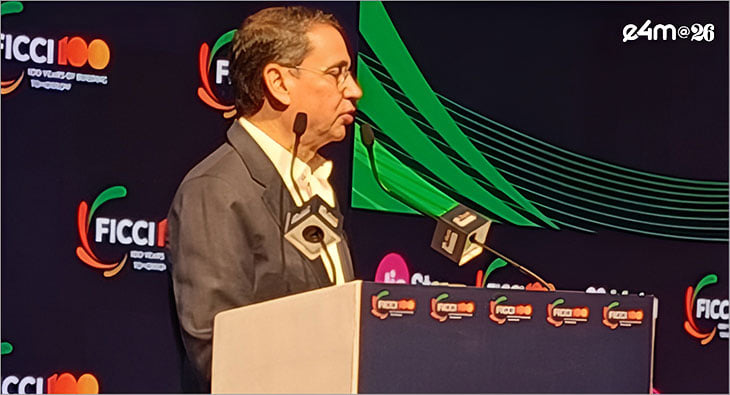

- Uday Shankar, Vice Chairman of JioStar, emphasized the media and entertainment industry's crucial role in shaping India's global narrative during his acceptance speech for a Lifetime Achievement Award at FICCI Frames.
- He argued that while India has made significant progress, a stronger narrative is needed to enhance global perceptions and build "Brand India" across various media sectors, including news, entertainment, and sports.
- Shankar highlighted the media's influence on societal aspirations and the importance of storytelling in building institutional reputations, asserting that this responsibility extends beyond news media to the entire media ecosystem.
- Reflecting on his career, Shankar expressed gratitude for the relationships and mentors that shaped his journey in the media industry, acknowledging the contributions of key figures in FICCI.
The media and entertainment industry has a larger role to play in shaping how India is perceived globally, JioStar Vice Chairman Uday Shankar said, arguing that the country’s progress needs to be accompanied by a stronger narrative around it.
Speaking after receiving a Lifetime Achievement Award at FICCI Frames, Shankar said India had made significant progress, but that the media industry could do more to help the world understand and believe in that progress.
“While a lot remains to be done, our country has made tremendous progress. What we have achieved is incredible.”
“If we need the world to believe in India more than it does today, we still need to play a role in that. And again, not just news, but entertainment, sports, movies, we need to build brand India,” he said.
For Shankar, that responsibility does not rest with the news media alone. He broadened it to the wider media ecosystem, pointing to the role of storytelling in building the reputation of institutions.
“The institutions that are known today to be great are also known today to be great because they have invested very actively in sharing their experiences, in telling their stories and building the narrative around that.”
He believes the same principle can apply to India as the country moves towards its next phase of growth. “And I think that as the country progresses to a greater future today, we can play a much bigger role in building brand India. And that responsibility lies squarely with us.”
Shankar's argument for a stronger role for media in shaping India's narrative stems from a broader view of what the industry contributes to society.
“I believe in the power of media,” he said, reflecting on the changing media landscape. Despite the changes in formats and platforms, he said the media continues to influence how people imagine their future and their place in society.
“First and foremost, no matter how many changes we have seen and have come about, the media continues to be a fundamental pillar of society. It is the foundation on which society's imagination, society's vision for the future and individual's aspirations for a better life, for a better world, for a better country, all of those are shaped. And I'm not just talking about news.”
Shankar acknowledged the importance of news, but said the influence of media extends across entertainment, drama, cinema and sports.
“News, of course, is very important. But all walks of media, whether it is entertainment, whether it is drama, whether it is cinema, whether it is sports, each one of these elements of media have an infinite ability to inspire people, people who have been left sidelined by the progress of the world. They can just imagine and they can create and it gives them a sense of hope.”
That role, he said, has remained relevant even as the ways in which media is consumed and produced have changed.
“And that is the role that it continues to play today. It has played in the past and it will continue to play tomorrow. The forms in which these are expressed may have changed. But that role remains far more pivotal today than it ever was.”
The remarks came as Shankar accepted the Lifetime Achievement Award, a recognition he described as a “humbling moment”. Reflecting on a career spent in media, he said the industry was not simply his profession but the only work he had ever known.
“But the media has been my life. Ever since I became an adult, media is the only thing that I have done.”
His remarks turned personal as he reflected on the people, relationships and institutions that had been part of his journey with FICCI. He specifically recalled Dr Amit Mitra and Yash Raj Chopra, crediting them with introducing him to FICCI and encouraging him to take an active role in the organisation. He also remembered the late Leena Jaisani, Head of FICCI's M&E division, saying FICCI Frames would not be what it is without her “indomitable energy and commitment.”
Read more news about Television Media, Digital Media, Advertising India, Marketing News, PR and Corporate Communication News
For more updates, be socially connected with us onInstagram, LinkedIn, Twitter, Facebook YouTube & Google News
