Buyability, Not Reach: LinkedIn's Devajit Roy redraws marketing playbook at e4m TechManch
LinkedIn's Head of India tells marketers to trade vanity metrics for "buyability" as AI reshapes how B2B buyers discover and trust brands
 by
by
Published: Jul 27, 2026 8:33 AM | 3 min read
 Follow Us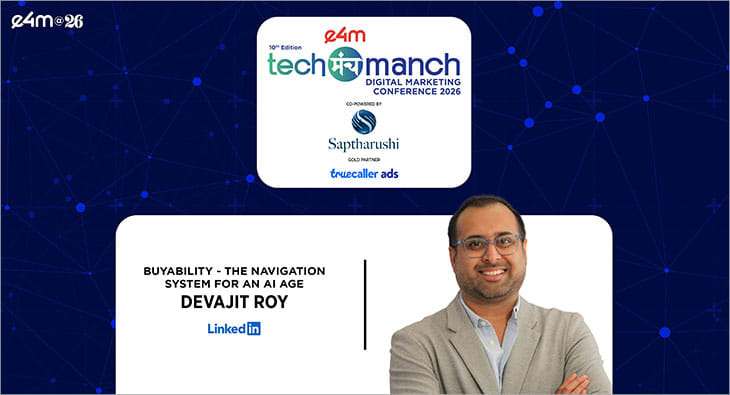

- Devajit Roy, Head of India at LinkedIn Ads, emphasized the need for marketers to focus on revenue growth rather than traditional metrics like reach and clicks during his session at e4m TechManch 2026.
- He highlighted the shift in B2B buying behavior, noting that 94% of buying groups now utilize large language models for research, necessitating a transition from push to pull marketing strategies.
- Roy introduced the concept of Generative Engine Optimization (GEO), which he argues will replace traditional SEO, focusing on brand relevance and defensibility in decision-making.
- He advised marketers to enhance their presence on LinkedIn through long-form content, active company pages, and leveraging trusted voices within organizations to improve brand visibility and authority.
Marketers chasing reach, clicks and impressions are optimising for the wrong scoreboard, according to Devajit Roy, Head of India at LinkedIn Ads, who delivered the Spotlight Session "Buyability - The Navigation System For an AI Age" at e4m TechManch 2026.
Opening with an aviation metaphor, Roy asked the audience to imagine themselves as pilots checking a navigation system that only displayed reach, traffic and clicks. "No one's really asking the questions which I'm sure is being asked to you. What is the growth in revenue that you really generated from all these three vanity metrics?" he said, arguing that the traditional funnel of awareness, familiarity and preference no longer reflects how buyers actually behave.
Citing research showing that 94% of B2B buying groups now turn to large language models such as ChatGPT and Gemini to research problems and solutions, Roy said marketing must shift from a push strategy to a pull strategy. He stressed that B2B purchases are rarely made by a single decision-maker but by a "buying committee" spanning influencers, users and executives. "You have a 20x chance of more likelihood of being bought if you really know the entire buying group," he said.
Drawing on a study of roughly 700 decision-makers, Roy said defensibility, not ease of decision-making, was the top factor buyers weighed before choosing a brand. "They would rather go for an option where they felt they could defend the decision even if it goes wrong," he noted, adding that this shift is data-driven rather than preference-driven, powered by AI-generated citations alongside traditional sales engagement.
This, he said, is where Generative Engine Optimization, or GEO, comes in. "SEO would be a thing of the past, but GEO is going to be the thing of the future," Roy said, describing a new navigation system built around four questions: whether a brand is being talked about, whether it surfaces in relevant LLM searches, whether it registers with decision-makers, and how defensible it is.
Turning to LinkedIn's own role in this shift, Roy said the platform's content is now cited five times more in LLMs over the past six months, a supremacy he attributed to first-party authority signals such as verified industry, designation and organisation data. He urged marketers to prioritise long-form posts and newsletters, keep company pages active with at least two posts a fortnight, and invest in employee advocacy. "Nothing really convinces people to search for you and to buy you rather than the people themselves who are talking about their own particular brand," he said.
Roy also spoke about cultivating "trusted voices" within organisations, senior leaders such as CMOs, CEOs and founders who post consistently and build follower bases beyond 3,000. He revealed that 40% of LinkedIn citations in LLMs come from members with over 10,000 followers, 35% from those with smaller but active followings, and the remaining 25% from company pages.
Closing the session, Roy summed up the shift succinctly: "Today is just not about reach. It is about relevancy and it is about authority that you're driving in sending your message to the target audience that matters to you."
Read more news about Marketing News, Advertising News, PR and Corporate Communication News, Digital News, People Movement News
For more updates, be socially connected with us onInstagram, LinkedIn, Twitter, Facebook, YouTube & Google News