AI is reshaping consumer journeys, making Search more personal: Google's Nikhil Bansal
Speaking at the Pitch CMO Summit in New Delhi, Nikhil Bansal outlined how marketers can adapt to changing consumer behaviour as AI-powered tools increasingly influence online experiences
 by
by
Published: Jun 18, 2026 1:08 PM | 4 min read
 Follow Us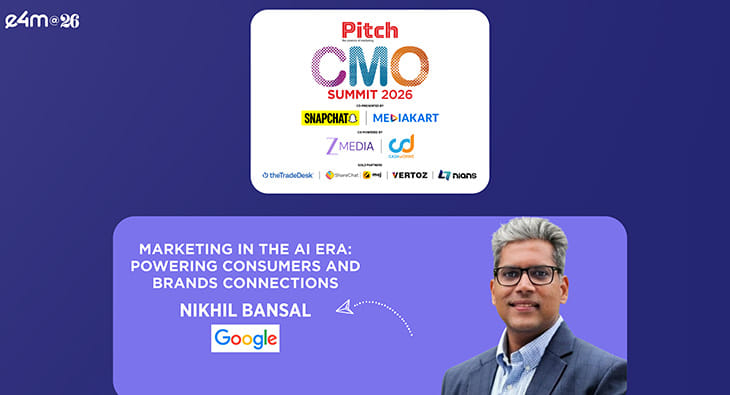

- Nikhil Bansal from Google India highlighted at the Pitch CMO Summit how AI is transforming consumer behavior in product discovery, evaluation, and purchasing, enabling brands to create more personalized experiences.
- He emphasized the need for marketers to adapt to evolving consumer interactions with information across various platforms, leveraging AI to deliver relevant experiences at scale.
- Bansal noted that AI is changing search behavior, with consumers increasingly using longer, conversational queries, providing richer signals of intent for brands to connect with potential customers.
- The session underscored the importance of integrating AI into marketing strategies, as organizations that adopt AI tools early will be better equipped to meet changing consumer expectations and enhance engagement.
Artificial Intelligence is fundamentally changing how consumers discover, evaluate and purchase products, creating new opportunities for brands to engage audiences through more personalised and intent-driven experiences, according to Nikhil Bansal, Industry Head, Tech B2B & Consumer Electronics, Google India.
Speaking at the Pitch CMO Summit in New Delhi, Nikhil Bansal outlined how AI is transforming the consumer journey from discovery to decision-making, while enabling marketers to create, capture and convert demand more effectively.
"AI has created a new consumer, one whose curiosity is met instantly, whose personal needs are deeply understood and whose path from discovery to decision-making is shorter but more fluid than ever before," Nikhil said.
The session focused on how marketers can adapt to changing consumer behaviour as AI-powered tools increasingly influence online experiences. According to Nikhil, brands need to understand how consumers interact with information across multiple touchpoints and leverage AI to deliver relevant experiences at scale.
He noted that Google has accelerated its AI development efforts over the past year, introducing new Gemini capabilities, personalized AI experiences and enhancements to search aimed at better understanding user intent.
Highlighting the pace of AI adoption, Nikhil said more than, in 2025, they saw a 3x increase in Gemini-generated assets created by advertisers, He cited the example as evidence of how quickly consumers are embracing generative AI tools.
The growing integration of Gemini across Google's products was another focus area. Nikhil said Gemini powers several of Google's major consumer products, including Search, YouTube and Maps, and described it as a key driver of newer AI-powered experiences across the ecosystem.
For marketers, the implications are significant. Nikhil Bansal spotlighted that search behaviour itself is evolving as consumers increasingly move from short keyword-based queries to longer, conversational prompts. This shift provides richer signals about user intent, allowing brands to connect with potential customers more effectively.
According to him, AI-powered search experiences are expanding rather than replacing traditional search. Nikhil said Google sees around 5 trillion searches annually, with 15% of daily queries being entirely new. He added that AI experiences such as AI Overviews and AI Mode are creating new ways for users to interact with search and discover information.
Nikhil said, "Longer and conversational searches mean more signals and richer signals of intent. The richer signals only help us with matching our products better to the end consumer." He noted that richer intent signals allow marketers to connect more effectively with consumers during the decision-making process.
He described the future of search as becoming increasingly intelligent, personal and agentic. helping users move from information discovery towards decision-making and task completion.
"For everyone in this room, it means your brand is no longer just a search result. When search is agentic, your business becomes that final answer in a frictionless path to purchase," he said.
The presentation also highlighted YouTube's role within Google's broader AI-driven marketing ecosystem. Nikhil positioned the platform as a key destination for consumer attention, creator-led content and commerce opportunities.
He noted that consumer engagement increasingly extends beyond live events and traditional broadcasts, with audiences turning to digital platforms for highlights, commentary and related content. This, he said, creates opportunities for brands to remain connected with consumers throughout their interest journey rather than only during marquee moments.
Nikhil said that 84% of Indian consumers use Google and YouTube every day, citing the statistic as evidence of the platforms' role in consumers' daily digital habits, underscoring the role of trust and habitual usage in driving engagement across the company's platforms.
The discussion further focused on performance marketing outcomes enabled by AI. Nikhil cited examples of brands using Google's AI-powered advertising tools to improve conversion rates, lower customer acquisition costs and generate stronger returns on advertising spend.
According to him, AI is becoming increasingly central to advertising effectiveness as marketers seek greater efficiency while maintaining relevance and personalisation. Nikhil said Google is integrating Gemini across its advertising products with the aim of improving campaign creation, audience relevance and performance outcomes.
The broader message from the session was that marketers must move beyond viewing AI as a standalone technology trend and instead integrate it into their customer engagement strategies.
As consumer expectations evolve and digital experiences become increasingly personalised, brands will need to adapt to a landscape where discovery, content consumption, shopping and decision-making are becoming more interconnected through AI.
Nikhil concluded by encouraging marketers to experiment with AI-powered tools and incorporate them into campaign planning and execution, reiterating that organisations that embrace the technology early will be better positioned to respond to changing consumer behaviour.
Read more news about Marketing News, Advertising News, PR and Corporate Communication News, Digital News, People Movement News
For more updates, be socially connected with us onInstagram, LinkedIn, Twitter, Facebook, YouTube & Google News