RCB on the block: Why is Diageo reviewing its most powerful IPL asset now?
The likely triggers, experts say are RCB being at its strongest-ever commercial peak, the fact that IPL teams rarely come up for sale and Virat Kohli's 17-year association with the team
 by
by
Published: Nov 7, 2025 9:32 AM | 9 min read
 Follow Us

Just a month ago, several reports hinted that Royal Challengers Bengaluru (RCB) could be headed for an ownership shake-up, and the speculation now appears to have turned official. On November 5, Diageo, through its Indian subsidiary United Spirits Ltd (USL), formally announced a strategic review of its investment in Royal Challengers Sports Pvt Ltd (RCSPL), the entity that owns both the IPL and WPL RCB teams. The disclosure, made through stock exchange filings, effectively confirmed that one of India’s most high-profile sporting assets is now on the block.
Read e4m report on the official announcement
The timing has raised several questions as RCB’s potential sale comes at a moment when the Indian Premier League is at its strongest-ever commercial peak, and at a time when RCB itself is experiencing its highest brand momentum since the franchise was created in 2008.
Houlihan Lokey’s IPL Brand Valuation Study 2025 underscores just how powerful the league’s financial environment has become. According to the report, the IPL’s enterprise value has climbed 12.9% to $18.5 billion, while its standalone brand value has risen 13.8% year-on-year to $3.9 billion. Sponsorship appetite is at record highs: the BCCI’s sale of four associate-sponsor slots delivered a 25% jump over the previous cycle, while the Tata Group extended its title sponsorship through 2028 in a $300 million deal.
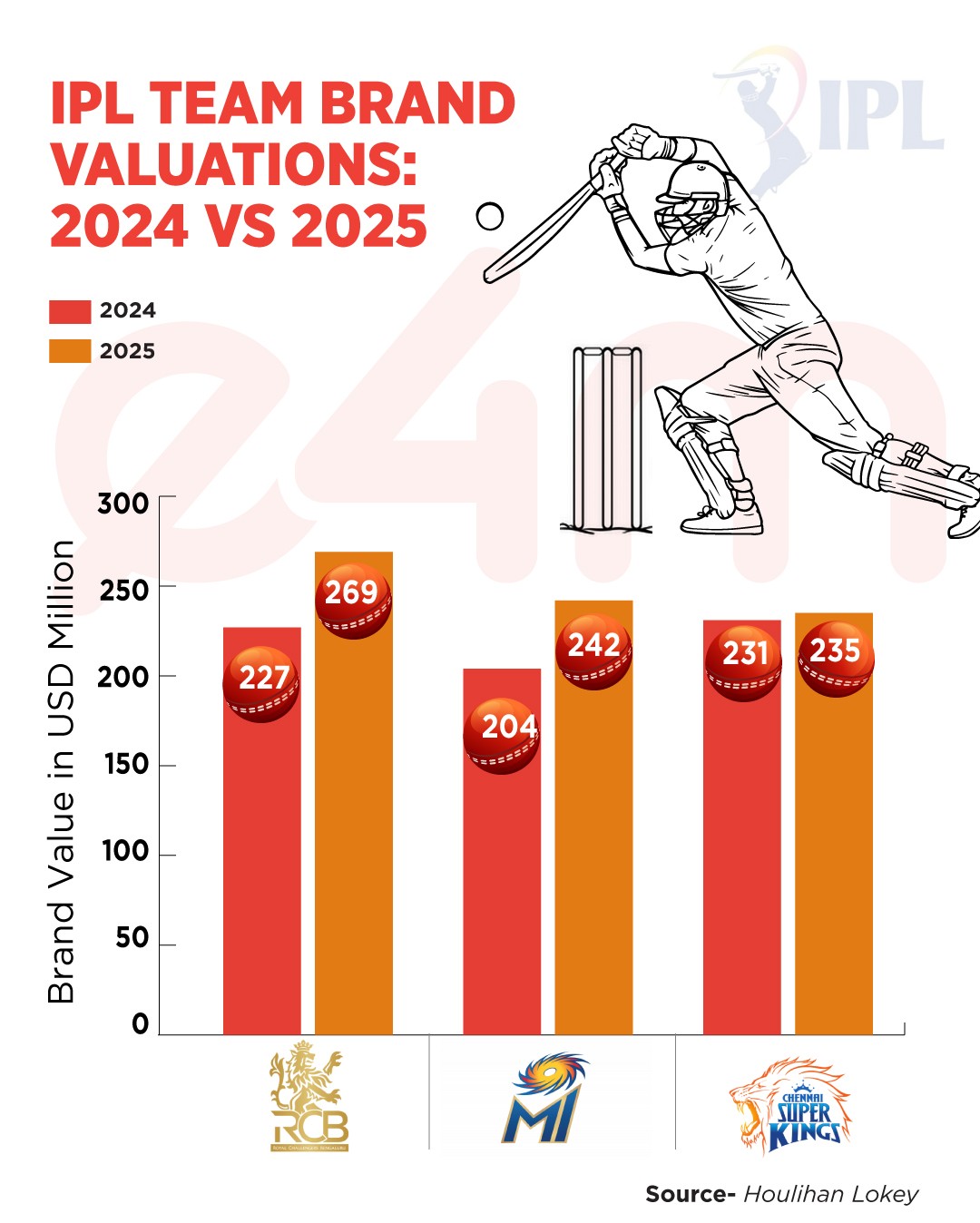
And within this booming ecosystem, RCB has emerged as the biggest winner. The franchise now leads the IPL’s brand rankings with a valuation of $269 million, up from $227 million last year, overtaking long-time leader Chennai Super Kings.
RCB’s rise is about far more than financial cycles or trophy success. It reflects a rare blend of deep fan loyalty, powerful digital communities, an expanding merchandising engine, and the enduring cultural influence of Virat Kohli, whose 17-year association has become central to the franchise’s identity.
Industry experts told e4m that RCB has consistently been a top-three IPL brand even in seasons when it never came close to winning.
Read e4m report on RCB’s IPL win
“RCB hadn’t won earlier, but in terms of brand value, sponsorships, and especially social media metrics, they were always right at the top. Their engagement numbers were usually No. 1 or No. 2. That’s rare. Globally, most sports brands build brand equity by winning. RCB didn’t, yet they remained a massive brand,” said Indranil Das Blah, Founder, AMP Sports & Entertainment.
“RCB is massive today. The men’s team won IPL 2025, the women’s team won WPL 2024 — two major trophies in 15 months, and that completely changes brand memory. They’re now the most-followed IPL franchise on Instagram with over 21 million fans actively showing their love every day. At this point, RCB isn’t just a Bengaluru franchise; it’s a national love mark. The combination of recent wins, the women’s title, and always-on digital engagement has made the brand incredibly sticky,” said Dr. Sanjay Arora, Managing Partner, Shells Advertising Inc.
To understand the bigger picture of what may have prompted Diageo’s decision — or why exit now? We spoke with several experts. But before diving into that, it’s important to first examine just how big RCB really is today, and what the franchise is actually worth.
The $2 Billion Question — What Is RCB Really Worth?
As soon as Diageo formally announced the strategic review, several reports began suggesting that the company is seeking a valuation of around $2 billion for RCB. At first glance, the number may seem aggressive, but as multiple experts told e4m, it is actually consistent with how the IPL’s economics have evolved. In fact, some argue it may even be on the conservative side.
According to Houlihan Lokey, RCB’s brand valuation currently stands at $269 million, making it the highest-valued franchise in the IPL. But this figure reflects only the brand. The enterprise value of an IPL team is significantly higher, powered by revenue share, broadcasting payouts, sponsorship cycles, ticketing, licensing, merchandising, and most importantly, long-term scarcity value.
Read e4m report on RCB brand value
And crucially, this is not unprecedented.
This isn’t the first time IPL valuations have surprised the market. The most striking example remains the Lucknow Super Giants (LSG) acquisition in 2021–22. Despite being a brand-new franchise with no legacy, no fanbase, no titles, and no on-ground history, the RP-Sanjiv Goenka Group secured the rights with a staggering ₹7,090 crore bid — roughly $940 million at the time. Even today, LSG has never reached an IPL final, and has finished mid-table in the last two seasons. Yet that near-$1 billion winning bid instantly reset expectations for IPL team valuations.
Against that backdrop, a legacy team like RCB, with 17 years of fan culture naturally commands a far higher premium.
As Blah explained, valuation in sport often defies traditional logic “a legacy brand like RCB asking for $2 billion isn’t unrealistic at all. It’s aggressive, yes, but in Indian cricket there will always be takers.”
The biggest driver, several experts say, is scarcity. IPL teams rarely come up for sale. Many owners, like CSK, MI, KKR, RR and SRH, are long-term holders with no plans to exit. That means anyone who wants entry into the world’s most valuable cricket league has extremely limited options.
Another major factor is cultural relevance. RCB is not just a cricket franchise, it is a youth brand, a lifestyle identity, and one of India’s most influential digital communities. Its social engagement matches global football clubs in scale and intensity.
And then there is Virat Kohli. His 17-year association with RCB has shaped the franchise’s aura and its commercial appeal. Even if he retires soon, experts believe he will likely remain connected to the brand in some capacity. “RCB and Virat are almost inseparable in how fans see them. Even if he stops playing, he will be part of the system, which will cushion any impact,” says Indranil.
“Star players are rocket fuel for awareness and commercial deals. Even the 2025 valuation study highlights the ‘presence of marquee players such as Virat Kohli’ as a key driver of franchise value. Kohli himself is India’s No. 1 celebrity brand at $231.1 million (Kroll 2024), and his 274 million Instagram followers are bigger than most global sports teams — that halo unquestionably flows to RCB,” added Arora.
Beyond Kohli, RCB also boasts major names in its roster, including Smriti Mandhana and Josh Hazlewood, among others.
Sources close to the development told e4m that the names such as Adani Group and Adar Poonawalla of serum Institute, would be the potential bidders.
According to Ramakrishnan R, Co-Founder and Director at Baseline Ventures, the surge in global venture-capital and private-equity interest in sports has made IPL teams extremely attractive alternative assets. But he also noted that IPL auctions have a history of throwing up surprises.
What is clear for now is that RCB will likely attract intense competition from multiple investor classes, private equity funds, industrial families, global sports investment groups, and deep-pocketed strategic corporates, all eyeing a rare opportunity to buy into the IPL.
Why Is Diageo Reviewing Its RCB Investment Now?
According to United Spirits Ltd, the reason for initiating the review now is straightforward. In its filing, the company said the exercise is aimed at reassessing the role of this asset within its broader India portfolio. USL noted that while RCSPL has been a “valuable” business, it sits outside its core alcobev focus. The review is expected to be completed by March 31, 2026, as part of a long-term effort to optimise value for stakeholders.
But sources told e4m that the official explanation is only one part of the story.
“Diageo’s leadership has said it’s not their core business, that’s the official statement. But beyond that, there are several other factors,” one source familiar with the matter said on condition of anonymity.
One major factor is the looming Virat Kohli transition. While some experts noted earlier that he will likely remain attached to the brand in some form, others told e4m that any move toward retirement, even if two or three seasons away, introduces uncertainty around RCB’s long-term brand equity.
“RCB has stayed a top-three brand even without titles, because of Kohli. His retirement, whenever it happens, will definitely impact valuations,” stated Blah.
A second factor is the media-rights environment. With Star and Jio now dominating IPL broadcast rights, experts believe the extraordinary surges seen in earlier cycles may moderate, making long-term revenue projections less predictable.
Additionally, USL has been navigating broader category headwinds. Stricter alcobev advertising norms, volatility in sponsorship markets after gaming regulations tightened, and the reputational discomfort following the stampede at an RCB fan event earlier this year have all contributed to a more cautious operating environment.
The business’s current financial posture also offers clues. In its Q2 FY26 earnings call on October 31, USL highlighted a quarter of strong execution and premiumisation momentum, reporting robust revenue growth, sharply improved margins, and disciplined reinvestment into its core categories. In the statement, its management has emphasised its focus on brands and initiatives “most elastic to growth,” underscoring the strategic logic of sharpening the portfolio toward premium alcobev and away from non-core ventures.
But perhaps the most significant driver is timing. RCB is at its commercial peak, fresh off an IPL title, a WPL title, record engagement, and now the most valuable IPL franchise with a brand valuation of $269 million. “Owning an IPL franchise is profitable, but sometimes it’s simply the right time to exit or hold a minority stake,” said Ramakrishnan.
Meanwhile, the markets have also reacted cautiously to the announcement. On November 6, the day after the strategic review announcement, USL’s stock fell 2.39%, closing at ₹1,416.25.
e4m reached out to Diageo for comments, but the company declined to speak beyond its official statement.
But, given the cultural identity RCB has built over nearly two decades, experts believe any new owner will preserve the franchise’s core brand elements such as the colours, the tone of communication, the hyper-local Kannada integration, and the broader fan-first culture. “New owners may add their touches, but it has to be gradual — not immediate,” experts emphasise.
With the process expected to conclude by March 31, 2026, one of Indian cricket’s most closely watched ownership shifts is officially underway.
In many ways, Diageo’s move closes one chapter, and sets the stage for one of the most significant ownership battles the IPL has seen in years.
Read more news about IPL 2024 News, Internet Advertising, Marketing India, PR and Corporate Communication, Television Media
For more updates, be socially connected with us onInstagram, LinkedIn, Twitter, Facebook YouTube & Google News