Microdramas eye $5bn market with AI as protagonist
Bite-sized format, binge-worthy content, cost-friendly production place microdramas at an inflection point; players exploring brand partnerships and monetisation avenues, say industry watchers
 by
by
Published: Nov 6, 2025 9:01 AM | 10 min read
 Follow Us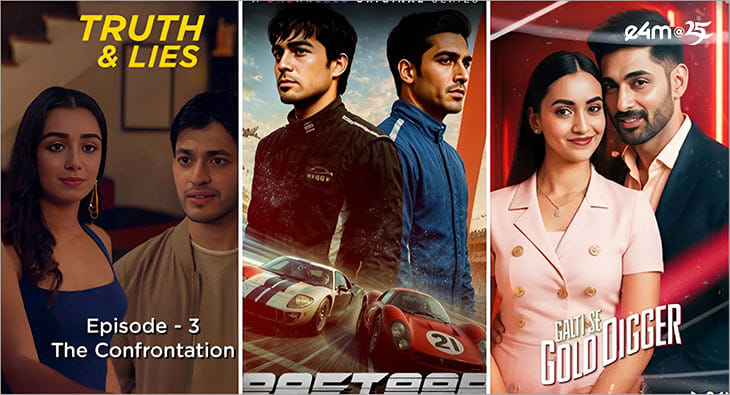

Have you been lately seeing a flurry of short, dramatic videos that look like mini soap operas while scrolling through your social media feeds? A breakup, a twist, a sudden pause or a cliffhanger that makes you click the next clip. This appears to be the new storytelling wave.
The microdrama has quietly grown from a creator’s experiment into a full-fledged entertainment format. What began as fun, creator-led sketches are now drawing support from startups, AI firms and social media platforms.
Ankush Sachdeva, Co-founder and CEO of ShareChat and Moj, says this new category is now a key part of the company’s business strategies. “We have built a strong core business with a large and loyal user base that allows us to invest confidently in new areas. The microdrama format gives us a clear opportunity to expand both subscription and advertising revenue,” he said.
Read e4m report on streamers exploring snackable formats
And the new ingredient that seems to be working wonders for this format is AI.
From writing scripts and editing videos to even creating digital characters, artificial intelligence is changing how these short dramas are made and distributed. India’s next phase of short-form entertainment is being driven as much by algorithms as by the actors.
Read e4m interview with ShareChat's Gaurav Jain on short videos
Shorter Format Keeps Budgets in Check
Industry experts say the charm of microdramas lies in the bite-sized format - tight story arcs, quick emotional payoffs and almost always an end on a hook. These are mostly 60-seconds long and designed for binge-watching. As per data from ShareChat, half of India’s short video viewers spend more than 30 minutes a day on such content. Nearly one in three watches for an hour or more. With 77 per cent of young Indians saying they prefer short-form videos over other formats, the audience appetite is only growing.
ShareChat’s short video app Moj has built a strong base of users with its microdrama feed. This May, it launched QuickTV, a subscription-based app focused entirely on serialised short dramas. The platform has 15 million downloads.
Read e4m report on 60-sec OTT dramas
According to the company, it has more than 35 million users who watch short-form stories across its platforms every day, spending close to an hour on them. ShareChat has also reported a 72 per cent drop in losses in FY25, helped by this new revenue stream.
Manohar Singh Charan, Co-founder and CFO, ShareChat, believes the microdrama economy is still taking shape. “The creator economy is at an inflection point. While creators are not yet able to depend fully on income from this format, the foundations are being laid. As more brand partnerships come in, monetisation will follow,” he said.
The shorter format helps keep budgets in check, Charan added: “A 10 to 15-episode series costs between ₹10,000 and ₹25,000 a minute depending on quality and cast. That is far lower than traditional long-form production costs.”
If ShareChat gave structure to the format, Story TV brought in the AI factor. The platform from the Eloelo Group has more than 20 million users and 300 live microdramas. Earlier this month, it launched Sach Ya Kalesh, India’s first reality-based microdrama hosted by Sima Taparia of ‘Indian Matchmaking’ fame.
The show follows nine real-life couples as they take lie detector tests on camera. “With Sach Ya Kalesh, we are taking the next big leap,” said Saurabh Pandey, Founder and CEO of Story TV. “It is India’s first non-fiction microdrama designed for mobile audiences. It is vertical, relatable and spontaneous.”
“I strongly believe micro dramas will be more than a $5 billion market in the next 3 years and will unlock a new form of storytelling, with Story TV leading from the front. Together with Balaji, our exclusive partnership will make micro dramas a staple across India, in line with the growing demand for stories that are entertaining, immersive & mobile-first,” Pandey said.
https://youtube.com/shorts/c-KOQS-1efo?si=ofu0WfAcD9jLICOE
The company plans to release over 800 microdramas within a year and reach 100 million users. Story TV was also India’s most downloaded app in October. The platform has tied up with Balaji Telefilms to co-produce more mobile-first stories.
“At Balaji, we have always evolved with the audience and the platforms they love,” said Sanjay Dwivedi, CEO, Balaji Telefilms. “Microdramas are an exciting new frontier. They are short, impactful and fit today’s viewing habits.” Pandey expects the segment to touch five billion dollars in value within three years.
According to Vinod Kumar Meena, COO and Co-founder of Kuku TV, “Our platform has a creator-first approach in this booming $5 billion microdrama industry.”
Backed by Tech
Technology firms are now stepping in to accelerate production. Bengaluru-based Dashverse has produced Raftaar, an AI-generated microdrama series. Built on its proprietary engine Frameo.AI, the 90-minute story series cut production time by half and reduced costs by nearly 75 per cent.
“Raftaar is more than an experiment. It shows how AI can help lower barriers to video production,” said Sanidhya Narain, Co-founder and CEO of Dashverse. “We are building a sustainable model where creators can earn directly in this new format.”
Sharing more insights on the creators, Soumyadeep Mukherjee, Co-founder and CTO Frameo.AI, said the platform was designed to support creators, not replace them. “Frameo.AI delivers professional-grade videos with speed and consistency. It helps creators go from script to screen in days,” he said. Dashverse plans to release 100 more AI-led dramas by year-end.
Rise of digital actors
Another player in the AI space is Avtr Meta Labs. The company has launched Truth & Lies, a 12-episode AI-led series featuring India’s first digital actor, Naina Avtr. Sponsored by Nature4Nature, the story unfolds over one intense night in Mumbai, exploring themes of friendship and betrayal.
https://www.instagram.com/reel/DQLuBH7CIYw/?utm_source=ig_web_copy_link
“Naina is not just an AI character. She represents what storytelling can become in the AI era,” said Abhishek Razdan, Co-founder and CEO of Avtr Meta Labs. The series used a mix of AI face-swap and voice cloning technologies, costing about ₹1 lakh per episode. “We can now clone voices in multiple languages and sync perfectly with dialogue at a fraction of the usual cost,” Razdan said.
The company plans to expand Naina’s presence into fiction, entertainment and conversational AI, building an ecosystem around India’s first digital star.
The quality and credibility challenge
Not everyone is convinced that AI can take over storytelling. Krisneil Peres, Co-founder of Fame Keeda, said AI dramas face two major challenges: quality and credibility. “AI speeds up production but often misses emotional depth and cultural nuance. Indian audiences are very sensitive to tone and realism,” he said.
He pointed out the backlash faced by the AI-generated Mahabharat on Hotstar, which many viewers found lifeless. “Drama is not an ad slot. It needs credible storytelling. Brands must act as partners, not interruptions,” Peres added.
Still, he believes AI-led dramas will grow with time. “This is part of a silent OTT revolution. As tools advance and localisation improves, microdramas will evolve into their own storytelling category with distinct economics and creative language,” he said.
Keeping it human
While AI dominates the headlines, several startups are betting on human-driven stories. ReelSaga, a mobile entertainment company, raised 2.1 million dollars this year from Picus Capital, ITI Growth Opportunities Fund and Nazara Technologies.
“Vertical short dramas are a cultural shift,” said Shubh Bansal, Co-founder and CEO, ReelSaga. “They are quick, emotional and addictive. Drama does not have to be long to move you.”
Abhijay Thacker of Picus Capital agreed that microdramas are here to stay. “This is not a passing trend. Microdramas are becoming the default format for a generation of mobile viewers,” he said.
Flick TV, another new player, raised 2.3 million dollars from Stellaris Venture Partners to produce short vertical dramas under five minutes. “India’s appetite for good stories is growing,” said Co-founder Kushal Singhal. “We are building a studio system that combines cinematic storytelling with creator agility.”
TukTuki Entertainment, another entrant, is focusing on family-friendly regional content. “TukTuki is about everyday Indian life,” said Founder Anshita Kulshrestha. “We are producing short dramas in Hindi, Bengali, Marathi and Gujarati that anyone can relate to.”
Platforms, Brands open doors for new talent
Despite the rise of AI, individual creators remain at the heart of this ecosystem. Dolly Singh, one of India’s most recognisable digital faces, launched the third season of her microdrama The Best Worst Date in September.
https://www.instagram.com/reel/DPN2I65jpWY/?utm_source=ig_web_copy_link&igsh=MzRlODBiNWFlZA==
The series, shot in Nainital, continues her exploration of modern dating and relationships. “In the first season, people said there was too much branding,” Singh said. “We learnt from that and made integrations more natural in the next seasons.”
Her latest season featured Tresemmé shampoo and Safari Bags. “We need brands to make these projects possible. They supported the story and let us work freely,” she said. Singh’s growing popularity shows that human-led storytelling still has a strong pull.
Kuku TV has gone a step further to nurture upcoming creators. Its Drama Drop contest offers ₹10 lakh each to four winners, along with exclusive content deals. “Microdramas are the future of entertainment,” said Vinod Kumar Meena, COO and Co-founder of Kuku TV. “This contest is our way of investing in creators who have ideas but not yet the reach.”
Gaming meets storytelling
Gaming companies are also joining the story bandwagon. Social gaming platform Zupee has launched Zupee Studio, a dedicated section for microdramas like Maut Ki Ghati and Billionaire in Love. The shows crossed five million views in the first month.
https://www.instagram.com/reel/DPygwylkhHd/?utm_source=ig_web_copy_link
Zupee has also acquired Sydney-based AI storytelling firm Nucanon. “For decades, we have been stuck between cinema and games,” said Dilsher Singh Malhi, Founder and CEO of Zupee. “With Nucanon, we are merging the two. The Pixar of the next century will come from the fusion of AI, video and gaming.”
Nucanon CEO Nilushanan Kulasingham said the collaboration gives them the scale to push boundaries. “The goal is to give users true control within a compelling story,” he said.
The global view
The global market for microdramas is expanding fast. The Motion Picture Association estimates it will grow from 1.4 billion dollars in 2024 to 9.5 billion dollars by 2030, an annual growth rate of 28 per cent. Japan is set to be Asia’s biggest market outside China, expected to touch 1.2 billion dollars by the end of the decade.
In the United States, companies such as DramaBox and ReelShort are leading the race. DramaBox made 323 million dollars in revenue last year and turned profitable, while ReelShort reached nearly 400 million but still posted losses due to high marketing spend. The numbers underline an important lesson for Indian players: while production costs may be low, distribution and audience acquisition remain expensive
India’s microdrama economy is now splitting into two streams. One is powered by creators and their storytelling charm. The other is driven by AI, promising scale and efficiency. Both are feeding the country’s growing appetite for short stories made for mobile screens.
As the format evolves, the winners will be those who blend speed with substance. The technology may change, but the story still needs a human heartbeat.
Read more news about Digital Media, Internet Advertising, Marketing News, Television Media, Radio Media
For more updates, be socially connected with us onInstagram, LinkedIn, Twitter, Facebook, YouTube & Google News