Rs 120 crore and counting: Influencer marketing becomes Bihar’s new election arsenal
Bihar’s 2025 election has shifted to the digital arena, where Bhojpuri stars and local influencers are driving political narratives through reels, memes, and viral campaigns
 by
by
Published: Oct 15, 2025 9:32 AM | 8 min read
 Follow Us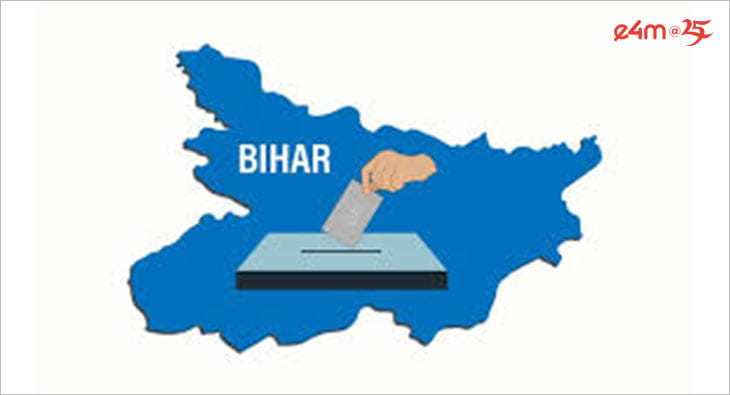

‘Aiye na humra Bihar mein’… ‘Modi ji hai toh mumkin hai’. These catchy jingles scrolling across your social media feeds are no accident. They’re part of a deliberate push to make the Bihar election trend online. As campaigning shifts to the digital battleground, influencer-marketing budgets are spiking, mirroring consumer brand behaviour.
Just like in consumer marketing, election campaigns increasingly rely on recall, virality, and creator credibility—not just reach. That’s where influencers like Shamita Yadav, aka the.ranting.gola, with 1.4 million followers, and Arpit Sharma with 2.1 million followers, come in.
As Bihar gears up for its two-phase Assembly elections this November, political parties are going all-in on influencer marketing, turning the state’s social media feeds into a digital arena.
Also read: Bihar: Polls still 2 months away but parties splurge nearly Rs 5 cr on digital in 30 days
Politics as Brand Campaigns
Political campaigns today look a lot like brand campaigns, only with higher stakes. Influencers are briefed like creative agencies, content calendars are aligned with election schedules, and engagement metrics determine where political funds flow. According to industry estimates, influencer marketing spends in Bihar have surged nearly five-fold since 2020—from ₹20–25 crore to an estimated ₹100–120 crore in 2025.
Google Ad Library data shows a massive surge in ad spending this October: ₹3.29 crore, up from just ₹0.19 crore in September. Over the last seven days, Bihar alone accounted for ₹3.29 crore in political ad spending, with the BJP contributing ₹1.13 crore.
Meta Ad Library data reveals that the BJP spent ₹30.42 lakh on political ads in Bihar in the last week, reaching over 1 million impressions, with an average of 6,000–7,000 impressions per ad. In contrast, the Indian National Congress ran no campaigns during this period, though it spent a modest ₹58,000 across 157 ads over the last 30 days. The Janata Dal (United) spent ₹1.75 lakh, reflecting a measured digital presence compared to the BJP’s aggressive outreach.
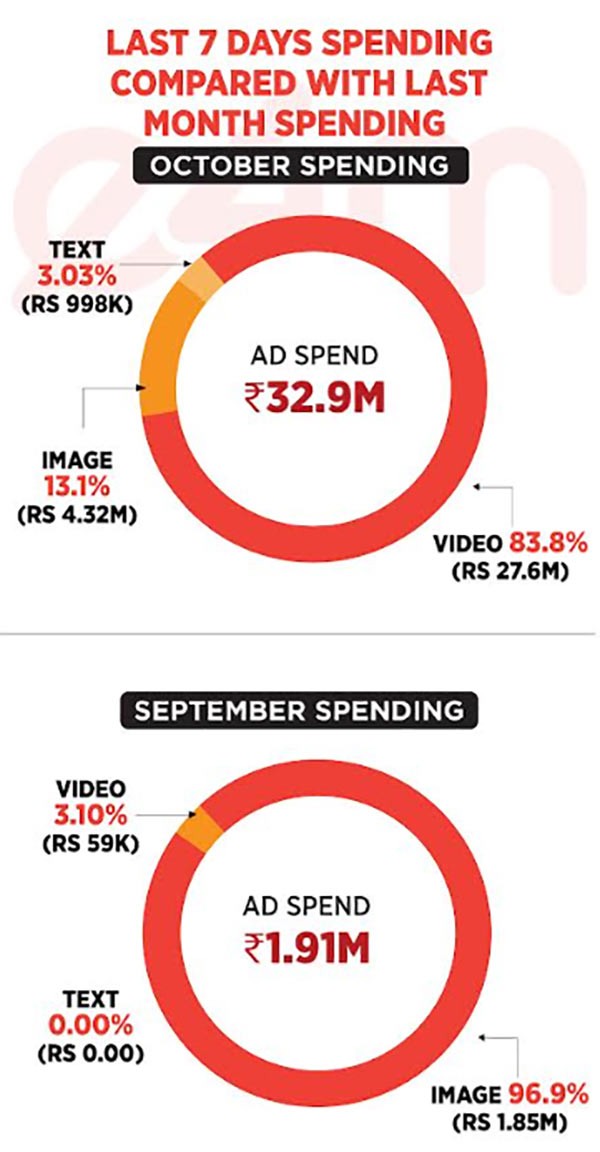
Video ads dominated October’s budget with 83.8% (₹27.6M), while image ads fell to 13.1% (₹4.32M) and text ads entered at 3.03% (₹998K). September, in contrast, was overwhelmingly image-led at 96.9% (₹1.85M), with minimal video investment (3.1%) and no text ads. This shift signals a strong pivot toward video-led campaigns.
Also read: BW Businessworld's latest issue examines Bihar's economic makeover & GST 2.0 rollout
View this post on Instagram
View this post on Instagram
View this post on Instagram
Digital First campaigns
Traditional media use in Bihar lags: NFHS 2019–21 shows only 42.6% of men and 24.6% of women read newspapers. TV consumption has increased in rural Bihar (+8.7%), even as it declined nationally. Digital adoption is uneven too—NSSO data suggested only about half of adults recently used the internet.
Yet, those online are highly active and influential. Low literacy (61%) and high WhatsApp penetration create fertile ground for short viral content, both informative and misleading.
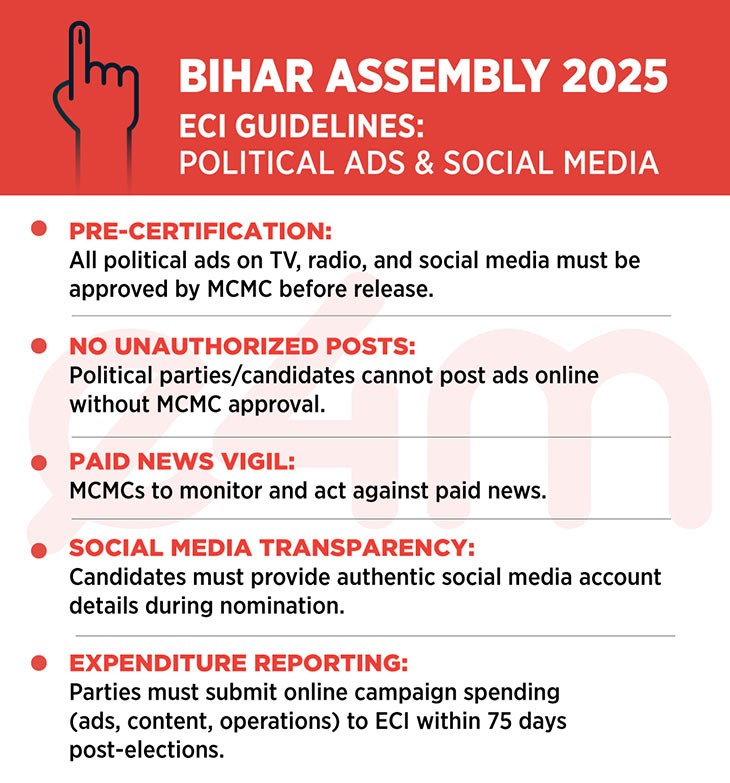
Also read: ECI makes pre-certification mandatory for political ads on electronic and social media
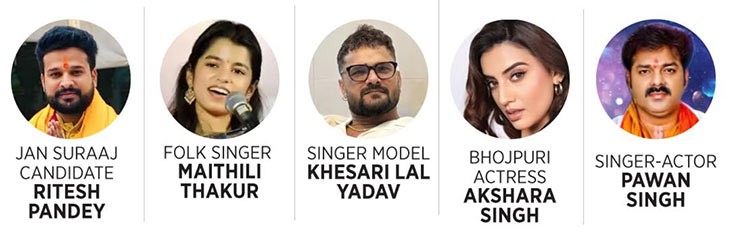
Anup Sharma, PR and Political Communications Advisor, explained the star power in Bihar politics: “Bhojpuri stars like Khesari Lal Yadav (6M+ Instagram followers), Pawan Singh (4.8M), Ravi Kishan (3.1M) and others are re not just entertainers — they are mass-audience brands. Ravi Kishan and Manoj Tiwari have already shown how film-and-folk popularity can be converted into parliamentary profiles: Kishan in Lok Sabha, Tiwari earlier in national politics. Their moves into politics changed the media dynamic, a press note is replaced by a trending reel, a public meeting by a viral clip, and a constituency visit by nonstop social chatter.”
While superstars bring eyeballs, Bihar’s real digital muscle lies in hyperlocal creators. From a Samastipur vlogger to a Begusarai YouTuber, these micro and nano influencers command trust in their communities. Their videos are raw, relatable, and often form the base layer of political virality. “Bhojpuri celebrities amplify reach; grassroots creators amplify trust,” Sharma added.
Creator Maithili Thakur’s (6 Million followers), recent political debut with BJP exemplifies this crossover. Her reel announcing her entry garnered 4,000 likes and 2,000 comments within hours—proof that in Bihar, a digital post can generate more buzz than a press conference.
“I will follow whatever instructions are given to me. Contesting an election is not my goal. I will abide by the order given to me by the party leadership,” she told the media, after taking membership of the saffron party in Patna. She was full of praise for the development work undertaken in Bihar under NDA rule.
“I have seen the developments brought about by the NDA in the state,” she added.
Thakur has been tipped to be fielded from the Alinagar assembly seat in Darbhanga district.
Former political strategist Prashant Kishor’s Jan Suraj focuses on hyperlocal stories amplified digitally, benefiting from a network of experienced digital warriors. Meanwhile, former Bollywood actor, LJP leader, and Union Minister Chirag Paswan’s ‘Chirag ka Chaupal’ will blend grassroots meetings with high-energy social reels. Political communication today is no longer traditional advertising versus influencers—it’s digital theatre, where voters engage with stories, humour, and drama, not just policies.
The AI-Driven Campaign Machine
Parties are now blending influencer power with AI content production. BJP and JDU have invested in AI-generated reels showcasing development projects like the Ganga six-lane bridge, while RJD leans on satire and humour. Prashant Kishor’s Jan Suraj has built a professionalised grassroots influencer network mirroring a digital newsroom, distributing hyperlocal stories across Facebook, YouTube, and WhatsApp.
The ‘Modi ji hai toh mumkin hai’ campaign featured national stars like Varun Dhawan, Rajkummar Rao, Arshad Warsi, and Vikrant Massey in collaboration with T-Series, one of YouTube’s largest channels. The video alone has 1.5 million views. Chirag Paswan’s upcoming “Chirag ka Chaupal” campaign is a hybrid model—mixing physical meetings with digital storytelling. Each reel, meme, and soundbite is designed to hit both emotional and algorithmic sweet spots.
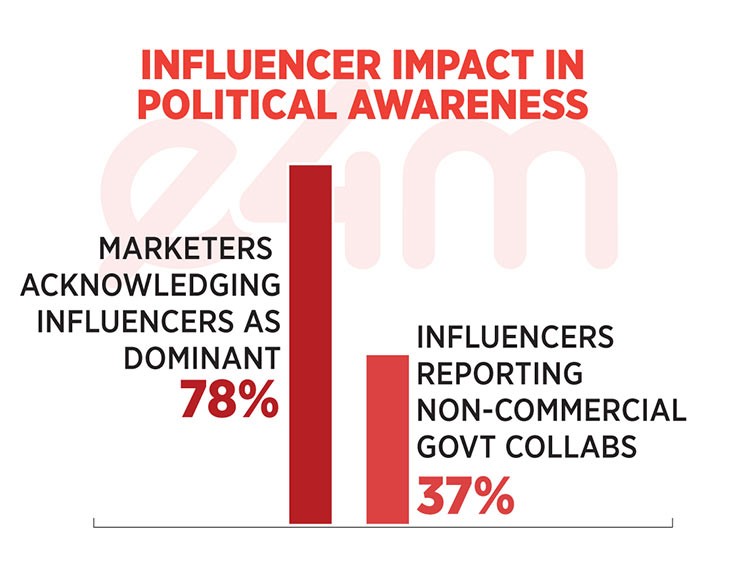
The influencer ecosystem in Bihar now runs parallel to traditional campaign setups. Creators coordinate with digital teams, plan shoot schedules around rallies, and adapt messaging to local dialects. “Politics has gone online. The same way brands pay for recall, parties pay for narrative,” said an influencer marketing agency expert. Creators like Shamita Yadav or Arpit Sharma may earn ₹3–4 lakh a month for political content, though few display overt branding. Their content is emotional, relatable—and effective.
The Tightrope of Digital Credibility
Virality is a double-edged sword. A reel can trend one day and trigger backlash the next. Tejashwi Yadav’s viral dance reel on Patna’s Marine Drive sparked both fandom and criticism. “Reels grab attention, but in Bihar, voters have sharp political instincts. They may watch everything, but they don’t fall for everything,” Sharma noted.
The New Digital Democracy
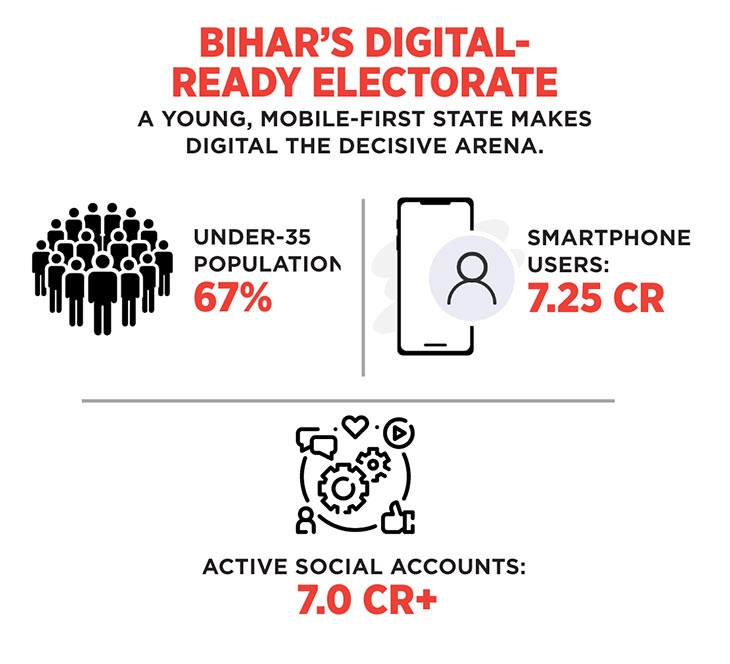
Bihar is young and digital. About 67% of the population is under 35, with 7.25 crore smartphone users and over 7 crore active social media users. Cheap internet and short-format video consumption mean younger voters experience politics through reels, memes, and trending debates on Instagram, X, and YouTube Shorts.
A Bhojpuri star’s reel can generate the same immediate reach as a local rally, landing in the hands of a viewer in Muzaffarpur, shared in Nawada, and discussed on TV panels in Patna and Delhi. Mega-influencers offer enormous followings, emotional recall, and cultural resonance across rural and semi-urban pockets. Parties coordinate these public moments with digital outreach, multiplying visibility exponentially.
Parallel to superstars, micro and nano influencers—like local vloggers and WhatsApp group admins—drive grassroots engagement. Their raw videos form the foundation that stars’ reels and party posts remix and amplify. In other words, Bhojpuri superstars amplify reach; micro-influencers amplify trust.
The 2025 Bihar Assembly Elections make one thing clear: Bhojpuri stars are strategic assets, turbocharging reach and creating instant social trends. But the layered ecosystem of micro-influencers, hyperlocal YouTube channels, WhatsApp networks, and ground-level organisers still determines outcomes.
Transparency must catch up with technology. Just as newspapers label ads, political reels and influencer posts need disclaimers. Reports show the Economic Offences Unit flagged over 430 objectionable posts in the first seven months of 2025, with FIRs filed in 15 cases—illustrating the scale of the challenge. Regulation must proactively check fake followers, bot amplification, and undisclosed ad spends while allowing creativity to thrive.
Today, young voters scroll reels, elders watch grassroots YouTube clips on WhatsApp, and both groups discuss the content at corner chowks. Elections are now being fought online, where political parties craft compelling narratives, engage millions, and galvanise support—defining not just Bihar 2025, but the future of elections across India.
Read more news about Digital Media, Internet Advertising, Marketing News, Television Media, Radio Media
For more updates, be socially connected with us onInstagram, LinkedIn, Twitter, Facebook, YouTube & Google News