Bihar: Polls still 2 months away but parties splurge nearly Rs 5 cr on digital in 30 days
Unlike 2020, when Covid restrictions forced parties to lean on online outreach, 2025 is seeing them fire on all cylinders with reels, memes and influencer tie-ups
 by
by
Published: Sep 9, 2025 9:08 AM | 8 min read
 Follow Us

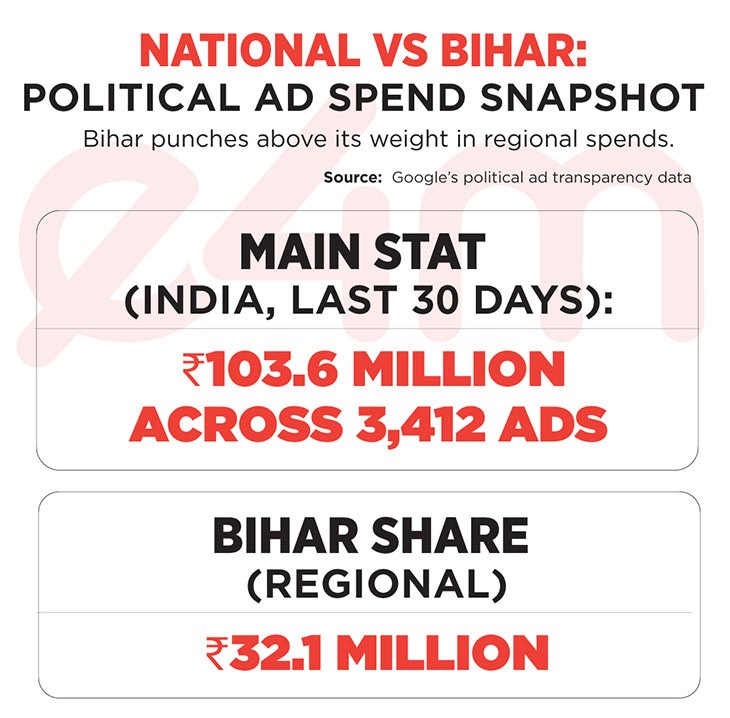
Bihar is headed for assembly elections in November and digital has already become the frontline battlefield. Political parties are depending heavily on online campaigning this year, with more than Rs 48.1 million (Rs 4.81 crore) spent by political parties in Bihar on Google and Meta alone in the last 30 days, as per transparency data. This accounts for over a quarter of the Rs 178 million that parties have spent on Google and Meta nationally in the same period, even as the polls in the state are still more than two months away.
Unlike 2020, when Covid restrictions forced parties to lean on online outreach, 2025 is seeing them fire on all cylinders with reels, memes and influencer tie-ups. The Bharatiya Janata Party (BJP) is leading the charge, outspending rivals nationally as well as in Bihar, setting the stage for a fierce digital showdown as the Election Commission prepares to announce the poll schedule.
Bihar has a history of staggered polling, with elections held in three phases in 2020 and five phases in 2015. This time too, the Election Commission is expected to conduct voting in three phases before the Assembly’s term ends on November 22, 2025. The contest will see the ruling National Democratic Alliance (NDA), led by Chief Minister Nitish Kumar, face off against the Opposition’s INDIA bloc helmed by the Rashtriya Janata Dal (RJD). In the 243-seat Assembly, the NDA currently holds 131 seats against the INDIA bloc’s 111, making the digital battleground even more critical in a tightly fought race.
BJP pumps in millions on Google and Meta, opposition lags
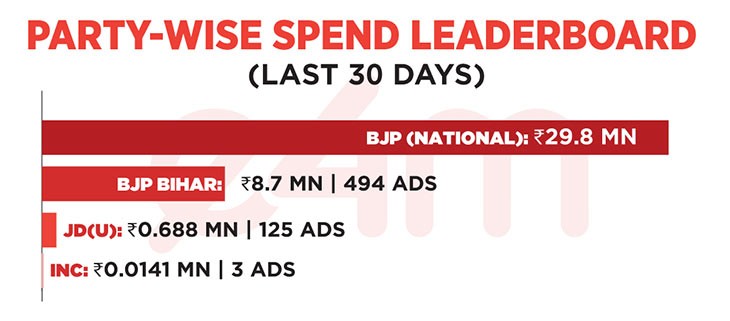
As per Google’s political ad transparency records, the Bharatiya Janata Party (BJP) has spent Rs 29.8 million, making it the single-largest spender in the last 30 days. On Meta too, BJP has taken the lead, with the Ad Library showing spends of Rs16 million during the same period. By contrast, JD(U), Congress and Jan Suraj reported zero ad spends on Google and Meta during this period, while RJD spent a token Rs 99 on Meta.
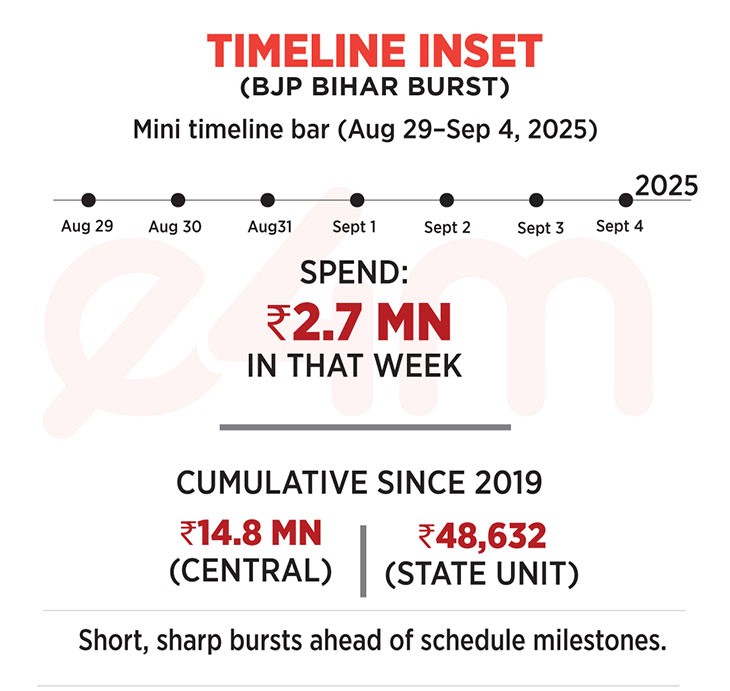
Looking at shorter cycles, in the last seven days alone, BJP spent Rs 2,731, 692 on Google ads and Meta ads, while rival Janta Dal (United) managed only Rs 99,357 between them. Overall, political ad spends from Bihar stood at Rs 32.1 milllion on Google and Rs 16 million on Meta, underscoring how digital campaigning has become the central battlefield this election season.
While these figures cover only Google and Meta, but experts estimate total spends — factoring in smaller and local platforms — to be at least 50% higher.
Digital playbook of political parties
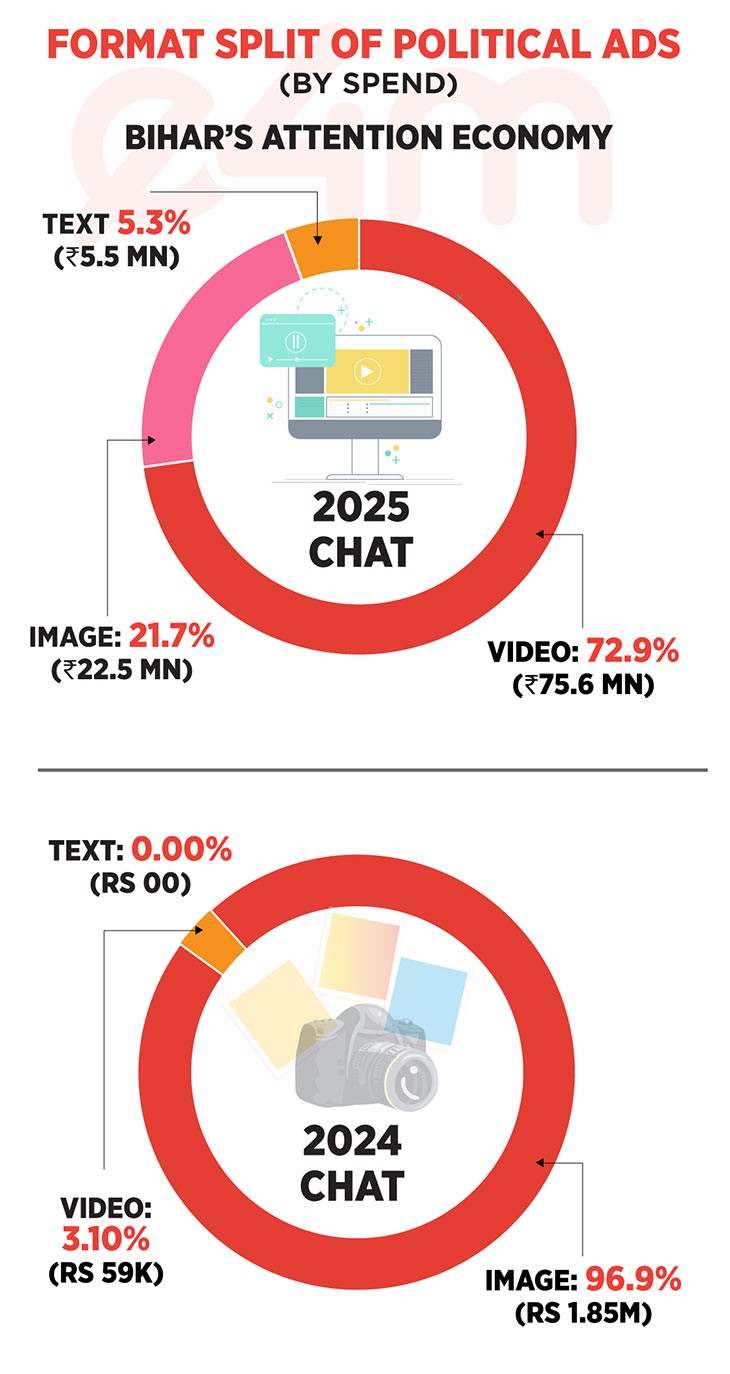
According to Google, video dominates political advertising in India, accounting for 72.9% of total spends (Rs 75.6 million) in last 30 days, followed by image-based ads at 21.7% (Rs 22.5 million) and text ads at just 5.3% (Rs 5.5 million). Experts say the split mirrors the format mix typically seen in state-level campaigns.
But the real shift is in influencer and content spends. According to Anup Sharma, PR & Strategic Political Communications Advisor, “In the 2020 assembly elections, spends on social media influencers in Bihar were in the range of Rs 20–25 crore, mostly experimental. This time, we’re already looking at Rs 100–120 crore, as digital campaigning has become the key platform.”
The surge is not just in volume but efficiency. Sharma adds that AI has slashed production costs dramatically. “Earlier, big influencers charged Rs 5–25 lakh per reel. Now digital teams are trained to use AI tools that create memes, reels, cartoons, and even voice-cloned speeches almost overnight. Voters will see a flood of content, humour, satire, emotional appeals, all at a fraction of the old cost.”
Governance reels, satire and grassroots ops define campaign mix
BJP and JD(U) are already amplifying governance reels highlighting projects such as the Ganga six-lane bridge and welfare schemes. RJD is experimenting with satire, while Prashant Kishor’s Jan Suraj has built one of the most professional grassroots digital operations in the state. Chirag Paswan’s LJP has entered with its “Chirag ka Chaupal” campaign, designed for both physical engagement and digital amplification.
Suneil Chawla, Co-founder at Social Beat and Influencer.in, said, “Usually we have seen state-level political campaigns to be in the Rs 15-30 crore range for digital budgets. For influencer and meme pages, spends would typically be in the range of Rs 3-4 crore. Many folks also work with political parties without a commercial consideration.”
Overall, Bihar’s digital political ad spends in the past 30 days stood at Rs 16 million across parties, highlighting how online platforms are shaping campaign strategies as the state prepares for another high-stakes election.
View this post on Instagram
View this post on Instagram
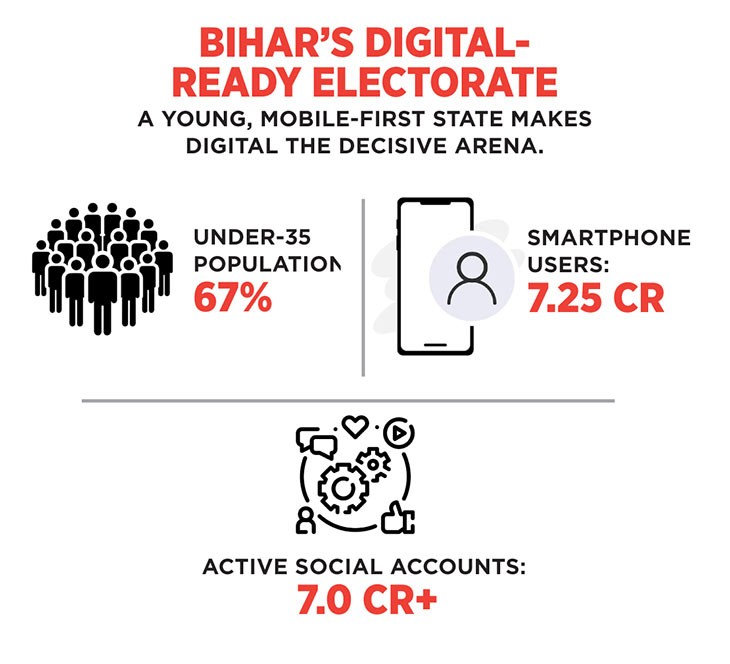
Bihar is one of India’s youngest states, 67% of its population is under 35. With over 7.25 crore smartphone users and 7 crore-plus active social media accounts, the reach is massive. But digital campaigning here is not confined to Gen Z reels and Instagram stories.
Grassroots YouTube channels covering hyperlocal issues, ranging from road projects in Gopalganj to hospital shortages in Nalanda are equally influential. Their clips often get chopped into short videos, shared widely on WhatsApp, and debated at roadside chowks. The result: digital content doubles as both entertainment and a powerful opinion-shaping tool.
Recognizing this, political outfits from BJP and JD(U) to RJD and Jan Suraj are building integrated content ecosystems. These campaigns weave humour, satire, emotional storytelling, and hyperlocal narratives, ensuring that both urban youth and rural elders are drawn into the digital conversation.
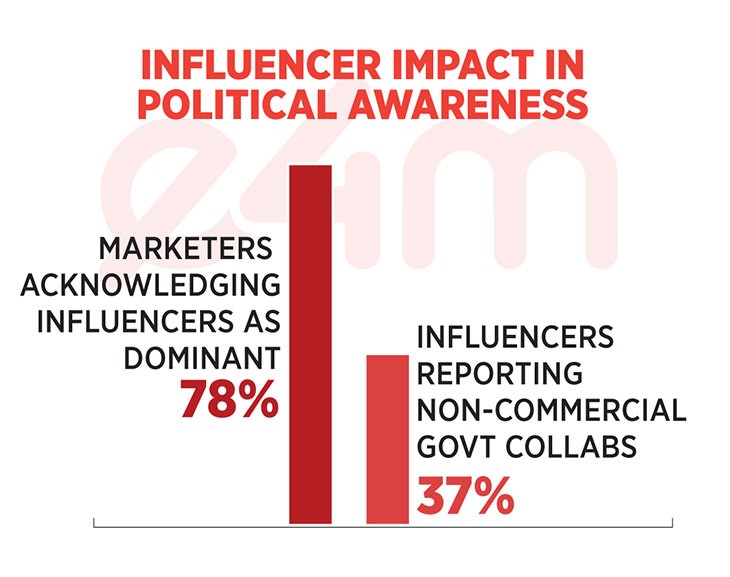
According to a Zefmo report, 78% of marketers acknowledge influencers as a dominant force in political awareness campaigns, while 37% of influencers report growing non-commercial government collaborations, highlighting the evolving role of influencers in public communication and advocacy.
AI meets street politics
Parties are increasingly blending AI with programmatic advertising. “In states like Bihar, ground-level outreach, rallies, street meetings, mobilization—remains vital, but it is now complemented by AI-powered targeting, chatbots, and predictive analytics,” said Sanket Savaliya of MGID.
Campaigns now send WhatsApp messages tailored to farmers in one region while deploying AI-driven youth forums on Instagram in another. As per EY report, AI could drive 41–45% productivity gains across content and marketing. India’s AI sector itself is projected to grow from USD 1.25 billion in 2024 to USD 12.4 billion by 2033.
View this post on Instagram
Rachit Malik, VP at Cyber Media said, “the new tactics mix AI-powered personalization—voice-cloned calls in local dialects, WhatsApp videos tailored to district-level issues, and simultaneous translations of speeches—with old-school mobilisation. AI and programmatic advertising are set to become the backbone of election strategies in India. They’re most effective when used together—AI drives personalization while traditional methods build trust.”
Influencers beyond celebrities
From reels to folk songs, the BJP-JDU alliance has doubled down on segmentation, targeting urban youth with infrastructure reels and AI-powered animations, while rural voters are reached through Bhojpuri songs, folk storytellers, and relatable village influencers. RJD, meanwhile, has chosen relatability as its plank, Tejashwi Yadav making reels with youth creators was not coincidental but a deliberate attempt to position himself as one of them.
Prashant Kishor’s Jan Suraj movement illustrates how influencers can be organized at scale. With over 21 lakh followers on Facebook, it runs a grassroots digital network that amplifies hyperlocal stories with authenticity, even as it remains highly structured. Chirag Paswan, too, is experimenting with his ‘Chirag ka Chaupal’ campaign, blending traditional village meetings with modern reels, memes, and shorts.
“The influencer today isn’t just a YouTuber or Instagrammer. It could be a local farmer giving a testimonial, a Bhojpuri singer lending their voice, or a student vlogger with a small but loyal following. That relatability is priceless in politics, where trust matters more than follower counts,” said Sharma.
Influencers offer something traditional ads cannot: emotion. A Bhojpuri singer’s endorsement feels like a neighbour’s voice, not a paid slot. But the medium is volatile. Tejashwi Yadav’s Marine Drive dance reel trended quickly but also drew ridicule, showing how easily content can boomerang.
Regulation struggles to keep pace
Transparency, however, lags behind. Just as newspapers label advertisements, reels and influencer posts in politics need disclaimers. Without them, voters can’t distinguish between organic endorsements and paid campaigns. Bihar’s Economic Offences Unit flagged over 430 objectionable posts in the first seven months of 2025, filing FIRs in 15 cases, evidence of the scale of the challenge.
As regulation catches up, tackling fake followers, bot-driven amplification, and hidden ad spends, one thing is clear: the battleground has shifted. Political parties are now investing in influencers as heavily as they once did in prime-time ads, setting a new precedent not just for Bihar 2025, but for elections across India.
Read more news about Digital Media, Internet Advertising, Marketing News, Television Media, Radio Media
For more updates, be socially connected with us onInstagram, LinkedIn, Twitter, Facebook, YouTube & Google News