MarTechAI Summit 2025: Can AI understand human emotion? Experts weigh in
At the MarTechAI Summit 2025, top leaders debated whether AI can truly grasp human emotion or if empathy will always remain uniquely human
 by
by
Published: Dec 10, 2025 4:37 PM | 6 min read
 Follow Us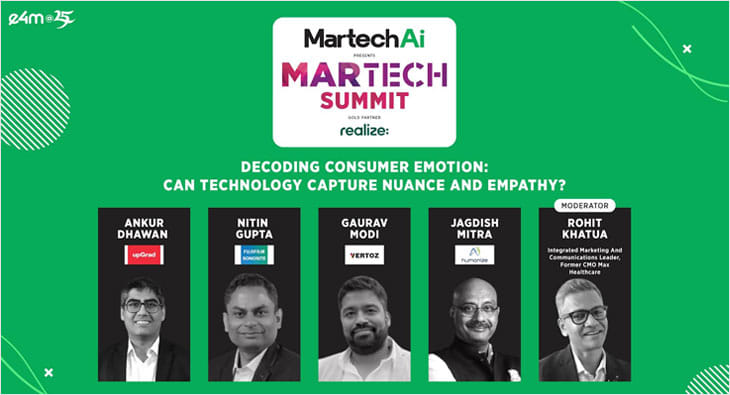

The MarTech Summit 2025 turned introspective with one of its most compelling sessions: a panel discussion titled “Decoding Consumer Emotion: Can Technology Capture Nuance and Empathy?” The conversation, moderated by Rohit Khatua, Integrated Marketing and Communications Leader and former CMO of Max Healthcare, brought together voices from edtech, healthcare, adtech, and AI innovation. Together, they explored whether machines can ever understand emotional subtlety, or if empathy is destined to remain a distinctly human advantage in marketing.
Khatua opened by grounding the discussion in a central truth of modern marketing: consumers today are emotionally fluid, hyper-informed, and operating in high-speed digital environments. “Attention spans are shrinking, expectations are rising, and emotional context changes by the minute,” he observed. “Marketers are asking whether technology can keep up – not just with behaviour, but with how people feel.” He framed the debate not as a clash between human and machine but as a partnership still being defined.
Understanding Emotional Signals Beyond Sentiment
The first major theme surfaced by Ankur Dhawan, Transitioning CPTO at upGrad, was that emotion analysis has evolved well beyond basic sentiment detection. “We used to measure emotion in three buckets: positive, negative, neutral. That world is gone,” he said. Dhawan explained that modern learning platforms and consumer apps now detect emotional micro-patterns that signal confusion, confidence, hesitation, motivation, or even quiet frustration.
Dhawan highlighted an important nuance: emotional data is meaningless without context. “A pause in a learner’s journey might indicate boredom, or struggle, or simply distraction. Without behavioural context, AI misreads emotion as easily as humans do.” He argued that empathy in AI stems from interpretive sophistication, not just computational power. This includes analysing time spent on tasks, drop-off points, response speeds, and life-cycle behaviour.
However, Dhawan acknowledged a critical ethical boundary. “The closer we get to decoding emotion, the more responsibly we must act. Emotional intelligence in AI cannot be allowed to become emotional manipulation.”
Emotion As Experience, Not Data Points
Jagdish Mitra, Founder and CEO of HumanizeTech.ai, expanded the conversation into the philosophical realm. He challenged the assumption that machines should attempt to “feel” emotions. Instead, he argued that technology must learn to respond appropriately to human emotion. “Emotions are experiences shaped by memory, culture, and intent,” he said. “The goal is not artificial emotion. The goal is artificial sensitivity.”
Mitra emphasized that emotional interpretation requires dynamism, not static profiling. “Personas built six months ago are obsolete. Even personas created yesterday might be outdated. What matters is real-time emotional fluidity.”
He explained that AI systems can already detect changes in tone, irregular pauses, and abnormal browsing behaviour that indicate stress or excitement. The next step, he said, is creating systems that adjust their responses mid-journey. For brands, this means shifting from rigid segmentation to living emotional profiles that update constantly.
He also warned that brands must avoid “flattening” emotion into simplified categories just to make AI processing easier. “Humans experience layered emotions: joy mixed with anxiety, excitement layered with doubt. Capturing that complexity is the real challenge.”
Adtech and The Ethics of Targeting Emotional States
Representing the advertising and programmatic sector, Gaurav Modi, Vice President at Vertoz, brought a pragmatic lens to the conversation. He noted that programmatic signals already hint at emotional states through behaviour, time-of-day activity, dwell time, scroll patterns, and content categories. “Emotionally contextual advertising is no longer theoretical. It’s happening quietly across the ecosystem,” he said.
Modi shared that emotional targeting has improved creative relevance and engagement rates, especially in sectors like fashion, entertainment, and QSR. But he cautioned against crossing ethical lines. “Just because technology can detect emotional vulnerability doesn’t mean brands should act on it,” he said. “A consumer browsing late at night while anxious or lonely should not be served predatory messaging.”
He advocated for explicit guidelines on emotional AI in advertising, including transparency frameworks, limits on targeting emotional distress, and consumer opt-out mechanisms. “Trust will define the next decade of MarTech. Emotional intelligence must never become emotional exploitation.”
He also predicted that regulatory bodies will soon examine emotional AI just as closely as data privacy. “We regulated personal data. The next frontier will be emotional data. And brands that prepare early will lead the trust economy.”
Healthcare: Where Empathy Is Not Optional
The discussion’s most grounded perspective came from Nitin Gupta, Managing Director for India & South Asia at FUJIFILM Sonosite India. Operating in a field where empathy directly affects patient outcomes, Gupta shared that technology’s role is supportive, not substitutive.
“In healthcare, technology doesn’t replace compassion. It enables it,” he said. Gupta explained that AI in clinical devices can now detect stress markers (such as tightened facial muscles, elevated speech stress, or distracted responses) and adapt its prompts accordingly. “If a patient is anxious, the system can slow down instructions. If they seem overwhelmed, it can simplify communication. That is a form of digital empathy.”
Gupta stressed that emotion detection is particularly useful in ultrasound diagnostics, emergency triage, and remote consultations, where clinicians rely on subtle behavioural cues. “AI becomes the second set of eyes, helping clinicians notice what they might miss under pressure,” he noted.
However, Gupta emphasized the need for strict oversight. “In healthcare, empathy without accountability is dangerous. Emotional AI must be medically validated, ethically governed, and always supervised by humans.”
The Central Question: Can AI Truly “Feel”?
Moderator Rohit Khatua pushed the panel to address the session’s core dilemma: “Are we expecting AI to understand emotion, or simply respond to it? And is that enough?”
Mitra argued that a response is enough if it respects human experience. Dhawan insisted that without interpretive nuance, AI risks shallow assumptions. Modi emphasised privacy and transparency as the non-negotiable pillars. Gupta reminded the audience that in critical industries, AI must enhance empathy instead of imitating it.
Khatua summarised the tension: “Machines may decode emotion, but meaning comes from people. The future lies in how well the two work together.”
Read more news about Digital Media, Internet Advertising, Marketing News, Television Media, Radio Media
For more updates, be socially connected with us onInstagram, LinkedIn, Twitter, Facebook, YouTube & Google News
