Agentic marketing is the next defining leap for industry: Siddharth Gopalkrishnan, Netcore
At MarTech Summit 2025, the Chief Customer and Marketing Officer of Netcore outlined how multi-agent workflows are turning marketing's long-standing ‘impossible problems’ into operational reality
 by
by
Published: Dec 10, 2025 3:27 PM | 4 min read
 Follow Us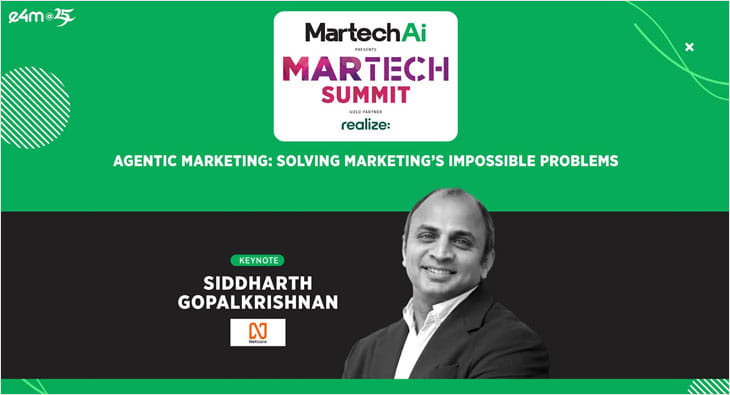

Siddharth Gopalkrishnan, Chief Customer and Marketing Officer at Netcore, delivered one of the most forward-looking keynotes at the e4m MarTech Summit 2025, positioning ‘agentic marketing’ as the next defining leap for the industry. Speaking to a packed audience under the summit theme ‘Agentic AI and Beyond – Redefining the Future of MarTech,’ he said marketers today are standing at the edge of a breakthrough moment. One that mirrors a historic sporting milestone.
He began with the story of Roger Bannister’s legendary four-minute mile. “For decades, nobody could break that barrier. It was considered physically impossible,” he said. “But once it was done, hundreds followed. What was impossible suddenly became achievable.” Gopalkrishnan said marketing faces its own impossible barriers: hyper-fragmented customer behaviour, chronic attribution puzzles, and the inability to personalize at scale. “We are in a similar situation. Customer behaviour is changing faster than organizations can respond,” he noted.
Gopalkrishnan argued that the traditional funnel is no longer sufficient. Search and discovery have become sharply intent-driven, making relevance non-negotiable. “People aren’t Googling anything and everything anymore. They’re being much more specific. Your funnel now starts with a smaller catchment and demands much higher relevance,” he said. As a result, marketers must move from broad targeting to micro-precision engagement.
He laid out the long-standing struggles that marketers repeatedly cite. Questions that have persisted despite years of technological investment. “Can we move away from the vicious attribution loop? Can we actually create actionable micro-segments without overwhelming teams? And can cross-sell and up-sell finally become meaningful instead of mechanical?” he asked. Industries such as e-commerce, BFSI, and real estate continue to confront low conversions, poor repeat rates, and disconnected customer journeys across channels.
The promise of agentic AI, he said, is its ability to unlock both scale and relevance at once. While most marketers already use individual AI tools for segmentation, insights, or content, he stressed that the true transformation comes from orchestrating these agents collectively. “With one prompt, can we create many more micro-segments and a much larger set of creatives: personalized, channel-ready, real-time, and with built-in trust layers? That is the equivalent of breaking the four-minute mile,” he said.
Gopalkrishnan showcased compelling examples where agentic workflows are already reshaping outcomes. Hyper-relevant product recommendations, vernacular messaging based on past call-centre interactions, and dynamic cross-sell journeys are no longer theoretical. “These are small things that make messaging so much more relevant - and they are absolutely possible today,” he said.
His most detailed illustration came from Netcore’s recent work with a global fashion brand during its quarterly sale, where the brand used agentic workflows to reimagine the entire campaign lifecycle. Including questions like “What insights do the last campaigns reveal? Which segments did we miss? If the agent were to design the campaign end-to-end, what would it look like?”
AI uncovered untapped customer groups, generated more than 20 tailored segments, produced customized creative variations, enforced brand guidelines, and determined optimal timings and channels; all automatically. “What would take an eight-to-ten-member team a week to put together can now be done in minutes,” he said. The system even prepared assets for WhatsApp whitelisting and used predictive insights to refine the rollout.
Gopalkrishnan emphasized that this is not a lab experiment, but it is already live across multiple sectors. He said the next step is adopting outcome-based pricing models that hold technology partners accountable for real business impact. “We’re happy to tie fees to actual revenue outcomes. That’s the model the industry must move toward,” he added.
He closed with a call for marketers to rethink their operating stack. “A unified data layer, strong decisioning systems, seamless activation, and a tight feedback loop: this is the stack marketers should aspire to build,” he said. Agentic marketing, he concluded, is not just another evolution in MarTech but a structural shift that will redefine how marketing is imagined and executed in the years ahead.
Read more news about Digital Media, Internet Advertising, Marketing News, Television Media, Radio Media
For more updates, be socially connected with us onInstagram, LinkedIn, Twitter, Facebook, YouTube & Google News
