Srinivasan Swamy’s BARC appointment puts credibility under fresh lens over Hansa link
At a time when BARC's credibility is already under the microscope before MIB, industry executives say the appointment risks opening an uncomfortable new front for the ratings body
 by
by
Published: Aug 14, 2026 3:00 PM | 8 min read
 Follow Us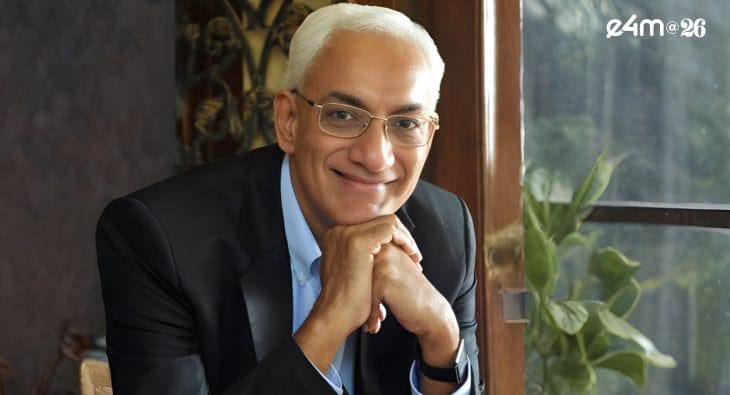

- Srinivasan K Swamy has been appointed to the Board of the Broadcast Audience Research Council (BARC) to replace Shashi Sinha, nominated by the Advertising Agencies Association of India (AAAI).
- Swamy's association with Hansa Research, a company linked to a controversial TRP manipulation scandal in 2020, raises concerns about BARC's credibility and governance, especially as the organization seeks to reassure stakeholders about its independence from commercial interests.
- The TRP scandal highlighted vulnerabilities in India's television ratings system, with allegations against Hansa Research regarding undisclosed commercial interests and lack of accountability for malpractice.
- Swamy's appointment is seen as a test for BARC's governance reforms, with industry executives questioning whether the organization has adequately addressed potential conflicts of interest and restored trust in its ratings system.
For a body whose entire business rests on one word — credibility — the latest change on the Board of the Broadcast Audience Research Council (BARC) could hardly have come at a more awkward time.
Srinivasan K Swamy, Executive Group Chairman of RK Swamy, has been nominated and elected by the Advertising Agencies Association of India (AAAI) board to replace Shashi Sinha on the BARC board, people familiar with the development said.
On paper, it is a straightforward industry appointment. Swamy is a veteran of the advertising industry and heads one of the country's established advertising groups.
But there is another part of the story that makes the appointment considerably more contentious: Hansa Research.
Hansa Research is part of the RK Swamy group, and its name remains indelibly linked to the television ratings controversy that shook India's media industry in 2020.
At a time when BARC's credibility is already under the microscope before the Ministry of Information and Broadcasting (MIB), industry executives say the appointment risks opening an uncomfortable new front for the ratings body — not necessarily because of anything Swamy himself has done, but because of the questions that the Hansa association inevitably brings back.
The Hansa question refuses to go away
The TRP controversy was supposed to have exposed the vulnerabilities in India's television measurement system. Instead, years later, some of the same names are still capable of reopening questions about how that system is governed.
Hansa Research was entrusted with installing and maintaining BARC's audience measurement barometers in Mumbai and parts of Maharashtra. These meters feed into the data that ultimately determines television ratings — the numbers that broadcasters sell to advertisers and agencies.
The Mumbai Police chargesheet in the alleged TRP manipulation case raised serious questions about Hansa's role.
According to the chargesheet, Hansa Vision Pvt Ltd, described as the holding company of Hansa Research, had commercial interests with various television channels but did not disclose those interests to BARC.
The police document also alleged that Hansa Research did not inform Meterology Data Ltd (MDL), a BARC-related entity, about those commercial interests.
And there was more. The chargesheet said there was no procedure to investigate or take action against Hansa Research employees or officers in cases of malpractice. Five of the 12 people arrested at that stage in the TRP case were former Hansa Research employees, according to the police document.
The allegations were contested and do not amount to a finding of guilt against Hansa Research, its parent group or its executives.
But reputationally, the damage was already done.
Hansa eventually withdrew from providing services to BARC, notifying Meterology Data Private Limited in 2021 of its withdrawal.
Now the group returns to the BARC boardroom
This is where Swamy's appointment becomes politically and institutionally interesting.
The man entering the BARC boardroom is not Hansa Research. There is no suggestion that Swamy himself was involved in the alleged TRP manipulation.
But he is the Executive Group Chairman of the group that includes Hansa Research.
And that distinction may be legally neat. It is less neat from a credibility standpoint.
“At a time when BARC is trying to reassure the ministry and the industry that its governance and measurement ecosystem are insulated from commercial interests, this appointment creates an obvious perception problem,” said a senior media industry executive requesting anonymity.
The executive added that the question would not simply be whether Swamy had a direct conflict.
“The more uncomfortable question is whether BARC has learnt from the TRP controversy. If the answer is yes, then the board should be able to demonstrate exactly what disclosure and conflict-of-interest safeguards are now in place,” the executive said.
BARC's biggest problem is not ratings. It is trust.
That is the uncomfortable reality confronting BARC.
Television ratings are not just another piece of market research. They decide where advertising money goes, influence channel valuations, determine programming strategies and can make or break television businesses.
The ratings body therefore has to be held to a higher standard than an ordinary industry association.
After the TRP scandal, BARC spent considerable effort rebuilding confidence in its measurement system. The industry was promised greater robustness, transparency and safeguards.
Which is why any board appointment that can even appear to reopen questions around commercial interests is likely to attract attention.
“BARC cannot afford to be judged only on whether there is an actual conflict. It has to be judged on whether there is a perception of conflict,” said another senior advertising industry executive requesting anonymity.
“Once the market starts asking whether the people overseeing the ratings system have links to entities with commercial interests in television, you are back to the same credibility conversation that BARC has spent years trying to move away from.”
And the MIB backdrop makes it worse
The timing could hardly be more sensitive.
BARC is already operating in an environment where its relationship with the MIB and the future of India's television audience measurement framework are under scrutiny.
For the ratings body, therefore, the Swamy appointment is not happening in a vacuum.
The ministry's lens is likely to be wider than the appointment of one individual. It is about whether the institution has built a governance framework that can withstand questions from broadcasters, advertisers, agencies and regulators.
That makes the Hansa history difficult to ignore.
One industry executive described it bluntly: “If BARC's credibility is already being questioned before the ministry, why would you voluntarily introduce another issue that can be questioned? Even if the appointment is perfectly legitimate, the optics are terrible.”
The defence will be simple. The questions won't be.
Swamy's supporters can point to his credentials and his long association with the advertising industry. His nomination also came through the AAAI board, giving the appointment an institutional industry mandate.
There is also a straightforward argument that ownership or group association does not automatically mean operational involvement.
Hansa has previously maintained that its research operations were separate from the advertising activities of Hansa Vision and disputed any suggestion that the research business was compromised by the group's commercial activities.
That defence may be factually relevant.
But BARC's problem is that credibility does not operate like a legal technicality.
In audience measurement, perception matters.
“If the ministry asks whether the appointment is permissible, that is one question. If the industry asks whether it inspires confidence, that is a completely different question,” said a senior executive familiar with the ratings ecosystem.
Swamy Responds
Swamy did not respond to the queries sent by e4m, however, in an email to AAAI members, Swamy stated, "Hansa Research Group (HRG) was actually the Complainant. The entire scandal came to light because of HRG. On October 6, 2020, Hansa's Deputy General Manager, Nitin Deokar, discovered internal malpractice and filed an FIR with the Mumbai Police. The complaint alleged that a former relationship manager (field executive) of HRG had compromised data to rig TRPs and sought broader police investigation. While any other Company would have at the most, dismissed the errant Employee, HRG took the high road and sought an investigation to book the larger network of criminals involved in it. We underwent the unpleasant ordeal of legal hassles but did not compromise on ethics.
"At a press conference by Param Bir Singh, Mumbai Commissioner of Police on 8th October 2000, he accused three channels of manipulating TRPs. Another important player in this case was Sachin Waze Assistant Police Inspector. Pertinently, they both were dismissed from service after investigation of their role in extortion. We played an important part in bringing the truth out and it is sad that half-baked google research should make you arrive at conclusions contrary to Judicial records."
"Hansa Research filed a Criminal Writ Petition in Bombay High Court against Mumbai Police when they started harassing our senior people and wanted our “statements” to frame certain channels. Our case was so strong that Mumbai Police had to run for cover and there was pressure on us to withdraw the case. We stood firm and the Court had to exonerate us from any wrongdoing. This is verifiable from Court records."
A board seat becomes a governance test
Swamy's appointment could ultimately become a test of whether BARC has genuinely strengthened its governance since the TRP controversy, especially with the license renewal process underway.
The obvious questions are straightforward.
Has every potential commercial connection been disclosed?
Can the board demonstrate that decisions involving vendors, broadcasters or measurement operations are insulated from individual or group interests?
And, crucially, are these safeguards strong enough for the MIB and the wider industry to believe that BARC's ratings currency is beyond commercial influence?
Those questions are likely to matter more than Swamy's credentials.
Because the irony is difficult to miss: BARC's most valuable asset is trust, and its biggest vulnerability is anything that makes the industry question that trust.
The TRP scandal exposed how fragile that confidence can be, while the landing page tussle created complexities.
Now, with Hansa Research's history once again sitting uncomfortably close to the BARC boardroom, the ratings body has another credibility test on its hands.
And this time, the question may not be about whether the meters can be manipulated. It may be about whether the institution overseeing those meters can convince everyone that it is beyond reproach.
Read more news about Internet Advertising India, Marketing News, PR and Corporate Communication News, Digital Media News, Television Media News
For more updates, be socially connected with us onInstagram, LinkedIn, Twitter, Facebook YouTube & Google News