Are moving OOH ads becoming the new playground for creativity and mobile marketing?
Experts told e4m that advertisers are leveraging mobility not just for visibility, but to match the speed, immediacy, and frequency the format allows
 by
by
Published: Oct 15, 2025 9:15 AM | 8 min read
 Follow Us

From hand-painted truck backs and auto rickshaw panels to buses, metros, and sleek digital screens on wheels, moving Out-of-Home (OOH) advertising in India has come a long way. What was once a simple visibility tool has today transformed into a strategic, measurable medium that integrates creativity, data, and technology. Everything from EV fleets and delivery vans to intercity buses and logistics networks has become part of the mobile media landscape today and are turning ordinary commutes into dynamic brand experiences.
Earlier campaigns focussed on hyperlocal visibility, promoting services such as sexual health awareness or betting platforms using auto rickshaws. Over time, advertisers have expanded their approach, moving from simple back-panel ads to using vehicles as a canvas for creative stunts.
Read On: AI in OOH: Outdoor sees spike in engagement, thanks to precision & data-driven push
Jeevansathi’s viral ad recreating a wedding mandap at bus stops captured public imagination, Tinder turned garbage trucks into eye-catching moving billboards that generated thousands of viewer interactions, apps like WinZO leveraged ride-hailing platforms to reach users on the move, and global brands such as Uber and LEGO experimented with innovative campaigns to stand out in crowded urban spaces.
Other noteworthy campaigns include Shaadi.com’s life-size ice sculpture in Bandra, which played on popular phrases to connect emotionally, and Croma’s “AC Ho Toh Croma Se Ho” initiative featuring frozen chairs in metro coaches across 120 cities, showcasing how storytelling and relevance are now central to OOH creativity.
Now, most recently, delivery platforms like Zomato have jumped onto this bandwagon. Just a few days ago, food delivery giant Zomato began turning its delivery bags into ad spaces through a pilot partnership with CARS24 in Bengaluru, transforming thousands of delivery bags into moving billboards and turning every order into a brand touchpoint.
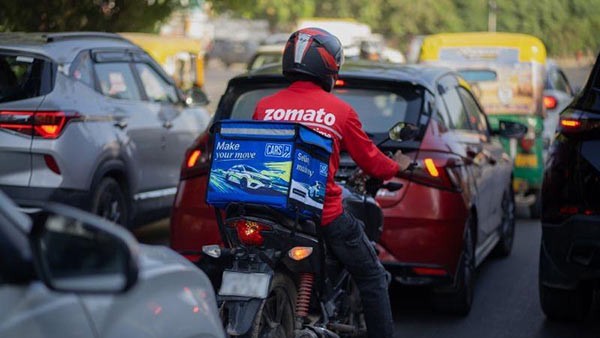
Gajendra Jangid, Co-Founder of CARS24, told e4m that the objective was to explore innovative and hyper-local ways to engage with consumers while ensuring the brand’s presence was meaningful and responsible on the road. “Delivery bags, constantly on the move across the city, provided a natural medium for the CARS24 brand to reach audiences in everyday environments, making our messaging visible in a contextually relevant and safe manner,” he said.
He added, “Unlike traditional billboards, this medium brings the brand directly into real-world contexts, capturing attention where people live, work, and shop, while reinforcing road safety.”
Read On: The New OOH: From nails to potholes, how brands are rewriting the rules of advertising
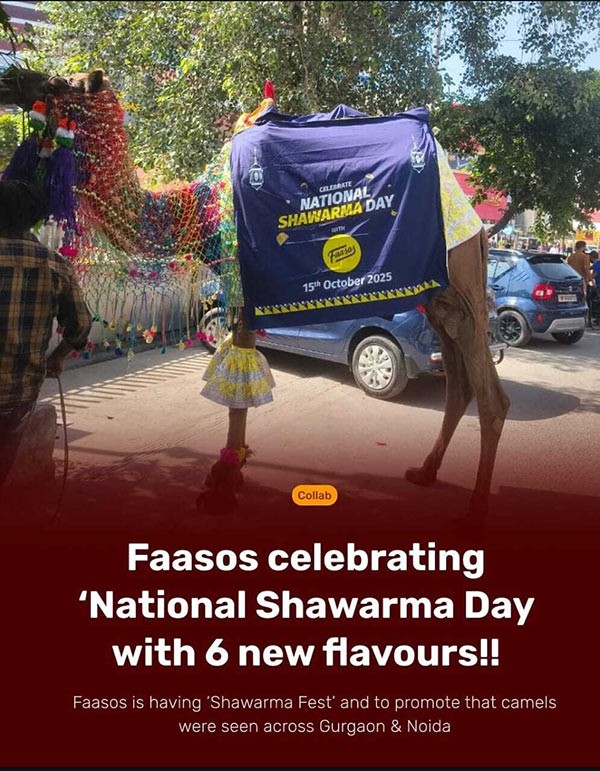
Enterprise brands like Zoho are also taking this approach further, and are leveraging airport buses and other urban transit to reach audiences in innovative and impactful ways. Adding to the creativity, Faasos has used a camel to advertise around National Shawarma Day, showcasing the playful and unconventional potential of moving OOH. This shift clearly signals a broader evolution in India’s advertising landscape.
Krishna Iyer, Director of Marketing at MullenLowe Lintas Group, said, “What was once used primarily for visibility has now become a measurable and strategic part of the marketing mix. Today, everything from delivery vans to intercity buses and logistics networks can serve as mobile media platforms, delivering targeted, high-impact campaigns. This mirrors trends in advanced markets like London, Singapore, and New York, where mobility and data have transformed vehicles into high-frequency, hyperlocal media assets.”
Turning Streets into Storyboards
Several experts told e4m that advertisers are leveraging mobility not just for visibility, but to align their messaging with the immediacy, speed, and frequency that the format offers. And, certain categories have emerged as clear frontrunners in the moving OOH space, led by delivery, quick commerce, fitness, healthcare, fintech, entertainment, and retail brands.
Pramod Sharma NCD, Rediffusion, explained: “Categories that rely on timing, proximity, and frequency, like food delivery or fitness apps, benefit most. The city becomes your storyboard, the streets your audience. Imagine a Nike message behind a Zomato delivery box or an Apollo bike tyre ad on a Zepto vehicle—the possibilities are enormous.”
Adding another layer to this, Rajesh Radhakrishnan, Co-Founder & CMO at Vritti iMedia, said, “The Union government and PSUs have utilised LED-mounted vans to disseminate information and awareness programmes in remote areas, including the Mahakumbh Mela, demonstrating its scalability. FMCG, BFSI, and consumer durable brands have also adopted mobile vans and bus stations to drive awareness and app adoption in rural markets.”
Read On: Rural OOH sees 15-20% uptick as early monsoons boost farm incomes
Sarabjit Singh Puri, Chairman of Fateh Rural Limited, added, “Delivery and quick-commerce brands have been among the most enthusiastic users, as the idea of ‘speed and movement’ aligns perfectly with their value proposition. Entertainment, retail, and telecom brands also benefit, using the format for quick visibility and mass reach. However, many brands still use moving OOH tactically rather than strategically—often for short bursts of buzz rather than sustained storytelling. In smaller towns, real-estate developers and local service brands have found success using moving OOH to create presence and credibility.”
Market Growth and Budget Trends
This creative shift comes at a time when the overall OOH sector is on a strong growth trajectory, creating more opportunities for brands to experiment with new formats.
It is pertinent to note that the industry grew 12% year-on-year, from ₹4,140 crore in 2023 to ₹4,650 crore in 2024, and is expected to cross ₹5,000 crore in 2025, as per Pitch Madison Advertising Report 2025. High-footfall locations such as malls, airports, and metro stations are enabling brands to deliver dynamic, interactive, and highly visible campaigns to urban audiences.
When it comes to moving OOH, however, the picture is more fragmented. The category remains largely disorganised and comprehensive data is still not available. But experts estimate that 15–20% of marketing budgets in 2025 could be allocated to moving formats, though Pramod Sharma, National Creative Director at Rediffusion believes the actual spend for certain campaigns may be closer to 5%.
Currently, the distribution of spends varies by region. Airports command the largest share in metro markets, railway stations dominate in urban areas, and bus stations lead in rural regions, according to Radhakrishnan of Vritti. Fabian Trevor Cowan, Director, Connect Network added that metros attract the biggest chunk overall, followed by buses, taxis, and then autos.
Read On: Bold Care, Zepto & Shaadi.com’s witty OOH banter grabs eyeballs
Moving OOH Takes Modern Twist
Moving OOH has become a playground for experimentation, particularly for D2C and new-age brands, as per many experts. While legacy advertisers continue to leverage static OOH for mass awareness, start-ups and digital-first brands treat moving OOH like a social-media moment on the streets—bold, playful, and instantly shareable.
Sharma mentioned that moving OOH is inching towards the mainstream, however, it will always thrive as a creative playground. “Moving OOH works best when it surprises, not when it becomes wallpaper. It’ll grow, but its strength will remain in doing what static can’t.”
Puri said, “New-age brands have brought fresh energy to moving OOH—they experiment more, take creative risks, and are quicker to deploy short, sharp campaigns. Legacy brands are steadier and more disciplined. Over the next few years, I expect a more balanced blend—newer brands learning the value of consistency, while established advertisers borrow agility from start-ups."
Media Buying Challenges
Despite its appeal, moving OOH presents a unique set of challenges. The biggest hurdle as per experts isn’t execution—it’s precision.
Cowan explained, “Identifying the right markets, audiences, and message fit is critical. You might pass thousands of people on a route, but only a fraction are actual prospects.”
Read On: OOH industry urges finance minister to rationalise GST
According to Sharma, “The challenge isn’t buying space, it’s buying movement with meaning. In an era of message tracking, measuring the audience response remains a challenge. But yes, technology today can help solve that too.”
Another expert shared that understanding audience movement patterns is key, “Geography matters immensely—a route that works brilliantly for a delivery brand in Mumbai may make little sense for a rural banking campaign in Punjab. Relevance and timing determine success far more than frequency alone.”
While moving OOH in India has evolved from simple visibility to a strategic, measurable, and creative medium, blending mobility, technology, and data, the industry still remains fragmented.
For marketers, it offers unparalleled opportunities to surprise, engage, and convert urban and rural audiences, turning streets into a dynamic canvas for brand storytelling. However, challenges around measurement, scalability, and organisation persist. At the same time, as experts point out, it is still difficult to predict how large this segment might grow or what its full potential could look like.
Read more news about Out of Home, Internet Advertising, Marketing, Digital Media, TV Media
For more updates, be socially connected with us onInstagram, LinkedIn, Twitter, Facebook, YouTube & Google News