I took the biggest risk of my career by moving to DD News: Sudhir Chaudhary
Sudhir Chaudhary speaks about risk-taking, the changing nature of audiences, personality-led journalism, and more
 by
by
Published: May 18, 2026 9:17 AM | 7 min read
 Follow Us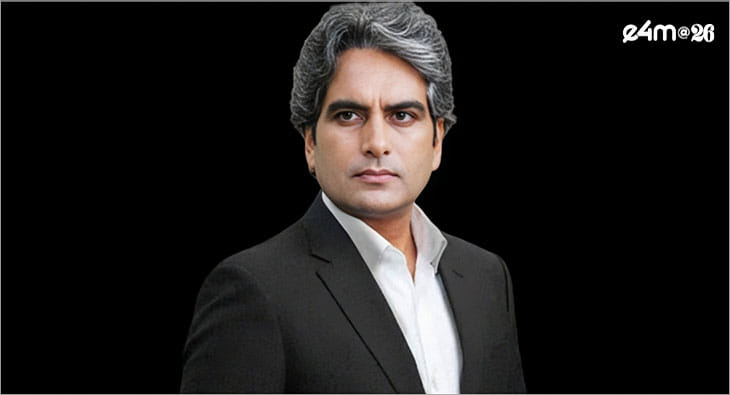

- Sudhir Chaudhary transitioned from private television to public broadcasting with DD News, describing the move as a significant professional challenge and one of the most satisfying experiences of his career, achieving over 1.3 billion views for his show "Decode" in its first year.
- He emphasizes the importance of adapting to change and the evolving nature of audiences, noting that today's viewers range widely in age and demographics, which has influenced the format of his news show to appeal to families.
- Chaudhary highlights the challenge of shrinking attention spans among audiences, leading to a demand for faster news consumption, while maintaining that in-depth journalism remains essential for true understanding.
- He discusses the role of personality in news journalism, arguing that recognizable faces enhance storytelling and audience engagement, while also addressing the historical context of media privilege and the need for continuous evolution in the industry.
After decades in private television news and successful shows like DNA and Black & White, Sudhir Chaudhary took what many considered an unexpected leap into public broadcasting with DD News. One year later, he says the move has become one of the most professionally satisfying phases of his career.
In this conversation, he opens up about risk-taking, the changing nature of audiences, personality-led journalism, attention spans, digital storytelling and why he believes news today is as much about “experience” as it is about information.
Q. Your move from a large private network to a public broadcaster surprised many people. How did you view that transition personally?
As a professional, my nature has always been to accept difficult challenges. Every few years, I feel the need to test myself again, to shake my own ecosystem and check where I stand professionally. Moving from a large private television ecosystem into a government broadcaster with comparatively lower viewership was probably one of the biggest challenges any journalist could take.
At this stage of my career, after spending over three decades in television journalism, I felt it was the right time to take the biggest challenge of my life. And honestly, professionally, it has been one of the most satisfying experiences I’ve ever had.
I also wanted to test something important: do viewers follow channels, or do they follow people? Moving from one private channel to another is still understandable for audiences. But shifting from a completely different ecosystem into public broadcasting was a very different test altogether. I wanted to see whether viewers would make that transition with me.
And the results have been beyond expectations. We completed one year of Decode on DD News and across digital platforms we crossed more than 1.3 billion cumulative views. Honestly, this seemed almost impossible initially.
Q. How would you sum up this one-year journey at DD News? What were your biggest learnings?
The biggest learning was accepting change. Whenever you move from one institution to another, you enter a completely new environment, a new team, a new playground. Your ability to adapt to change and still perform becomes the real test.
The second challenge was whether audiences from one ecosystem would accept me in another ecosystem. Would viewers shift to DD News for me? Thankfully, they did.
The third aspect was creative reinvention. Earlier, I launched DNA, which became a huge success. Then came Black & White, which again became successful. Decode is my third signature show. I consider myself fortunate that in one lifetime I got the opportunity to create three distinct signature shows across different eras and platforms.
Each generation changes. The audience that watched DNA in 2013 is very different from the audience consuming content in 2025. Attention spans have changed. Consumption habits have changed. Technology has changed. Yet remaining relevant across generations is perhaps the biggest challenge for any journalist. And if you can do that consistently, it also keeps you humble.
Q. How has the changing and more diverse news audience shaped the way you built Decode?
Earlier, the typical news viewer was considered the male head of the family. Women watched entertainment. Young people watched sports or music channels. News had a very narrow audience profile.
Today, when I study viewership data, I see large numbers of women, young viewers and even school children consuming news. Sometimes children studying in sixth or seventh standard come to me and say they watch my show regularly. Earlier, I would never have imagined children watching prime-time news.
That is why while creating content today, I keep in mind that the audience could range from a 12-year-old child to a 65-year-old viewer. Men, women, young audiences, everybody is watching together. That’s also why we positioned Decode as “India’s favourite family news show.” The idea was always to create a format that families across generations could watch together.
Q. Young audiences increasingly consume news through short clips and reels. What challenges does that create for traditional long-format journalism?
The biggest challenge today is shrinking attention spans. Audiences want fast consumption. Just the way people shifted toward T20 cricket, they now want fast news. Even analysis, they want in one or two minutes. Many people consume news exactly like reels now.
For people like us who still create one-hour television shows, this is a major adaptation challenge. But I don’t believe audiences should adjust according to us. We should adjust according to audiences.
So today, we create long-format television content, but from that same content we also create platform-specific formats.
But despite all these changes, I still strongly believe that depth has no substitute. Real news analysis is like meditation. If you truly want to understand something deeply, you have to spend time with it. Meditation cannot happen in 30 seconds. Similarly, serious journalism also requires patience and depth.
Q. Is television news today ultimately a battle of personalities and storytelling styles rather than just information?
There are three stakeholders in this conversation: management, journalists and audiences. From the management perspective, most channels never want their business model to become dependent on one face. They fear that if one anchor becomes too powerful and later exits, the business suffers. So channels naturally create limits and boundaries around personalities.
But from the perspective of journalism and storytelling, faces matter immensely. Every form of storytelling has poster figures. Cinema has faces. Politics has faces. Cricket teams have faces. Every movement or narrative eventually gets associated with a personality. News cannot be an exception.
The problem with news television historically was that it created very few recognisable faces. And often, only those who broke away from the system and launched their own ventures became bigger brands because traditional ecosystems tried to contain personalities.
I consider myself fortunate that despite remaining within the larger television ecosystem, audiences began recognising me independently as a face and a brand.
From the audience’s perspective, people naturally connect with personalities. Audiences want storytelling. Today, news is not just information, news is also an experience. People want style, perspective and a unique storytelling approach. They choose which journalist they want to watch for elections, wars or analysis based on the style and credibility they connect with.
That’s why I believe multiple strong faces in news are actually good for journalism, good for audiences and good for business.
Q. How do you respond to terms like “Godi Media”?
The term “Godi Media” is often used today to undermine the contributions of journalists. But honestly, if you ask me, the real “Godi Media” existed much earlier, before social media existed. The difference was that nobody could publicly challenge it then.
There was a time when select journalists had extraordinary access and privilege. Certain journalists received special treatment, foreign trips with Prime Ministers, elite access, invitations to exclusive government events. If you were not part of that ecosystem, you were left out entirely.
I personally experienced that exclusion for years. I saw how ecosystems operated and how narratives were shaped.
At that time, journalism was also dominated by influential families and privileged backgrounds. Many journalists came from powerful political or bureaucratic families. Their paths were easier because doors automatically opened for them. People like us, who did not come from influential backgrounds, had to struggle much harder just to reach the same place.
I also believe that despite decades of coalition politics and unstable mandates between the 1980s and 2014, media ecosystems were rarely questioned in the way they are today.
Q. After more than three decades in television news, what continues to drive you?
Relevance. Every generation changes. Technology changes. Formats change. Viewers change. The challenge is whether you can continue evolving with those changes while still staying authentic to yourself.
The day you feel you have fully cracked the system, two days later a new challenge arrives. That is the nature of journalism today. You constantly have to evolve, your formats, your language, your storytelling and your understanding of audiences. That process never stops.
Read more news about Television Media, Digital Media, Advertising India, Marketing News, PR and Corporate Communication News
For more updates, be socially connected with us onInstagram, LinkedIn, Twitter, Facebook YouTube & Google News
