Looking beyond the role: Smriti Irani and the changing face of political leadership
Guest Column: Shradha Agarwal, Co-founder and Global CEO of Grapes Worldwide, on Smriti Irani’s evolving leadership journey and the changing nature of political leadership
 by
by
Published: Aug 21, 2026 12:13 PM | 3 min read
 Follow Us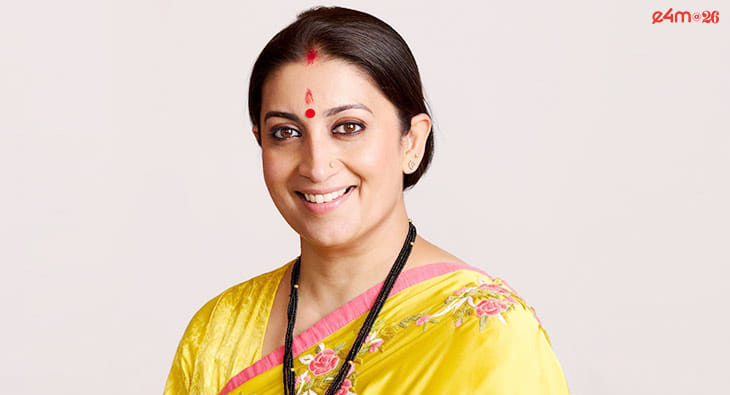

- Smriti Irani's appointment as national general secretary of the Bharatiya Janata Party for Uttar Pradesh highlights the evolving nature of leadership roles in politics, reflecting changing responsibilities and public expectations.
- Irani's diverse background in entertainment, public life, and government underscores the importance of leaders being adaptable and capable of engaging with various audiences in today's political landscape.
- The article emphasizes the unique challenges faced by women in public leadership, including societal expectations regarding their leadership style and public perception.
- It suggests that effective leadership is increasingly defined by the ability to communicate, listen, and adapt, rather than merely holding a prominent position, a principle applicable across various sectors beyond politics.
Leadership journeys are rarely straightforward. They evolve with changing responsibilities, public expectations and the circumstances of the moment. Smriti Irani’s appointment as a national general secretary of the Bharatiya Janata Party, with responsibility for Uttar Pradesh, is therefore worth looking at not only as a political development, but also as an example of how leadership roles continue to evolve in public life.
Irani has had a long and visible journey across entertainment, public life, government and politics. Her latest organisational responsibility adds another dimension to that journey. At a time when political parties are placing greater emphasis on organisation, communication and engagement with diverse audiences, such roles increasingly require leaders to operate across multiple areas at once.
It is also important to separate the individual from the political interpretation around the appointment. Every leadership change naturally invites speculation about strategy, elections and future priorities. However, the more immediate takeaway is that political organisations, like other large institutions, continue to reassess where experience and public connect can be most effectively utilised.
This is particularly relevant when we look at the changing nature of leadership itself. Public figures today are not defined by a single professional identity. People can build their careers in very different fields, and what they learn in one area can sometimes help them in another. In politics, for instance, being able to speak to people, understand their concerns and respond to changing public conversations can make a real difference.
Irani’s career also brings attention to the changing role of women in public leadership. Having a seat at the table is only one part of the story. Women in public life also have to deal with expectations around how they lead, how they present themselves and how their decisions are viewed. That added layer of public attention makes their experiences an important part of the wider leadership conversation.
Political communication has changed quite a bit over the years. Rallies and campaigns still matter, but leaders now have many more ways to speak to the public. Television, social media and digital platforms have made it possible to communicate more directly and stay in touch with people between campaigns as well. This has created an environment where clarity, consistency and the ability to understand different audiences have become increasingly important.
From a broader leadership perspective, there is a useful lesson here for organisations outside politics as well. Leadership is not always about holding the most visible position. It is also about being able to adapt when the nature of responsibility changes. Experience gained over time can acquire new relevance when circumstances change, provided leaders remain willing to learn and engage with the expectations of the moment.
Irani’s new role will naturally be assessed through the political outcomes and organisational responsibilities that follow. Those assessments will take place over time, rather than through the appointment itself. For now, it is perhaps more useful to view the development as another chapter in a long and evolving public career.
The larger conversation should remain broader than party politics. As institutions change and public expectations evolve, leadership will increasingly be judged not simply by position or visibility, but by the ability to listen, communicate, adapt and deliver on responsibility.
That is a standard relevant to every sector, and not just politics.
Read more news about Digital Media, Television Media, Out of Home Advertising, Print Media, Latest Advertising India
For more updates, be socially connected with us onInstagram, LinkedIn, Twitter, Facebook, YouTube & Google News
