The standard media planning and buying model is no longer sufficient: Sam Balsara
At e4m Confluence 2025, the Madison World Chairman called for industry reinvention, urging agencies to move beyond traditional models and embrace creative integration
 by
by
Published: Nov 12, 2025 9:39 AM | 5 min read
 Follow Us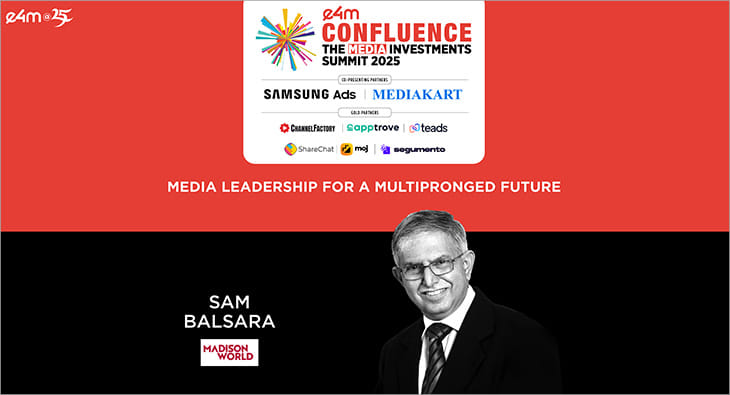

In a keynote address that challenged long-held industry assumptions, Sam Balsara, Chairman of Madison World, outlined a comprehensive roadmap for media agencies navigating an increasingly complex digital landscape at the e4m Confluence - The Media Investments Summit.
Speaking at the event themed 'Future Crafted: Purpose, Profit & Platforms in Media's New Era', Balsara reflected on three decades of evolution since Madison became Procter & Gamble's media agency of record in 1995; marking the birth of India's standalone media agency business.
"Over the last 30 years, the one constant at media agencies has been changed," Balsara noted, adding that "as the years went by, the rate of change went on accelerating to the extent that you can ask today, is this a media agency's job?"
The Digital Disruption
Balsara highlighted the seismic shift in India's media landscape, noting that digital advertising has surged from a mere 4.1% in 2010 to a projected 44.2% in 2025, overtaking television's 30% share. "Today, digital is 44%, compared to television's 30%," he stated, marking a historic shift in media consumption patterns.
"The arrival of digital as a medium has taken this change to a completely different level," he said, pointing to COVID-19 as an inflection point when digital jumped from 22.9% to 31% in a single year.
However, this growth comes with challenges. "What is silently creeping in is a steady drop in commission rates, which not many people talk about," Balsara acknowledged, adding that while top lines remain healthy, bottom lines are increasingly under stress. Addressing the current reality, he posed a critical question: "What should media agencies do to survive and come out strong in the next phase of growth?"
A Call for Reinvention
In perhaps the most striking moment of his address, Balsara, the architect of India's media agency model, advocated for a return to integrated services. "I can't believe it that 30 years ago, the gentleman who created the media agency is now saying, go back and add creative," he remarked, emphasizing that smaller and medium advertisers would welcome one-stop solutions.
"To thrive in the next generation, media agencies must transform themselves into strategic business partners for their clients," Balsara declared, outlining his vision for industry evolution. The Madison World chief outlined a multi-pronged transformation strategy centered on several key pillars:
- Data and Technology Mastery: Agencies must develop systems to track audience data, consumer journeys, and real-time campaign performance. "Media agencies that cannot simplify and present this data effectively to their clients will fall behind," Balsara warned.
- Beyond Traditional Models: "The standard media planning and buying model is no longer sufficient," he stated emphatically, urging agencies to integrate creative content and media services. "In an environment of shrinking budgets, clients value tangible business results, not just efficient media buys."
- Strategic Consulting: "Agencies should position themselves as strategic consultants helping clients navigate a fragmented landscape," he advised, noting this offers opportunities to "command higher margins and build deeper, more influential client relationships than consultancy firms can."
The Human-AI Balance
Balsara emphasized the strategic use of technology while maintaining human creativity at the core. "Use artificial intelligence to analyze data, optimize content, personalize content, and automate repetitive tasks. This frees up your team to focus on higher-level strategic thinking and creativity," he explained.
However, he was clear about the irreplaceable human element: "In a world where AI can automate many tasks, your agency must double down on delivering high-level strategic thought, real-world experience, and powerful storytelling that technology cannot replicate." In an emotional moment, he paid tribute to recently deceased industry veteran Piyush Pandey on this front.
Operational Imperatives
The veteran adman outlined specific strategies for survival, including specialization in an increasingly crowded market. "Just to share with you, there are over 34,000 digital agencies in the U.S. alone. So, niching down is critical," he noted.
On emerging challenges, Balsara highlighted the importance of first-party data: "With deprecation of the third-party cookie, agencies must help clients collect and utilize their own first-party data for more accurate, personalized, and privacy-compliant targeting."
He also emphasized the need for agencies to improve their own marketing: "It's often said that agencies are really bad when it comes to selling themselves. Possibly true."
Talent and Culture
Addressing the talent challenge, Balsara called for a fundamental shift in hiring priorities. "Hire data scientists, coders, and strategists, not just media planners," he urged, while fostering a startup culture that encourages experimentation.
"Lifelong learning and unlearning, equally important, is critical to success," he stated, emphasizing the need for continuous adaptation.
Trust and Ethics
In an era of misinformation and synthetic media, Balsara underscored the importance of transparency and ethical practices. "In an era of misinformation, a clear commitment to ethical practices, transparency, and consumer privacy is vital for building client relationships," he said.
He also noted changing consumer expectations: "Modern consumers, especially Gen Z, want to support socially consensuous brands that are transparent and authentic. Agencies must help their clients align their social initiatives with brand messages and follow through with promises to earn trust."
The Bottom Line
Concluding his address, Balsara reframed the industry's self-perception with a powerful statement: "Media agencies, you must remember, aren't just middlemen doing deals. We are, and possibly can be, clients' transformation partners."
His message was clear: the next generation of media agencies must evolve from service providers executing media buys to strategic business partners driving tangible business outcomes through integrated, data-driven, and ethically grounded solutions.
As the industry stands at this crossroads, Balsara's three decades of experience lend weight to his call for bold reinvention. This is a transformation he believes is not just advisable, but essential for survival in the media's new era.
Read more news about Marketing News, Advertising News, PR and Corporate Communication News, Digital News, People Movement News
For more updates, be socially connected with us onInstagram, LinkedIn, Twitter, Facebook, YouTube & Google News