AI has democratised creativity; The media ecosystem is fractured: Tarun Ummat, Teads India
At e4m Confluence 2025, Teads India MD Tarun Ummat champions a unified data and attention-led omnichannel model to repair the cracks in India’s splintered media ecosystem
 by
by
Published: Nov 12, 2025 7:39 AM | 5 min read
 Follow Us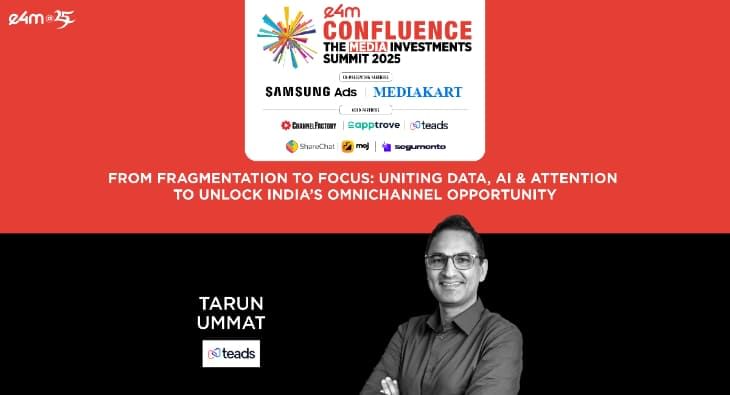

At a time when India’s media landscape is expanding faster than ever but increasingly fragmented, Tarun Ummat, Managing Director of Teads India, called for a “kintsugi moment” for the industry, where technology, data and creativity come together to mend the fractures caused by fragmentation and declining attention.
Speaking at the e4m Confluence – The Media Investments Summit, themed Future Crafted: Purpose, Profit & Platforms in Media’s New Era, Ummat’s spotlight session titled “From Fragmentation to Focus: Uniting Data, AI & Attention to Unlock India’s Omnichannel Opportunity” unpacked the dual challenge of a complex consumer journey and diminishing focus in a cluttered digital space.
Opening his address, Ummat underscored how the decline of linear TV viewership signals the dawn of a new, more intelligent era for connected television (CTV). “In India, the time spent on TV has dropped from three and a half hours to less than three hours. But this is not the end of television, it’s the beginning of a more dynamic and connected phase,” he said. With CTV advertising growing at 31% year-on-year, Ummat argued that the future lies in turning this growing complexity into a strength through a cohesive omnichannel strategy.
However, he was quick to acknowledge the barriers that brands face when executing such a strategy are fragmented media ecosystems, inconsistent targeting, data silos, duplication, and the lack of unified measurement. “It’s not just about connecting screens; it’s about connecting signals, formats, and most importantly, attention,” he emphasized.
Drawing from Teads’ proprietary data, Ummat revealed a troubling trend of nearly 70% of media spending will be on “low attention” platforms like social media, even as consumers engage less deeply with them by the end of 2025. “In short, we’re spending more money where people are paying less attention. That’s the irony of our times,” he remarked.
Compounding this challenge, Ummat highlighted the flood of low-quality, AI-generated content that has overrun the internet. By late 2024, AI-generated material had surpassed human-created content online, eroding user trust and authenticity. “Consumers are unsure whether what they see is real or fabricated. Attention is being stolen not just by brands but by algorithms,” he warned, illustrating with examples of absurd AI-generated videos that mimic reality.
To counter this, Ummat proposed a three-pillar framework focused on maximizing reach on quality media, enabling creative innovation, and fostering interactivity. “Quality is our foundation,” he asserted. “We built Teads as a true alternative to walled gardens, with direct integrations with the world’s largest publishers and now extending into CTV, all in a 100% MFA-free environment.”
Using attention as a metric of quality, Ummat shared data from Lumen showing Teads outperforming most platforms in attention retention. “You won’t see YouTube on that chart because it’s number one but 41% of the attention on YouTube is on the skip button,” he noted wryly, underscoring the difference between viewability and meaningful engagement.
Teads’ CTV Household Graph, representing over 120 million households globally, now bridges web and television data, creating a unified view of consumer behavior. “We can now see what people read, watch, engage with, and buy, all in one seamless ecosystem,” said Ummat, describing how this data integration allows advertisers to orchestrate cross-screen storytelling and measure outcomes more accurately.
Beyond data, Ummat emphasized creative innovation, particularly on the biggest screen in the house. “CTV is no longer about running the same MP4 across channels. We’re now bringing interactive formats, home-screen placements, and dynamic creatives that deliver 30% higher impact,” he shared. With exclusive partnerships with LG, Vida (Hisense), and Google TV, Teads has access to around 30 million addressable homes in India.
An attention study conducted with MediaMentor further validated this approach. “Heat maps show most attention on YouTube ads to the skip button or timer, whereas on home screens it’s evenly distributed, that’s what quality engagement looks like,” said Ummat.
Turning to the creative revolution powered by AI, Ummat cited the example of a $2,000 AI-generated ad for U.S.-based Kelshi that aired during the NBA finals, a campaign that would have been unthinkable at that speed or cost just a few years ago. “AI has democratized creativity,” he said. “Basic banners can’t compete with GenAI-generated formats anymore.”
At Teads, Ummat revealed, the creative teams now operate on a “predict, create, and personalize” model in partnership with AI firm Neuron, which uses eye-tracking and machine learning to predict which assets will capture attention. “It’s about editing intelligently and using AI to tell us where the viewer’s eye lingers and then optimizing for that,” he explained.
But the real transformation, Ummat stressed, lies in collaboration. “In most organizations, data and creative teams don’t speak to each other as they live in silos. We broke that with our DICE team, which bridges branding and performance, driving outcomes across the open internet,” he said.
Concluding his session, Ummat returned to his central metaphor of kintsugi, the Japanese art of repairing broken pottery with gold. “The media ecosystem is fractured. It has too many platforms, too little attention. But through data, technology, and creativity, we can mend those cracks and make it stronger and more beautiful than before,” he said.
With attention emerging as the new currency and quality as its backbone, Ummat’s call to rebuild the media ecosystem through unified, high-impact omnichannel strategies served as both a warning and a roadmap for an industry navigating disruption and urging it to trade fragmentation for focus, and fleeting impressions for meaningful impact.
Read more news about Digital Media, Television Media, Out of Home Advertising, Print Media, Latest Advertising India
For more updates, be socially connected with us onInstagram, LinkedIn, Twitter, Facebook, YouTube & Google News
