Every impression we serve can contribute to digital wellness: Kartik Mehta
At e4m Confluence 2025, Kartik Mehta calls for a conscious media ecosystem that balances growth with digital wellness
 by
by
Published: Nov 12, 2025 7:52 AM | 5 min read
 Follow Us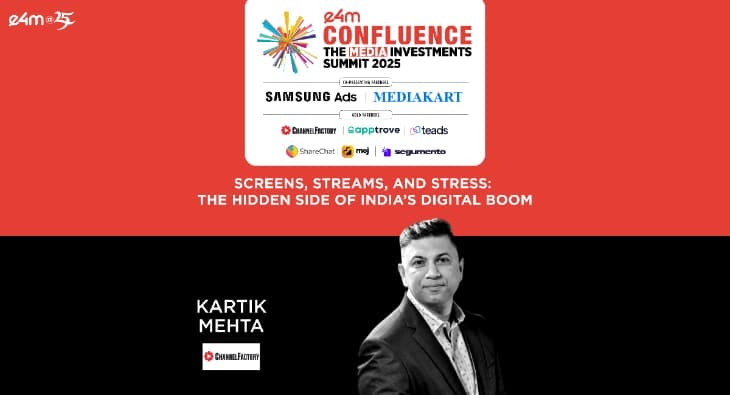

At the e4m Confluence – The Media Investments Summit themed “Future Crafted: Purpose, Profit & Platforms in Media’s New Era,” Kartik Mehta, Chief Business Officer for Growth Markets at Channel Factory, took the stage for a Spotlight Session titled “Screens, Streams, and Stress: The Hidden Side of India’s Digital Boom.” In a session that was equal parts introspective and urgent, Mehta peeled back the layers of India’s meteoric digital rise to reveal the growing shadow it casts of digital stress, mental health decline, and the invisible toll of social media on the country’s youth.
Right from the start, Mehta made it clear that this wasn’t going to be another pitch deck or product plug. “You are not going to hear anything about AI, campaign optimization, or ROAS,” he quipped, setting a candid tone that invited reflection over data points. His concern was deeply personal and professional regarding the darker psychological undercurrents of India’s digital economy, which, he argued, can no longer be ignored.
“India ranks second in the world in terms of digital stress among youth,” Mehta revealed, drawing gasps from the audience. “Fifty percent of our population is under 30, and studies by McKinsey and WHO show that over three hours of daily internet exposure heightens anxiety and depression. Imagine that when our average time online is over five hours.” He then connected the dots between hyper-connectivity and an array of issues like sleep disorders, body image anxieties, cyberbullying, and a loss of real-world social balance, affecting millions across the country.
What followed was an unusual but telling audience exercise. Mehta asked attendees to raise their hands if they or someone they knew had tried and failed to reduce their time on social media, lost sleep because of it, or lied about their screen time. Nearly every hand in the room went up at least once. “That,” Mehta said, “is proof enough that something’s off.” He went on to introduce the audience to something most had never heard of, the Social Media Disorder Scale, a psychological framework used globally to assess unhealthy social media dependence. “If you tick even a couple of boxes on this scale,” he warned, “it’s a sign that we need to pay attention. Because this is not just behavioral but it’s clinical.”
Addressing the question of why a company like Channel Factory, known largely for YouTube brand suitability and ad innovation, was taking on mental health, Mehta’s answer came back to corporate purpose. “Our brand ethos is about doing good business while doing good,” he said. “And if we truly believe in conscious business performance, we cannot ignore what’s happening to our audiences. This is not just about ad impressions anymore. It is about human impressions.”
He then unveiled the Channel Factory Mental Health Initiative, officially launched that morning in India. The initiative, he explained, will rest on three pillars - mental health research and innovation, elevating positive voices online, and curating inclusive, emotionally safe content ecosystems.
On research and innovation, Channel Factory is collaborating with clinicians and mental health specialists worldwide to establish safe online standards (SOS) across digital platforms. One of their key collaborators is Dr. Dan, a globally recognized suicide prevention expert. “This is not a marketing project,” Mehta clarified. “We are working with the best academic and medical minds to build frameworks that protect users at scale.”
The second focus was elevating positive voices, seeking to tackle one of digital media’s most corrosive issues of cyberbullying. Partnering with industry professionals and thought leaders such as Dr. Peter, Channel Factory aims to amplify creators and content that foster optimism, resilience, and inclusivity. “We have 20,000 rows of channels to choose from,” Mehta noted, addressing the advertisers and media planners in the room. “Just include a hundred that focus on positivity and you’ll begin to see the difference it makes.”
In perhaps the most defining statement of the session, Mehta declared, “Every impression we serve can contribute to digital wellness. As an industry, we can either fuel the noise or we can help shape a generation that consumes consciously.”
He closed by inviting collaboration from the larger advertising and media fraternity, emphasizing that digital well-being is not just a moral concern but a structural one that affects how brands build trust, how consumers behave, and how the industry sustains itself. “This isn’t about screens or streams,” Mehta concluded. “It’s about the unseen stress we’ve normalized. The future of digital India depends on whether we choose to address it today.”
With that, the Channel Factory Mental Health Initiative was officially launched, signaling a shift in how one of the world’s fastest-growing digital markets is beginning to reconcile profit with purpose, reach with responsibility, and engagement with empathy.
Read more news about Digital Media, Internet Advertising, Marketing News, Television Media, Radio Media
For more updates, be socially connected with us onInstagram, LinkedIn, Twitter, Facebook, YouTube & Google News