How brands find order in a non-linear world
At the e4m Pitch BrandTalk 2025, leaders discussed how non-linear consumer behaviour is reshaping categories, with AI and real-time insights helping turn this complexity into opportunity
 by
by
Published: Nov 22, 2025 12:58 PM | 6 min read
 Follow Us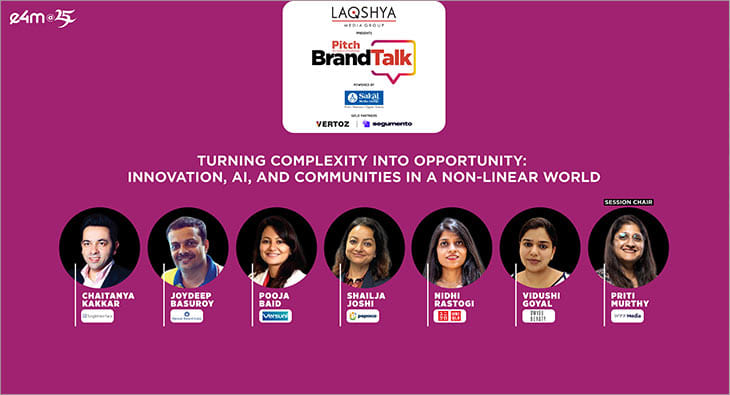

At a time when consumer journeys are collapsing, expanding and looping in unpredictable ways, marketers at the e4m Pitch BrandTalk 2025 examined how categories as distinct as alcobev, fashion, and beauty are adapting to rapid behavioural shifts.
Moderated by Priti Murthy, President – Client Solutions (South Asia), WPP Media, the session titled “Turning Complexity into Opportunity: Innovation, AI, and Communities in a Non-Linear World” featured perspectives from Joydeep Basuroy, Group Head – Marketing, India, Pernod Ricard; Nidhi Rastogi, Marketing Director – India, UNIQLO; and Vidushi Goyal, CMO, Swiss Beauty.
Opening the session, Murthy reflected on how the idea of “non-linear” is hardly new for consumers, even if marketing structures once appeared linear. “Thirty years back, the way we addressed media may have been linear, but the consumer was never linear because they didn’t think that way,” she said. She illustrated this with her own behaviour: “If I want a particular brand of chips and my local kirana doesn’t have it, I’ll go to Zepto, Blinkit, whoever can deliver it within eight minutes before my son throws a tantrum.”
She noted that every category plays out this non-linearity differently, each driven by its own DNA. Against that backdrop, she asked the panellists how their brands had adapted to shifting market behaviour and changing Gen Z preferences in the past 18 months.
Basuroy began by contextualising the alcobev space. “I represent a restrictive category where both the functional and emotional sides work in tandem. It’s almost like a triangle, and when the triangles meet, the consumer becomes the advocate,” he said. The last few years, he explained, had brought sharp behavioural shifts. COVID had created “a big surge in consumption behaviour” and dramatically reduced what he called the “tip-tap”. Experimentation rose, expectations around experience increased, and consumption patterns moved towards the home, which he called “the third space”.
To respond, Pernod Ricard leaned on AI to reduce complexity and stay relevant within consumer and regulatory boundaries. “Because of the behavioural change and consumption change, the sales pattern has completely changed,” he said. The company introduced an AI-based tool called D-STAR, which provides availability data and has increased productivity. “From a conversions data point, it has increased from 20% to 40%,” he noted. With media fragmentation accelerating, the brand is also using AI “very strongly both in BTL and ATL,” with ROI measured on both fronts.
Taking the discussion into fashion, Murthy asked Rastogi how UNIQLO had navigated similar shifts. Rastogi said the biggest transformation was the “democratisation of fashion”. “Earlier, fashion could only be inspired by Bollywood actors, and there were limited ways of understanding fashion. Democratisation, especially through social media, has made fashion accessible and equal for all,” she said. In her view, every customer today is, in some way, a fashion influencer. Individuality has sharpened, and people increasingly use fashion as identity.
This is where UNIQLO’s LifeWear philosophy sits naturally. “LifeWear means we provide clothes that make everyone’s life simple, whether you’re in Germany or India, whether you’re 20 and going to college or heading to your office,” she said.
The brand’s consistency across markets, she added, is fuelled by insights: “We use tools to understand the voice of customers throughout the world and see how we can provide the same kind of experience no matter where they are.”
From makeup, Goyal offered another lens on non-linearity. “Makeup as a category has never been linear,” she said. “We are in an industry of shades, and every skin in India is different. What shade works for me doesn’t work for you.”
Consumer expectations and trends shift constantly, and the last 18 months have been particularly transformative. A category once dominated by occasion-based use has become everyday. “When I speak to makeup artists, they tell me that in a batch of 50–100 people, almost 50% learn makeup for themselves, not as professionals,” she said.
She pointed to new consumer conversations such as undertones, long familiar in beauty, now intersecting with fashion trends emerging from Korea. But in India, she said, many consumers still struggle to understand undertones and which shades suit them. “AI is going to make this information easier for people and help them choose the right shades,” she said, adding that the potential excites the brand.
Murthy observed that the pace of change means many shifts no longer feel “AI-led” or “tech-led” because everything is happening so fast. She asked the panellists if consumer feedback has led to any co-created innovations.
Rastogi shared a striking example from COVID. UNIQLO’s AIRism technology, a moisture-wicking, extremely smooth fabric, was typically used for innerwear. “During COVID, a lot of customers started requesting if we had masks in AIRism,” she said. Social media and call centre demand surged globally and locally. The merchandising team noticed the pattern and responded instantly. “We had AIRism masks created and launched across the world. Everybody said they were one of the most comfortable masks to wear during COVID,” she said.
What impressed her most was the agility: “It was created and deployed in 24 countries. That was our way of giving back to customers.” Non-linear ways of working, she added, make such rapid response possible. “Earlier we’d do focus groups and six-month research cycles. Now it’s real-time.”
In the alcobev space, co-creation is emerging more slowly due to regulatory constraints. “India is 30 countries, and every single country behaves differently. Pricing is different and everything needs approval,” Basuroy said. Yet, he noted rising momentum globally, citing tequila trends and Hollywood co-creations, and described Pernod Ricard’s own launches, including a transparent, white whisky variant. The bigger opportunity, he said, lay in experience-led co-creation. He highlighted Boombox, a property blending hip-hop and melody, “We collaborated with a lot of artists and created music and music videos. That gives us the engagement we’re looking at.” Depending on the brand’s life stage, the objectives, and therefore the platforms, shift.
Finally, Murthy steered the conversation towards iterative innovation and how organisations handle non-negotiables while adapting their marketing value systems. Goyal said the shift from focus groups to real-time social chatter has changed their frameworks. “Earlier, digital signals and social listening helped us pick up trends. Today, AI helps us assimilate that into more meaningful information,” she said. For Swiss Beauty, this AI-assisted social feedback loop is now fully integrated into product development.
She explained with examples, “A few months back, mousse-format matte lipsticks became massive. We quickly said, ‘We need a mousse lipstick out there.’ Now in a month’s time, it’s coming out for us.” Similarly, glitter formats spike every October–November, shaping their launch calendars. “It’s a continuous process, and the frameworks for brands have changed accordingly,” she said.
Read more news about Marketing News, Advertising News, PR and Corporate Communication News, Digital News, People Movement News
For more updates, be socially connected with us onInstagram, LinkedIn, Twitter, Facebook, YouTube & Google News
