How India’s leading brands are rebuilding consumer trust in an age of uncertainty
At the e4m Pitch BrandTalk 2025, marketing leaders discussed how transparency, innovation, empathy and authenticity are reshaping the trust equation for today’s fragile consumer landscape
 by
by
Published: Nov 22, 2025 10:47 AM | 7 min read
 Follow Us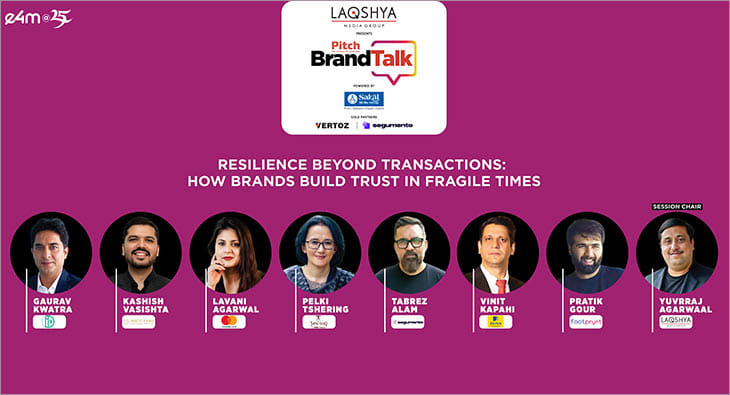

At the e4m Pitch BrandTalk 2025, marketing leaders came together to decode one of the most urgent imperatives in modern brand-building, i.e. earning and sustaining trust in a world where consumer confidence is increasingly fragile. Moderated by Yuvrraj Agarwaal, Chief Strategy Officer, Laqshya Media Group, the session explored what it takes for brands to move beyond transactional interactions and foster enduring credibility.
The discussion featured insights from Kashish Vasishta, Deputy General Manager – Marketing, PR, New Product Development & Ecommerce, MMTC-PAMP; Gaurav Kwatra, Chief Marketing Officer, iD Fresh Food; Vinit Kapahi, Chief Marketing Officer, Aviva India; Lavani Agarwal, Vice President – Marketing & Communications, MasterCard; and Pratik Gour, Co-Founder, Footprynt who together discussed the evolving dynamics of trust across categories as diverse as precious metals, fresh foods, insurance, digital payments and influencer-led communication.
Setting the tone, Agarwaal invoked the Japanese art of Kintsugi, the craft of repairing broken pottery with gold. “Instead of hiding the cracks, they filled them with gold lacquer,” he said, framing the metaphor for trust in consumer relationships. “Most brands spend heavily on quick fixes, but some stand out. They are the goldsmiths that rebuild trust again and again.”
Transparency, Education and Everyday Conversations
The discussion opened with a category where trust is paramount, gold and silver. Turning to Vasishta, Agarwaal asked why consumers should trust a brand over a local jeweller.
“They should definitely buy from the jeweller nearby,” Vasishta said. “For us, jewellers are also high contributors to our sales.” The differentiating factor, he explained, lies not in shifting behaviour away from local retailers but in empowering consumers through knowledge. “It is only when consumers ask the right questions that they truly understand what they are purchasing. Purity matters, whether there is positive or negative weight tolerance, where the refinery sources the metal from, whether it is accredited by LBMA or BIS.”
He elaborated that trust is built through uncompromising transparency. MMTC-PAMP focuses on detailing every aspect of its products, running educational campaigns and ensuring complete visibility regarding sourcing and purity. Visiting their facilities, he said, is like “living in a window house where you can see everything about the brand.”
Closing the loop with consumers is equally vital. “Whenever they have a question, we answer it,” he said, adding that he personally engages with consumers daily. Direct conversations, he argued, help identify gaps and strengthen communication. “That is when you build trust, when you are on the ground and talk to consumers.”
Tradition, Innovation and Purity: iD Fresh Food’s Pillars of Trust
Shifting focus to a category often cited as a trust benchmark, Agarwaal addressed Kwatra of iD Fresh Food. Referencing the brand’s trust shops, where consumers pick products and pay as they wish, he asked how iD retains its reputation for purity as it expands into new categories.
Kwatra explained that iD’s journey began as a “revolution of clean food, food without preservatives, and food without any artificials.” As the portfolio grew across Indian breads and other staples, the brand held firmly to three pillars.
“Our products are rooted in tradition,” he said. This grounding allows iD to bring regional authenticity to consumers across India. It is supported by a strong culture of innovation, exemplified by the now-famous vada batter packaging. “The biggest pain point was that you can’t make a round vada with the right hole inside. It took us a lot of back and forth and a couple of years to crack the packaging.”
Innovation, Kwatra noted, extends beyond product development into packaging and consumer experience. The third pillar, i.e. purity, remains unwavering. “Everything we do stands true to that.”
Whether it is Indian breads, filter coffee or pancake batter, the same disciplined approach applies. “When you stay true to these three pillars, you don’t need to worry about any new category diluting the brand core.”
For iD, each new product only reinforces the trust it has built. “India has a very rich culinary heritage, and there are many categories where consumers are looking for clean label, honest, authentic products.”
Reframing Insurance for a New Generation From Fear to Empowerment
Addressing one of the most complex and emotionally charged categories (insurance), Agarwaal turned to Kapahi to unpack how brands can shift the narrative from fear and uncertainty to empowerment.
“As a category, insurance probably is the most complex of all, and I don’t think a lot of consumers really understand even if they’re looking at what insurance to buy.” The long gap between purchase and claim further complicates matters. If, at the point of need, the brand is absent or the product inadequate, trust collapses.
Kapahi emphasised the need to simplify products for younger generations unwilling to engage with outdated, fear-driven narratives. Aviva’s approach centres on promoting positive habits rather than gloom. “If you really look at what our purpose is, with you today for a better tomorrow, it’s always been about the positive sides.”
The brand is also designing products that incentivises healthy living. He cited an upcoming offering where walking 10,000 steps daily multiplies the sum assured over time.
With pillars including physical fitness, mental well-being and dietary planning, Aviva aims to support consumers holistically. Trust, he argued, is rooted in transparency and consistent engagement, not just at the moment of claim but throughout the consumer’s life.
He also highlighted innovations in critical illness products, where claims will be paid at diagnosis, with no hospital bills or paperwork required. “At the point of diagnosis, the sum assured will be given to a consumer… no questions asked.”
While supported by rigorous underwriting, these offerings directly address the biggest pain points consumers face.
Empathy, Safety and a Legacy of Secure Transactions
In a world of hyper-personalisation and data anxiety, Agarwaal posed the question of empathy in digital experiences to Lavani Agarwal of MasterCard.
“We are operating at a time of perma-crisis,” she said, citing economic uncertainty, digital overload and shifting consumer expectations. As a result, trust has become less about what consumers buy and more about where they place their confidence.
For MasterCard, empathy is not a marketing concept but “the fundamental proposition of what we stand for,” built on safe, secure and reliable transactions. She added a crucial dimension, financial well-being. “That is really the core of what we want to provide, so that you can live a worry-free, hassle-free life.”
With over 50 years of legacy in securing transactions, MasterCard’s communication naturally flows from the product itself. Choices of channels, ambassadors and narratives are guided by a principled stance: doing right by the user, empowering digital participation and protecting against fraud.
“It is not so much about infusing empathy,” she said. “It is the fundamental product core proposition.”
Influencers as Trust Bridges
Closing the panel, Agarwaal turned to Gour to discuss whether influencers have become the new trust bridge between brands and consumers.
“When it comes to brands and how people trust them, one is obviously the product,” Gour said. If trust is broken at the product level, no amount of communication or influencer activity can repair it.
That said, human intermediaries, whether influencers or opinion leaders, have grown central in the past decade. But Gour emphasised that brands must be judicious in selecting them. “That individual should be a user of your product.”
Certain categories, such as fashion, have excelled by engaging genuine users as advocates. Everyday consumption categories, too, naturally lend themselves to authentic influencer storytelling. “It could be easily done in the case of ID… if an individual loves it, they can go on to talk about it.”
By contrast, insurance, “a once or twice in a lifetime buy”, poses greater challenges. Influencers cannot simply be chosen arbitrarily; they must embody the brand’s values in their lifestyle. “If the person is into fitness… walks 10,000 steps a day… fits perfectly for a brand like Aviva,” he said.
Ultimately, the alignment between the influencer’s lived reality and the brand’s ethos determines whether trust is strengthened or diluted.
Read more news about Marketing News, Advertising News, PR and Corporate Communication News, Digital News, People Movement News
For more updates, be socially connected with us onInstagram, LinkedIn, Twitter, Facebook, YouTube & Google News
