Rs 10 crore on Google in a month: Digital election war heats up in West Bengal
On Meta, BJP and Trinamool Congress spent ₹0.42 crore (about ₹42.6 lakh) in the last one week
 by
by
Published: Mar 10, 2026 9:47 AM | 6 min read
 Follow Us

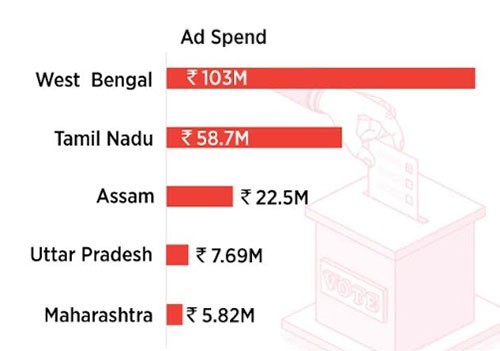
Political advertising in West Bengal is witnessing a sharp digital push ahead of the expected Assembly elections between March and May 2026. According to Google Ad Library, total political ad spending on the platform in the state has reached ₹10.3 crore across 3,969 advertisements in one month from February 8 to March 9, highlighting how digital platforms are becoming central to election campaigning.
Among other states expected to head to the polls in the same period, Tamil Nadu has recorded digital political spending of ₹5.87 crore, followed by Assam at ₹2.25 crore and Kerala at approximately ₹9,47,000.
A closer look at the data shows that a handful of advertisers account for a large share of spending in West Bengal. The Bharatiya Janata Party has spent ₹1.21 crore across 2,226 ads over the past 30 days, while Indian PAC Consulting Private Limited (the consulting firm for All India Trinamool Congress) has accounted for ₹2.34 crore through 683 ads. The remaining ₹6.75crore has been spent by smaller political parties.
According to data from the Meta Ad Library, political advertising activity saw a notable gap between the two major parties in the past week. The Bharatiya Janata Party (BJP) spent an estimated ₹0.33 crore (₹3,331,392) on political and social issue advertisements between March 1 and March 7, 2026, while the All India Trinamool Congress (AITC), led by Mamata Banerjee, spent around ₹0.093 crore (₹933,901) during the same period. The figures indicate that the BJP’s weekly ad spend on Meta platforms was more than three times higher than that of the Trinamool Congress, highlighting a sharper digital push by the party in the run-up to the upcoming elections.
Video Content Dominates Political Ad Strategy
On Google platforms, the advertisements reveal a clear format for campaigning. Video content overwhelmingly dominates the spending mix, accounting for 92.6 percent of total expenditure at ₹9.55 crore. Image-based advertisements contribute 7.26 percent, amounting to ₹0.75 crore, while text-only ads account for just 0.133 percent, or roughly ₹137,000.
The dominance of video reflects how political campaigns are increasingly prioritising visually engaging formats to maximise reach and engagement on digital platforms.
Industry experts say the growing investment also reflects the rising importance of global digital platforms in political communication.
Shudeep Majumdar, Co-founder and CEO of Zefmo, a creator marketing platform that has previously managed influencer campaigns during elections in the state, said digital giants command a large share of campaign budgets.
“In a high-stakes state like West Bengal, digital political ad spends during election season can run into several crores, and Google and Meta together command a disproportionate share of that budget, often 60–70% of total digital allocation. Transparency reports from both platforms confirm a sharp spike in political ad activity in the weeks leading up to polling.”
The surge in spending also reflects a broader shift in how political communication strategies are evolving.
Amit Dhawan, Co-founder at Crack’d, an influencer marketing and user generated content agency, noted that modern campaigns now operate within complex digital ecosystems rather than relying purely on traditional advertising.
“Political advertising has moved from mass broadcasting to precision communication. Earlier campaigns depended largely on rallies, print, television and outdoor media. Today campaigns are built around digital ecosystems that include short videos, creator collaborations, WhatsApp distribution networks and rapid response content. The objective is no longer just visibility but constant presence inside people’s feeds.”
The increasing sophistication of digital campaigns is also evident in the growing outreach to social media creators. According to media reports, several influencers in Kolkata claim they have been approached by agencies allegedly representing political parties and offered paid collaborations to create political reels.
The outreach reportedly includes eligibility criteria such as a minimum follower base of around 20,000 on Instagram and average views of 10,000 to 15,000 per post. Payments for such collaborations are said to begin at around ₹20,000 per reel and may reach up to ₹80,000 depending on audience size and engagement levels.
Majumdar explained that influencer collaborations allow campaigns to deliver more localised messaging that resonates with specific communities.
“Instagram, Facebook, and YouTube are now core campaign infrastructure, not supplementary. Campaigns are slicing audiences by district, language dialect and community identity. A micro-influencer in Murshidabad speaks very differently to their audience than someone in South Kolkata, and that authenticity is difficult to replicate through traditional political messaging.”
However, several creators have reportedly declined such proposals, stating they prefer to remain apolitical despite the increasing demand for creator-led political communication.
Social Media Data Enables Granular Targeting
Experts say digital platforms also offer political campaigns unprecedented capabilities in audience segmentation.
Nikhil Rangnekar, CEO at MediaCircle, an advertising and media agency, noted that voter behaviour on social media enables highly targeted political communication.
“Most voters are extremely vocal on social media about their political leanings, and it becomes easier for publishers and agencies with the right technology to segment audiences based on their posts and interactions. This allows campaigns to target fence-sitters or specific voter groups with tailored messaging.”
However, he added that digital media does not entirely replace traditional formats.
“Digital has the potential to take a lion’s share of advertising budgets because of its targeting capabilities. But television, print and outdoor media still play a crucial role in creating large-scale impact. Campaigns typically need a balance between both.”
Emotional Narratives Continue to Shape Political Messaging
While technology is transforming campaign distribution, the messaging itself still draws heavily from West Bengal’s deeply emotional political culture.
Majumdar observed that political communication in the state often revolves around identity and sentiment rather than purely policy-driven narratives.
“West Bengal is one of India’s most politically charged states where identity, pride and perceived threat narratives often move voters more strongly than policy promises. Digital campaigns that tap into local sentiment and community identity tend to perform better than broad informational messaging.”
The last West Bengal Assembly election took place in 2021 when the incumbent All India Trinamool Congress, led by Mamata Banerjee, secured a landslide victory. The election also marked the emergence of the Bharatiya Janata Party as the principal opposition, while the Left Front and the Indian National Congress failed to win a single seat for the first time in the state’s history.
Women Voters Remain a Key Electoral Bloc
Electoral data also highlights the growing influence of women voters in the state’s political landscape.
According to Election Commission data following the special intensive revision of electoral rolls, the number of women electors stands at around 3.44 crore, while male voters number about 3.60 crore. Women therefore account for nearly half of West Bengal’s 7.04 crore electorate.
Turnout data over the past two decades shows a steady rise in female participation. Women’s turnout stood at 80.75 percent in 2006 and rose to 84.45 percent in 2011. It further climbed to 94.42 percent in 2016. In the 2021 Assembly election, women again slightly surpassed male participation with a turnout of 81.75 percent compared with 81.37 percent for men.
As the election cycle gathers pace, the surge in digital spending highlights how political communication in West Bengal is rapidly evolving. While television, print and outdoor media continue to play a role, campaigns are increasingly relying on targeted digital advertising, short-form video and creator collaborations to influence voter sentiment.
With polling approaching, the contest for voter attention is likely to unfold not only through rallies and roadshows but also across the social media feeds that millions of voters scroll through every day.
Read more news about Digital Media, Internet Advertising, Marketing News, Television Media, Radio Media
For more updates, be socially connected with us onInstagram, LinkedIn, Twitter, Facebook, YouTube & Google News