Community-led influence takes center stage at Impact Digital Influencer Conference 2025
The panel discussion explored how digital creators are reshaping brand partnerships through authenticity and direct audience engagement
 by
by
Published: Dec 17, 2025 5:37 PM | 7 min read
 Follow Us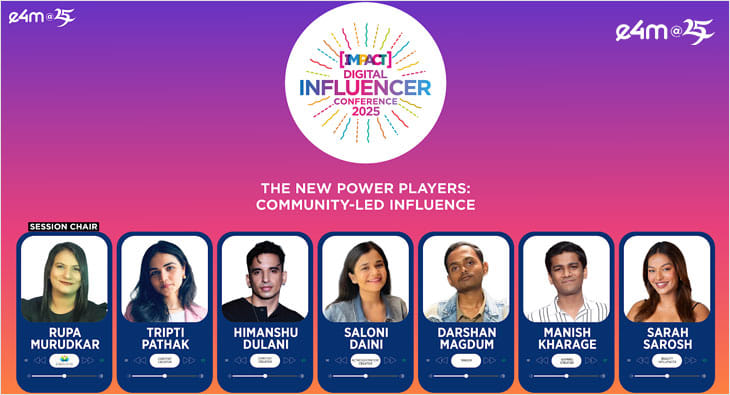

The Impact Digital Influencer Conference 2025 featured a session titled "The New Power Players: Community-Led Influence," bringing together seven influential voices to discuss how the creator economy is transforming traditional marketing paradigms.
Rupa Murudkar, Vice President of Marketing at Cholayil Private Limited, chaired the session, which featured content creator Tripti Pathak, dancer-choreographer Himanshu Dulani, gaming creator Manish Kharage, actress-creator Saloni Daini, singer Darshan Magdum, and beauty influencer Sarah Sarosh. The discussion aligned with the summit's overarching theme, "Influence 3.0: The Age of Authentic Impact."
Trust Over Fame: The New Currency of Influence
Tripti Pathak opened the conversation by articulating a fundamental shift in how brands approach partnerships. "Brands now understand that trust travels faster than fame. When they're reaching out to us, a creator like me, they are not just buying the reach or borrowing the reach, they are also borrowing the credibility that I bring to the table," she explained.
Pathak emphasized that creators occupy a unique position, accessible yet influential, where audiences can directly engage and quickly call out any perceived hypocrisy. "We sit in this sweet spot where we are not an invisible personality and at the same time we are also not a very big name or a big celebrity, so the audience can reach out to me. The audience has also become very smart in the sense that they call out the hypocrisy instantly. If I am not being honest or true to myself, they will call it out," she said.
The Unfiltered Revolution in Beauty Content
Sarah Sarosh brought a compelling perspective on how social media has democratized beauty standards. "I started creating content with the sole purpose that I don't want to use filters on my videos, I don't want to have to show my skin a certain sort of way," she stated, drawing a stark contrast with traditional celebrity marketing.
Sarosh explained how this approach has revolutionized consumer trust: "When a celebrity goes on a TV set, on a movie set, they are prone to editing, they are prone to looking a certain sort of way and growing up, we were conditioned to look at them and want to look like them. What social media allows us to do is to look at a certain person who has a following and be like, oh wow, I can be like this person, I don't have to look perfect, I don't have to have clear skin, I don't have to have the perfect body type."
She highlighted how today's generation demands radical transparency: "Gen Z is extremely sensitive and they call out bullshit instantly. If there's a filter online on your face and you're promoting a skin serum, they can see it. When I'm promoting a hair mask, I keep my hair exactly how it looks naturally, which is curly. When I'm showing people that ‘this is what my real hair looks like’ and ‘it works for this’, everyone who has the same hair type can relate and be like ‘okay, I can fit in, I can buy this product because it worked for Sarah, it will work for me’."
From One-Way Broadcasting to Two-Way Conversations
Saloni Daini, who bridges both mainstream entertainment and digital content creation, offered insights into how audience dynamics have transformed. "What we used to do back then, that entire industry was very different. It was mostly one way. We used to do our job, get seen on TV, and people liked you or didn't like you; it was all from a distance. We didn't know how they feel or what they do except when we go to an event," she reflected.
The shift to social media brought unprecedented intimacy: "When the social media community came, people got the right and the power to do everything: they talk back, they comment, they roast you, they correct you, they love you, and it's all over the internet. What surprises me the most is how emotionally invested they are in your journey. If I wear a necklace in every video and if I don't wear that necklace in one video, someone will make sure to point that out, asking what happened, why didn't you wear that necklace, did something happen, is everything okay?"
Balancing authenticity with evolution
Gaming creator Manish Kharage addressed the delicate balance between staying authentic and avoiding creative stagnation. "As a creator, I think from time to time, it's important to kind of just sit, reflect and see if you are doing what you used to do and you are following the path that you once had when you started off," he explained.
Kharage emphasized the importance of evolution without losing one's core identity: "There does come a time where you have to do something different from what you've been doing from the past. I've been making comedy content since two and a half, three years. I've come to a point where I want to continue doing comedy, be authentic to myself, but in a different way. It's more about being authentic while experimenting with your own authenticity."
Creative Freedom Through Clear Communication
On the topic of brand collaborations, Kharage offered practical wisdom about maintaining creative liberty. "When it comes to collaborating with a brand, it's a collaboration, right? You do have to make what you've been making all this while along with what the voice of the brand is as well," he noted, stressing the importance of direct communication.
"I've always believed in communicating directly with the brand because very minor miscommunications can just lead to unnecessary back and forth. If there's clarity in all phases of talking to a brand – the brief, the script – I think it's easier. If you communicate your ideas well, of course, if they're good, they're going to get convinced. Communication is the key."
Platform-Specific Communities and Long-Form Trust
Sarah Sarosh elaborated on how different platforms cultivate distinct community relationships, particularly emphasizing YouTube's unique value. "My YouTube is an older platform. I was there eight years back when Instagram wasn't even a thing. YouTube was always a long format platform to share 20-minute product reviews, 30-minute makeup tutorials. You can maybe make a person aware that okay, hey, this exists through a 60-second video, but only when I then go ahead and do my yearly favorites or monthly favorites and organically fit that brand in those videos, that is when the conversions really happen," she explained.
The depth of connection differs significantly: "If a person who follows me on Instagram has met me in public, they'll be like, I've seen your video somewhere. But if somebody from YouTube has met me, they'll be like, oh my God, how's your dog? How's your mom? That relatability and that connect you made with that YouTube family is insane."
The Ultimate Success Metric
Closing the discussion, Tripti Pathak articulated what she considers the pinnacle of successful brand collaboration. "Brands come to us because they can buy reach — they can go to so many big influencers if they want reach. They come to us because of that hyper-targeted and that trusted credibility that we have to offer. The win-win situation is when they say that an ad has been made and we didn't even know about it," she said.
This sentiment captured the panel's consensus: the future of influencer marketing lies not in polished perfection, but in seamless authenticity where brand messages feel indistinguishable from genuine recommendations.
Read more news about Digital Media, Internet Advertising, Marketing News, Television Media, Radio Media
For more updates, be socially connected with us onInstagram, LinkedIn, Twitter, Facebook, YouTube & Google News