ASCI’s AI rules put creator consent and brand liability under the spotlight
As ASCI tightens disclosure norms for synthetic advertising, legal experts examine how consent, approval and accountability could determine liability when AI makes creators appear to endorse products
 by
by
Published: Sep 30, 2026 9:08 AM | 5 min read
 Follow Us

- The Advertising Standards Council of India (ASCI) has issued new guidelines regarding the use of AI-generated content in advertising, emphasizing that disclosure of AI use does not equate to consent or approval of claims made in advertisements.
- The guidelines, effective from January 1, 2027, prohibit practices such as fabricated endorsements and unauthorized use of individuals' likenesses, while requiring clear disclosure when AI is utilized in ads.
- Legal experts stress that contracts must clearly differentiate between permission to use a creator's likeness and consent for AI-generated content, as existing agreements may not adequately cover new AI applications.
- The guidelines come amid rising concerns over the commercial use of AI identities, highlighted by a legal dispute involving actor Urvashi Rautela over unauthorized use of her likeness, raising questions about consent in the advertising industry.
Disclosure is not the same as consent, and consent is not the same as approval of a claim. That distinction is emerging as a central legal concern for brands, advertising agencies and creators following the Advertising Standards Council of India's (ASCI) new guidelines on the use of synthetically generated content in advertising.
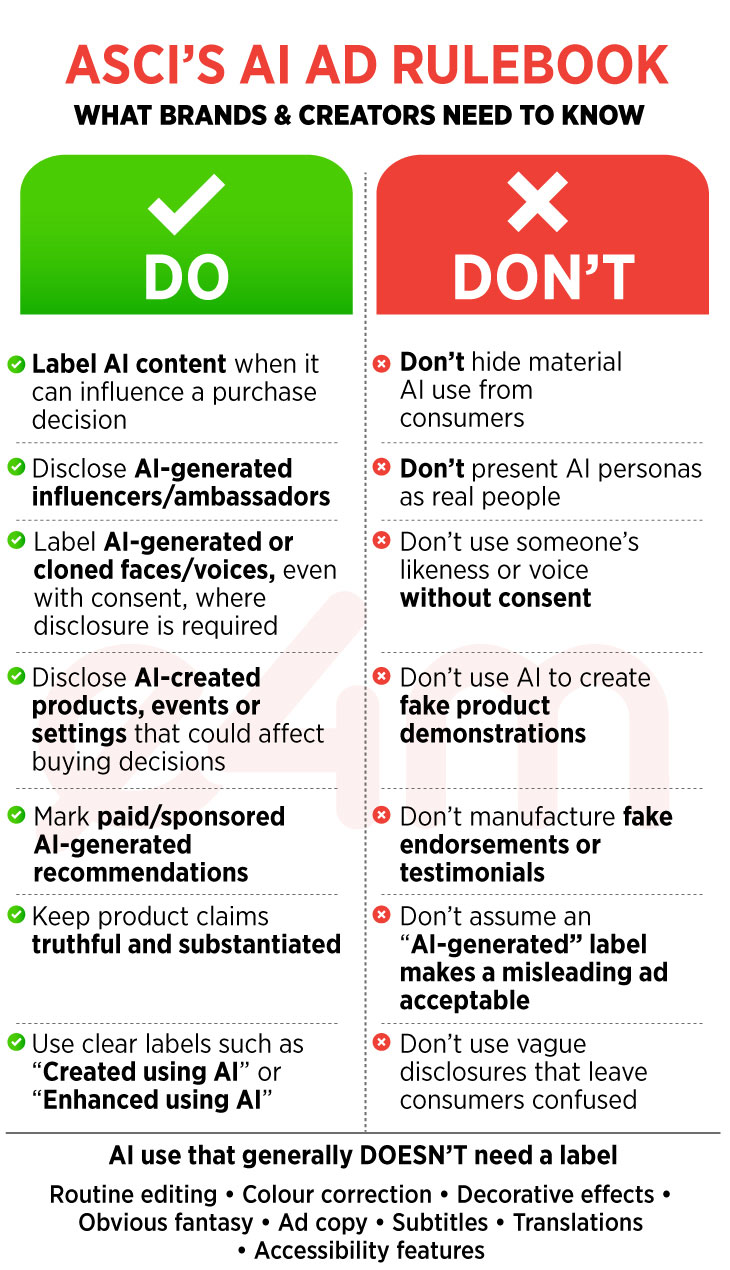
The guidelines, released on September 29, set out when advertisers must disclose the use of artificial intelligence (AI) in advertisements and identify certain practices, including fabricated endorsements and the unauthorised use of a person's likeness, that are not permitted. The framework is scheduled to take effect from 1 January 2027.
Read On: ASCI issues guidelines on responsible labelling of AI-generated ad content
Disclosure does not legitimise a false claim
The distinction between labelling and the truthfulness of an advertisement is particularly important when AI is used to generate an endorsement. A synthetic video may carry a disclosure stating that it was created using AI and still violate advertising standards if it makes a false or misleading product claim.
Read On: ASCI's Sudhanshu Vats calls for stronger ‘trust infrastructure’ in advertising
Malabika Boruah, Partner, Naik Naik & Co., said the disclosure requirement does not override the obligation to ensure that an advertisement is truthful.
“Even a properly labelled AI-generated endorsement can be misleading if the underlying claim is false. Disclosure and the substance of the advertisement are two separate questions, and getting the first one right does not absolve a brand or agency of responsibility for the second,” she said.
Under the Consumer Protection Act, 2019, the Central Consumer Protection Authority (CCPA) can direct misleading advertisements to be discontinued or modified and impose penalties in accordance with the law. Endorsers may also face action, although the law provides a due diligence defence in specified circumstances.
The question of liability becomes more complex when the creator has consented to the use of their likeness but has not approved the statement made through the synthetic version.
Sahni said responsibility should be assessed based on who authorised, created, approved and disseminated the representation. In cases where a creator's likeness has been used to manufacture a statement they never made or approved, the creator's mere appearance in the advertisement should not, by itself, establish liability.
Read On: ASCI flags surge in misleading summer ad claims; over 97% of ads found non-compliant
Contracts may need to go beyond a blanket AI consent clause
The guidelines are also expected to bring greater scrutiny to the way brands and agencies negotiate creator agreements, particularly when a campaign involves voice cloning, digital replicas or AI-generated performances.
Existing agreements that permit the use of recorded content may not necessarily address the creation of new statements, scenes or endorsements using a creator's face or voice.
Anshul Verma, Partner, SKV Law Offices, said contracts would need to distinguish between permission to use a creator's likeness and consent to process personal data.
“Consent to AI use must be specific to the actual processing, and a vague clause permitting AI use may not be sufficient. Contracts should distinguish between a personality-rights licence and consent to process personal data, because holding one does not necessarily mean the other remains valid,” he said.
Verma added that brands would need to address what happens to a creator's voice clone or likeness model if consent is withdrawn, including the continued use of synthetic assets after a campaign ends.
For creators, the key contractual questions include whether a brand can generate new performances using their likeness, whether scripts and AI-generated statements require prior approval, how long the replica can be used and whether it can be carried forward into future campaigns.
For brands and agencies, the agreements would also need to establish who is responsible for ensuring that synthetic advertisements carry the required disclosures and comply with the applicable advertising code.
Read On: ASCI advocates ‘risk-based approach’ for synthetically generated content in advertising
Brands and agencies face scrutiny over synthetic content
The guidelines come at a time when the commercial use of AI-generated identities is increasingly intersecting with disputes over consent and personality rights.
On September 29, actor Urvashi Rautela's team said it was pursuing legal remedies against a Los Angeles-based AI company over the alleged unauthorised commercial use of her name, photographs and videos. The team said damages were being assessed at ₹7,000 crore. The allegations have not been established by a court.
While the dispute concerns the alleged commercial use of a celebrity's identity, it highlights a broader question for the advertising industry: whether permission to use a person's likeness extends to generating new content or endorsements through AI.
The ASCI guidelines distinguish between synthetic content that requires disclosure and content that is prohibited. Routine editing and enhancements that do not materially affect consumer understanding may not require a label, while synthetic representations that could influence consumer decisions may need disclosure. Fabricated endorsements and unauthorised deepfakes remain prohibited under the framework.
For advertisers, the implications extend beyond the technology used to create an advertisement. The focus is on the representation consumers ultimately see and whether it is truthful, authorised and compliant.
As Sahni put it, liability should follow “consent, control and responsibility for the representation ultimately communicated to consumers”.
Read more news about Digital Media, Internet Advertising, Marketing News, Television Media, Radio Media
For more updates, be socially connected with us onInstagram, LinkedIn, Twitter, Facebook, YouTube & Google News
