‘Addressable TV is a huge boon’
Once seen as a fringe addition, Connected TV (CTV) is fast becoming a core element of media planning for both mass and premium brands
 by
by
Published: Jun 14, 2025 8:29 AM | 10 min read
 Follow Us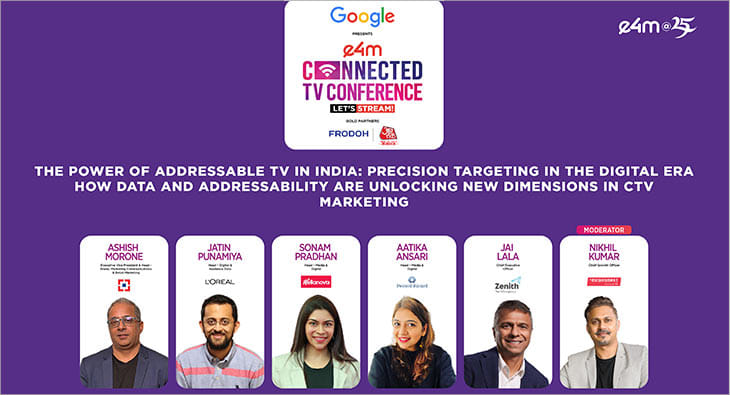

At the e4m Connected TV Conference 2025, digital marketing leaders came together to unpack the transformative power of addressable TV and how data-backed targeting is reshaping the future of brand storytelling across Indian households.
Moderated by Nikhil Kumar, Chief Growth Officer at Mediasmart, the session featured Ashish Morone, EVP & Head – Brand & Retail Marketing at HDFC Bank; Jatin Punamiya, Head – Digital & Audience Data at L'Oréal; Aatika Ansari, Head – Media & Digital at Pernod Ricard; and Jai Lala, CEO of Zenith – The ROI Agency.
Opening the discussion, Kumar outlined how TV in India has moved from traditional broadcasting to a data-driven, digital-like experience. “With AI, automation, and addressability, brands can now plan, target, and measure TV with the same precision and agility as digital,” he noted. He added that household-level targeting, dynamic creatives, and real-time measurement are no longer future trends, but are shaping the medium today.
Kumar cited that India's addressable TV advertising market is expected to touch Rs 10,000 crores by the end of 2026, with connected TV households estimated to reach around 50 million by 2025. “We’re seeing close to 30 percent higher engagement for brands using addressable formats—especially in auto, FMCG, BFSI, and retail,” he shared, adding that adoption is also growing rapidly in tier 2 and tier 3 markets.
Kicking off the panel, Kumar posed a common question to all speakers: in a diverse and dynamic market like India, how is addressable TV shaping the future of brand storytelling, and what role does precision targeting play when layered with data?
Morone addressed the challenge with a nod to a well-worn marketing adage. “There’s a statement we’ve often heard ’50 percent of my advertising on TV works, but I don’t know which one’,” he said. “With the advent of addressable TV, there might be some solutions to it. I can now tell brand stories to a far more specific audience.”
He explained that HDFC Bank, like many brands, doesn't cater to the entire population but rather a clearly defined segment. “This definitely helps me target far better, far sharper, in the areas and markets I want to focus on,” Morone said. He added that the ability to personalise communication to specific cohorts has become a key strength. “We’ve experimented a lot in this space, and I speak with confidence when I say that the tools available today, especially when combined with Gen AI, make this extremely possible.”
Punamiya pointed out that for a category like beauty, which isn't yet deeply penetrated in India, addressable TV offers a much-needed edge. “Earlier, we would run ads on TV and have no idea where exactly they were reaching,” he said. “Connected TV gives us the big-screen experience but with digital precision.”
He emphasised that in beauty, visuals matter. “You need to see the product, the brand ambassador, and the effect of the product. That’s what helps us build strong communication.” According to him, connected TV forces a deeper re-evaluation of strategy. “It’s no longer about creating one creative and pushing it everywhere. Within the platform itself, how do you build a message that aligns with the cohort you’re targeting?”
Internally, this has posed an interesting challenge across teams. “It’s not just the media and digital people who need to adapt, brand and marketing teams now have to think differently as well,” he said.
Punamiya added that CTV publishers, from global giants to local players, are also realising the increasing value of advertisers. “They’re working with us to identify connected data points, partner on first-of-its-kind initiatives, and provide more audience data,” he noted.
“Understanding second-party data, exploring how L’Oréal’s data can work with theirs, and figuring out what kind of data pass-backs can improve targeting—this is where we see a lot of exciting potential.”
As the conversation steered into Connected TV (CTV), the panel unpacked its growing significance in the marketing mix, especially for digital-first brands.
Ansari took the discussion forward by underlining CTV’s strong fit with their category, which is predominantly male in India. “Addressable TV is a huge boon for us,” she said. “The general perception, and even BARC ratings, show linear TV is skewed towards women. The targeting capabilities are far more limited.”
She explained that a decade ago, targeting a weekday male audience was a challenge. “What were my options? News, movies, maybe advertise on ‘Naagin’ because of secondary viewing. But does it make sense for a Jameson Ginger Ale buyer? Probably not. Do I want to be associated with that programming? No.”
What’s changed is the depth of audience segmentation enabled by CTV. “There are 50 million addressable TV households. Assuming a bare minimum family structure of two, that’s 100 million young, affluent people who have proximity to my brand,” she said. “It gives us the ability to segregate based on affluence, international exposure, and more.”
Ansari also emphasised creative innovation: “CTV allows us to create content fit for that medium. Take Coldplay’s livestream on Jio, for example. People who didn’t attend the concert tuned in and we saw huge viewership. Sponsoring on ground is expensive, but this model gave us a presence at scale.”
Lala offered a consumer-first view, reflecting on how content consumption habits have evolved. “With digital’s explosion, the one-TV-per-household notion broke. Families splintered into individual content journeys. Digital offered progressive content, while TV became regressive,” he said.
But CTV bridged that gap. “It brought the family back together. First, it's a big screen so ad recall is better. Second, there’s better content, so families are watching together again. That’s powerful for advertisers.”
He added that CTV is at a tipping point. “We’re already at 50 million households. TVs are getting cheaper. Wi-Fi is more accessible. And in many places, cable or DTH doesn’t reach. We’re looking at 100 million homes very quickly.”
When it comes to CTV, L’Oréal is ahead of the curve, mentioned Punamiya. “I’m glad you brought up Coldplay on Jio. Maybelline was one of the few brands that advertised on Connected TV for that livestream. It was a punt, first ever live event on CTV. But it made sense for us. Gen Zs were the cohort. Suhana was our brand ambassador. The puzzle fit perfectly.”
He sees even more white space emerging. “So many on-ground events are happening. Everyone’s figuring out how to show them on CTV. It’s a new avenue for brands.”
He closed by stressing the versatility of CTV for a brand portfolio as wide as L’Oréal’s. “We have a Rs 600 Garnier serum and a Rs 6,000 Lancôme serum. So every show or event has a consumer for us. They're not just on ground, they're connected.”
Referencing MX Player, he noted the potential of deeper in-show integration. “There are great examples of in-show branding. It’s just the start of bigger and better things for sure.”
For a bank with a vast and varied customer base like HDFC, personalisation is less about audience affinity and more about product and intent relevance.
“As marketers, we’re also responsible for killing a medium if we don’t understand what it’s good for,” said Morone. “Connected TV gives me a storytelling canvas, but the verdict is still out on performance. It’s not about getting people to a digital journey, it’s about staying with them till conversion.”
HDFC relies on first-party data and propensity modeling to orchestrate product-led targeting, followed by precision remarketing, journey-level optimisation, and even agent intervention when needed. “We also contribute to 30–40 percent of the bank’s zero-human-touch business,” Morone noted. “That’s possible only when marketing stays with the customer till the very end.”
For Pernod Ricard India, it’s not just targeting. CTV unlocks creative agility and smarter geo-buys.
Ansari cited a campaign that generated over a billion user-customised films during the ICC World Cup. But what stood out was the shift in approach during the Champions Trophy.
“Jameson is a smaller brand. A regular TV spot would be too expensive and too wasteful,” she said. Instead, the brand opted for addressable CTV billboards with custom creatives tailored to specific cohorts, like ginger ale fans or younger metro audiences.
“Let’s judge CTV for what it is,” said Ansari. “You’re judging linear TV for demand creation? Judge CTV the same way. Especially for metro-centric or youth-first brands, CTV can be cheaper, more targeted, and far more effective.”
On being asked which verticals were leading the shift toward Connected TV, Lala smiled. “Like you said—it’s all of them,” he began. “But there are nuances.”
Mass-market brands like Maggi, he explained, have begun treating CTV as an extension of linear TV. “It becomes part of the core plan now. The question is just: how much of the TV budget goes to CTV?”
On the other end of the spectrum are ultra-premium or niche brands like Jameson, where traditional TV was never cost-efficient. “If you’re targeting SEC A++, cord cutters were unreachable. They weren’t on TV. They weren’t on digital in the same way. So you ended up spending on outdoor,” he said.
“CTV brought that audience back into reach.”
Lala emphasised that while CTV’s current strength lies in metros and tier-1 cities, the broader promise is growing. “You may not use it as heavily for rural or deep Hindi-heartland campaigns, but even there, it’s creeping in.”
Measurement was another game-changing advantage. “We’ve done this for Slice, where we could eliminate audience duplication,” he said. “You run the campaign, identify the cohort you’ve already reached, exclude them from the next platform, and build unique reach.”
That kind of precision was once impossible at scale. “With digital, you’re often hitting the same audience again and again. CTV lets you control that.”
He noted how it also levels the playing field for smaller advertisers. “Even with limited budgets, you can reach the exact right audience. And for premium brands, who want to be seen on a large screen, not just mobile, CTV solves that beautifully.”
He summed it up with conviction: “I keep telling my clients, ‘CTV has come as a solution to all our problems.’ Measurement. Big screen. Focused audience. Creative flexibility. It’s all there.”
Read more news about Digital Media, Internet Advertising, Marketing News, Television Media, Radio Media
For more updates, be socially connected with us onInstagram, LinkedIn, Twitter, Facebook, YouTube & Google News