‘BFSI brands doubling down on CTV for trust, precision, performance’
Sandeep Walunj, Executive Director and Group Chief Marketing Officer at MOFSL, broke down the importance of CTV in the brand-performance equation—particularly for BFSI marketers
 by
by
Published: Jun 12, 2025 10:33 AM | 5 min read
 Follow Us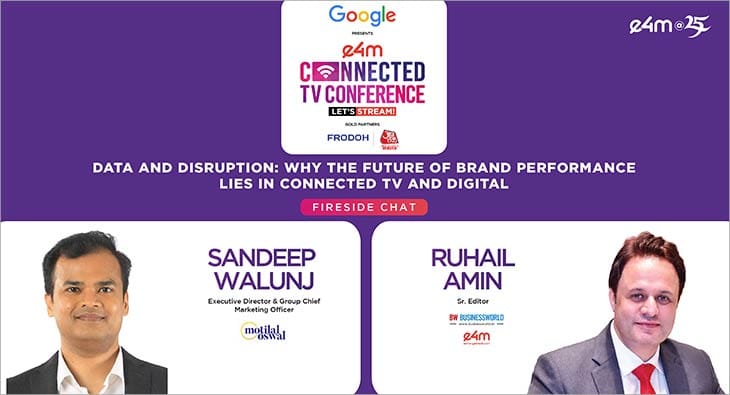

As India’s marketers demand more ROI from every ad dollar, Connected TV (CTV) is moving from buzzword to boardroom priority. Sandeep Walunj, Executive Director and Group Chief Marketing Officer at Motilal Oswal Financial Services Ltd., in a candid conversation with Ruhail Amin, Sr. Editor at BW Businessworld & Exchange4Media, broke down the growing importance of CTV in the brand-performance equation—particularly for BFSI marketers. With over three decades of experience across retail and financial services, Walunj offered a panoramic view of the shifts shaping consumer outreach.
For years, linear television ruled brand-building through gross rating points (GRPs) and approximate audience reach. But in today’s data-first world, that’s no longer enough. Walunj explained how Connected TV shifts the paradigm by offering data-driven clarity on what’s working and what’s not. CTV blends the immersive storytelling power of traditional television with the targeting precision of digital. It lets marketers move beyond rough estimates to a system where ad exposures can be tied to actions—be it site visits, app downloads, or purchases. With its integration into programmatic platforms, CTV enables brands to retarget users across channels like Instagram or YouTube, creating a unified customer journey across screens.
Walunj described the relationship between CTV and digital as deeply complementary. CTV acts as the reach engine that builds brand memory and emotional engagement, while digital platforms take that forward by driving conversions through sharper targeting and measurable outcomes. The two are no longer separate lanes—they are interlinked levers that push and pull consumers along the funnel. A campaign that begins on a large screen can seamlessly continue on mobile or desktop, strengthening brand touchpoints and improving overall effectiveness. In this context, running a CTV campaign without tying it into a digital remarketing strategy would be a wasted opportunity.
In the BFSI sector, where credibility and recall are crucial, CTV’s uncluttered and high-quality environment helps brands tell their stories with authority and nuance. For banks, insurers, and wealth management firms, the ability to target audiences by affluence, geography, and digital behavior brings a level of efficiency that linear platforms simply cannot match. Walunj pointed out that this precision is especially valuable to fintechs, which operate at the intersection of scale and speed. Whether launching a digital lending app or promoting a mutual fund platform, these companies need to build awareness and trust rapidly—CTV does that, while digital enables deeper engagement and action.
Interestingly, one of the most effective uses of CTV in BFSI is in reaching high-net-worth individuals, a segment that’s increasingly moving away from traditional cable. Walunj noted that HNIs are streaming-first consumers, making CTV an ideal medium for private banks and wealth platforms. Brands can now create tailored content such as market outlooks or investment insights and deliver it directly to affluent households in select postal codes or even specific buildings. Follow-up engagement can then take place via digital retargeting or personalised email marketing, making the entire journey feel bespoke. For merchant banking and institutional players, CTV can serve as a platform for thought leadership—brand films about ESG investments, IPOs, or infrastructure financing that target CXOs and financial decision-makers, with digital channels handling lead nurturing and content distribution.
CTV’s Growing Pains in India
Despite its potential, the CTV ecosystem in India remains fragmented. Walunj highlighted several structural challenges that marketers must navigate. OEMs like Samsung and Sony operate in closed environments, limiting cross-device audience tracking. The Android and Apple divide further complicates attribution, while YouTube on CTV exists in its own walled garden with Google-specific metrics that don’t integrate easily with other platforms. Moreover, CTV’s overall penetration remains below 30% of Indian households and is heavily concentrated in urban, affluent pockets. However, Walunj sees this not as a drawback but as an advantage—these urban segments are exactly the demographic that BFSI brands need to reach. The goal at this stage isn't mass scale, but high-quality, high-intent engagement.
For marketers looking to embrace CTV, Walunj urged them to reframe their understanding of the medium. CTV is not just another form of television—it demands its own strategy, creative approach, and performance metrics. Brands must avoid the trap of simply repurposing linear TV content for CTV and should instead focus on designing stories that match the viewer’s mindset in a streaming environment. Retargeting should be built in from day one, so that every impression on CTV flows naturally into a performance funnel powered by digital platforms. Measurement, too, needs an overhaul—brands must develop attribution models that track the journey from view to lead to conversion. Most importantly, media planning can no longer be done in silos. CTV, digital, mobile, and even offline touchpoints need to be part of one connected ecosystem. According to Walunj, CTV should be treated as the flagship channel for digital branding—one that won’t deliver mass reach overnight, but one that can consistently drive strong outcomes in trust, intent, and consumer action when combined with intelligent digital execution.
As the marketing landscape evolves and consumers fragment across devices, platforms, and attention spans, the case for Connected TV is growing stronger. For BFSI brands looking to build trust at scale without sacrificing precision, the fusion of CTV and digital may just be the most powerful tool in their arsenal.
Read more news about Digital Media, Internet Advertising, Marketing News, Television Media, Radio Media
For more updates, be socially connected with us onInstagram, LinkedIn, Twitter, Facebook, YouTube & Google News