The CTV moment is here: Aarav Singhal, BCG
Aarav Singhal, Managing Director and Partner at BCG, delivered an insightful session on how CTVs are poised to bridge the gap between linear TV’s mass appeal and OTT’s personalization
 by
by
Published: Jun 11, 2025 4:59 PM | 3 min read
 Follow Us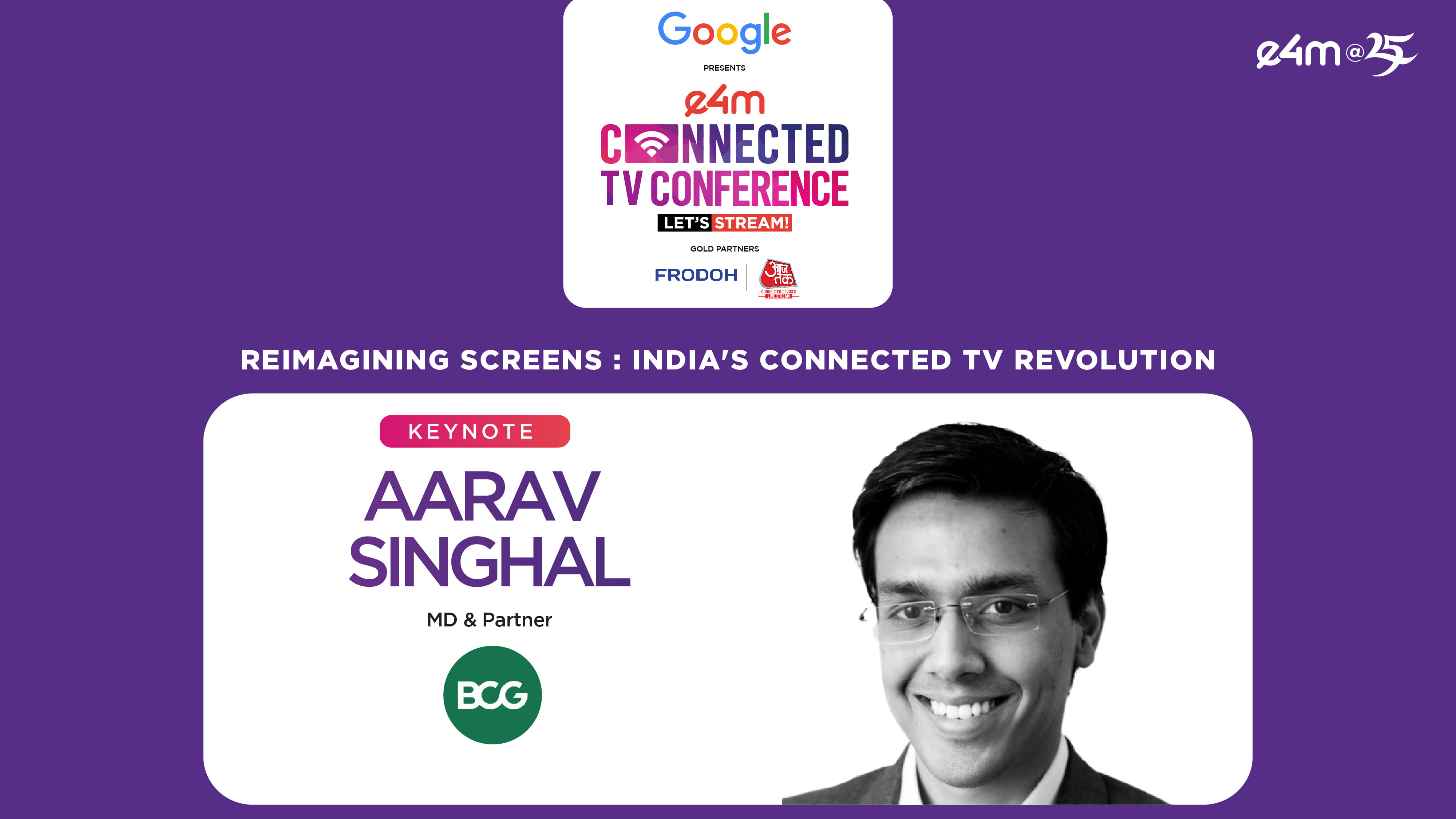

The evolution of content consumption in India has been nothing short of transformative. From radio antennas to cable TV, set-top boxes, and now smartphones, each leap has redefined how audiences engage with media, as Aarav Singhal, Managing Director and Partner at BCG, highlighted at the e4m Connected TV Conference today.
India’s digital adoption, accelerated by affordable smartphones and Jio’s internet revolution, has long been mobile-heavy. However, with 5G eliminating bandwidth constraints, CTVs are poised to bridge the gap between linear TV’s mass appeal and OTT’s personalization.
"TV has always been central to how an Indian household thinks and consumes media," noted Singhal. "But it fell behind technologically. Smart TVs are now addressing that, and it’s making a comeback." A personal anecdote underscored this shift: "The first thing I fixed while renovating my apartment was the TV’s position in the living room. That’s how central it is to family spaces."
This sentiment resonates with a broader trend, the return of shared viewing experiences, whether it’s families bonding over dinner-time shows or Gen Z friends gathering to watch sports or OTT releases.
Connected TVs encompass a spectrum: Smart TVs with inbuilt OS, streaming devices (e.g., Fire Stick), set-top boxes with app-streaming capabilities, gaming consoles doubling as streaming platforms, and Indian jugaad solutions enabling casting on traditional TVs. Singhal emphasized the untapped potential: "India has 30 million smart TVs today (120 million users). By 2030, this could reach 75 million TVs (300 million users)." Unlike the U.S., where CTV penetration is 70% of mobile screens, India stands at just 10%, a gap ripe for growth, driven by rising disposable incomes, cheaper devices, and e-commerce exposure.
Research reveals three key demand spaces where CTVs outshine mobile, first “All I Can Dream About is Video”, Super-users who seamlessly switch devices but still crave communal viewing. Second, “Chill Pill”: Social relaxation with friends/family watching together. "Gen Z wants shared experiences. They ask, How do we watch sports or OTT releases as a group?" said Singhal. Lastly, “A Full House", Prime-time family viewing, exemplified by IPL’s success as "general entertainment." Regional content is another game-changer. "Smart TVs democratize vernacular programming, letting families bond over mother-tongue content, especially in southern and eastern markets," he added.
For brands, CTVs offer the best of linear and digital, premium audiences ("CTV automatically means premium. FinTechs already leverage this," Singhal noted), family-first targeting through co-viewing that enables ads tailored to collective occasions, and interactivity through QR codes, play-alongs, and measurable ROAS that bridge TV’s passivity with digital’s engagement. However, challenges remain: "We need CTV-first interfaces, not mobile adaptations. Advertisers need sharper targeting, attribution, and education," he stressed.
To unlock CTV’s potential, Singhal urged collaboration among OEMs, app developers, and advertisers, India-first UX through voice search, multilingual support, and touchscreen-like simplicity, content innovation with fast channels, AVOD growth, and family-friendly OTT originals, and privacy-compliant tech stacks balancing data utility with user trust. "The CTV moment is here," Singhal concluded. "Are we ready to lean in and make it happen?"
As India’s screens evolve, Connected TVs stand at the intersection of nostalgia and novelty, reimagining not just how we watch, but how we connect.
Read more news about Digital Media, Internet Advertising, Marketing News, Television Media, Radio Media
For more updates, be socially connected with us onInstagram, LinkedIn, Twitter, Facebook, YouTube & Google News