Why brands are looking at CTV first
At the e4m Connected TV Conference, marketers explored how CTV is driving top-funnel impact with sharper targeting and immersive storytelling, especially for premium and emerging audiences
 by
by
Published: Jun 12, 2025 2:06 PM | 10 min read
 Follow Us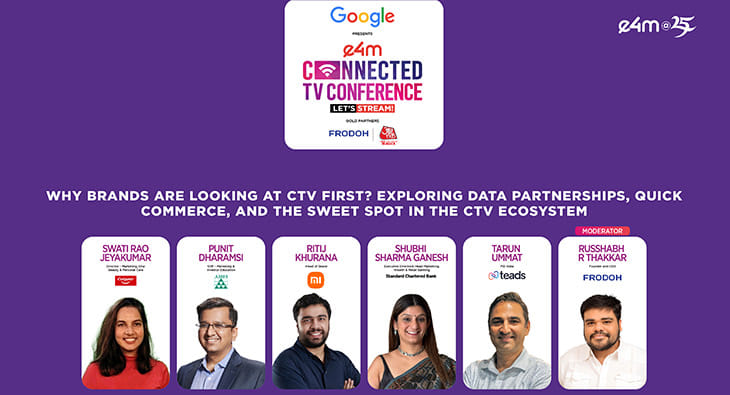

At the e4m Connected TV Conference, marketing leaders from top consumer and financial brands discussed the evolving role of Connected TV (CTV) in targeting affluent, aware audiences and how its immersive experience is reshaping top-funnel strategy and messaging for modern marketers.
The session featured Swati Rao Jeyakumar, Director – Marketing, Oral Beauty & Personal Care at Colgate; Punit Dharamsi, SVP – Marketing & Investor Education at AMFI; Ritij Khurana, Head of Brand at Xiaomi India; Shubhi Sharma Ganesh, Executive Director & Head – Marketing, Wealth & Retail Banking at Standard Chartered Bank; and Tarun Ummat, MD India at Teads. The panel was moderated by Russhabh R Thakkar, Founder and CEO of Frodoh.
Opening the conversation, Dharamsi noted how the perception of CTV as an affluent-only medium has significantly changed. “CTV, we realised, is not an affluent or an urban phenomenon anymore,” he said. “CTVs are available for as low as Rs 7,500 to Rs 12,000 during sales, and internet connectivity is now freely available because of Jio and Realtail.”
He explained that their mutual fund awareness campaigns have extended well beyond urban audiences. “Our audience has shifted further into the countryside. Apart from the urban affluent, whom we reach through bigger properties, we’re now able to target lower-tier cities as well on CTV.”
Dharamsi emphasised the importance of messaging differentiation. “When you're talking to a tier 2 or tier 3 city where awareness is really limited, then you talk about the basics of mutual funds. And when you're talking to an urban affluent audience, you would probably talk to an existing investor or someone who's aware of other options.”
Ganesh offered a perspective from the banking sector, explaining that affluent consumers engaging with luxury content on CTV are drawn to the medium’s high-quality, low-interference environment. “It is overall an affluent experience in terms of this media consumption,” she said.
She underscored the need to align this experience with the bank’s business goals. “We put our media spends in a space where our ROI is well defined,” Ganesh said. “This space gives us that opportunity to track the kind of investment we've made. If it is extremely targeted, it is very sharp because that’s what a sophisticated investor expects.”
Highlighting the evolving profile of their target consumer, she added, “We’re not just talking about someone beginning their wealth journey. Most of the banks are looking at a sophisticated investor who has already consumed a lot of content and is informed and aware. Making the content as sharp as you can becomes very easy on this medium.”
Jeyakumar took the session forward by addressing the measurability of CTV’s impact, particularly through real-time nudges and innovative formats like pause ads. “Everything boils down to what your full-funnel objectives are as a brand,” she said. “CTV primarily comes in at the top of the funnel. It’s used by us to target cutters of television, i.e., affluent and emerging affluent households in India.”
She explained that Colgate views CTV as a proxy TV experience. “We truly look at it from the perspective of driving mind measures and brand associations for the long term. Immediate sales uplift isn’t what we measure. We look at market mix modelling or measures that talk to the effectiveness of the copy.”
She also shared how pause ads were creatively used in Colgate’s habit-changing campaigns. “We ensured that we target audiences in urban India who are today not brushing a second time at night,” Jeyakumar said. “Only 20% of urban Indians actually brush twice a day. We took that opportunity during prime-time CTV viewing to interject.”
She explained that this form of disruption helped “seed the thought of a new habit”, even if the immediate action wasn’t measurable. In another campaign, Colgate used the pause-and-play format with a QR code for an AI-led oral health check-up. “The moment you pause, this frame appears with a QR code where you can just scan and do an online dental consultation.”
However, she clarified that such campaigns aren’t easily quantifiable through traditional metrics. “There are no real metrics to measure the efficacy of CTV versus other mediums built for the bottom funnel,” she said. “We all know QR scans are low. While Indians know how to scan a QR code in a GPay or a hotel menu, the QR code scans are much lower on attention-led, top-funnel mediumsbCTV included.”
The discussion shifted with Khurana addressing CTV's role in flagship device launches, noting the strategic approach required for premium targeting. “We just concluded a flagship launch. We ended up using YouTube digital. CTV was a very smart part of it, and we ended up using print a lot more,” he said. “I think it just keeps on varying as per which product you’re going into.”
He highlighted the unique challenges of targeting India's premium smartphone market, explaining that the segment above $700 represents only about two million units. “There are just two million people. I think where you would go about is finding the right test sort of markers for these two million odd folks,” he noted.
He emphasised current limitations in CTV targeting capabilities, stating, “You still can't target a 32-inch TV. You still can't target a 43-inch TV. And you still can't target a 55-inch TV.”
Despite these limitations, Khurana acknowledged CTV's value for internet-first brands, noting that it provides markers indicating users with reliable internet connectivity, making it particularly suitable for digital-native companies transitioning to omnichannel strategies.
Ummat shared insights from Teads' experience representing LG's OEM advertising capabilities, highlighting the educational challenges in the market. “When we started out and we went to market, one thing we realised very quickly was there was a dearth of education about what CTV native is about, what OEM advertising is all about,” he said. “CTV for most was about in-stream mid-roll ads. And we were going with home screen billboards, which is 100% SOV when you switch on your TV.”
He explained the advanced targeting capabilities available through LG's platform, including content recognition and screen size targeting. “We are able to determine users in terms of the kind of content they're consuming on TV, whether they're entertainment users, Netflix logged-in users. So there are multiple cohorts that we can target. And also, we can target users on the basis of the screen size as well,” Ummat noted.
For premium brands, Ummat highlighted the preference for larger screen targeting. “A lot of these premium brands that we work with, they usually target 50 inches and above. So the ask is to target TVs which are maybe a lakh and above in price,” he said, while acknowledging that price fluctuations make this parameter challenging.
He emphasised the medium's expansion beyond premium segments, stating, “The real growth now is coming from tier two, tier three cities. So it's no longer a very premium advertising model. So I think even brands which are mass, which are non-premium, they will find themselves on CTV very, very soon.”
Dharamsi discussed AMFI's approach to CTV advertising, focusing on category awareness rather than direct sales. “We don't push sales. We are, you know, as a policy, because we are just a trade body, we run awareness ads. Our whole idea is to create awareness about the category and expand the category,” he explained.
He acknowledged CTV's strength in awareness building while noting its limitations for immediate conversion. “It is still a medium where you would not really look at conversions immediately. It is a slow-growing medium for proper sales, but otherwise for awareness we have seen wonderful results on CTV,” Dharamsi said. The organisation leverages premium properties like IPL and KBC to maximise reach and impact.
Ganesh addressed the creative adaptation challenge, admitting that current approaches largely involve repurposing existing content. “The experiments that we have done, frankly, I'll be very honest, we have adapted repurposed,” she said. However, she emphasised the importance of aligning creative strategy with campaign objectives.
“If it's a brand campaign that you're trying to drive, and you're looking at adapting one of those brand campaigns and possibly putting a QR code and using this particular medium, your basic objective is to get visits to a particular page where the whole brand story is explained,” Ganesh explained.
She highlighted CTV's potential for more sophisticated storytelling, noting, “It is a medium which has an experience. And therefore it is possible to build an interactive brand story. So it is possible to create a convert campaign which actualises your return with the action that you have mentioned.”
Ganesh emphasised the medium's role within integrated campaigns, stating, “Media spends as a multimedia strategy. It is never a single media strategy. So we have to balance it as brands and see what is the main key objective of the campaign and use that medium in the part of the funnel that we think it will amplify most.”
Ummat reinforced this perspective, noting that CTV primarily serves upper-funnel objectives. “From our experience, what we've seen is it's still primarily very upper-funnel awareness-driven,” he said. However, he highlighted successful applications in other markets, particularly for sampling campaigns in beauty and luxury segments, suggesting potential applications for Indian brands.
Jeyakumar discussed CTV's growing importance for premium brands expanding beyond metro markets. “Premium brands are not only limited to metro cities anymore. The aspiration for buying premium brands exists across tier 1, tier 2, tier 3,” she observed.
She noted the medium's rapid growth, explaining how CTV's reach has expanded significantly. “We have seen CTV from the time it was about a 10 million household kind of penetration to all the way up to about 50–60 million audiences today,” Jeyakumar said. “We are seeing it becoming an important medium for us in our premium strategy.”
She emphasised that media selection should be audience-driven rather than platform-driven. “The choice is not to buy media on CTV but the choice is built out of a clear objective which then has a multimedia placement. So you go where your audiences are. And if the audiences today are on CTV and that audience size on CTV keeps increasing, the medium is going to keep getting more and more relevant for us.”
When addressing ecosystem utilisation, Khurana emphasised Xiaomi's commitment to maintaining separation between their hardware and advertising businesses. “We just want to be fair and do what's right. I think that's what we are as an organisation as well,” he said, referencing lessons learnt from Google's approach with the Nexus device range.
“We've always kept this very separately. As a matter of fact, sometimes we end up giving ROs to agencies to run ads on our own scheme of things.”
Read more news about Marketing News, Advertising News, PR and Corporate Communication News, Digital News, People Movement News
For more updates, be socially connected with us onInstagram, LinkedIn, Twitter, Facebook, YouTube & Google News